


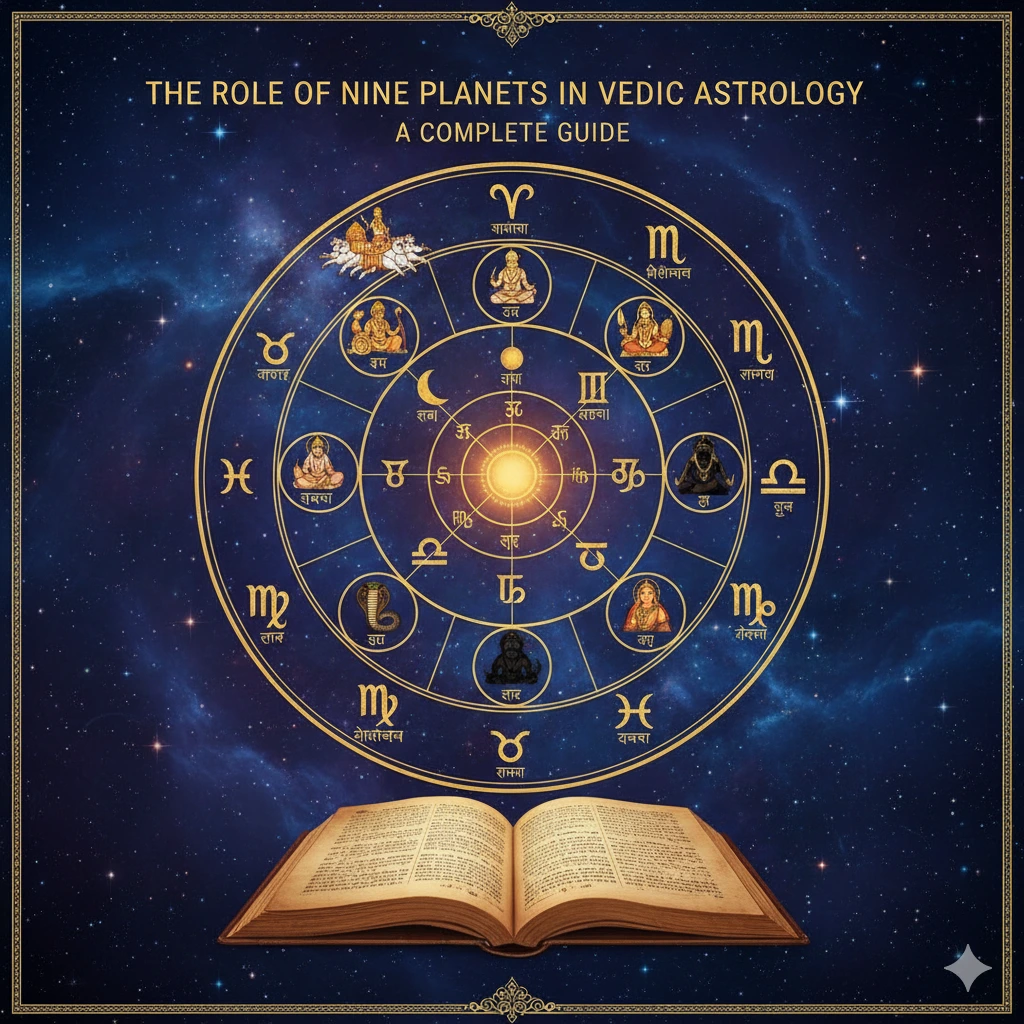
When we speak of the nine planets in Vedic astrology we refer to the group of celestial forces called the Navagraha, comprising the Sun, Moon, Mars, Mercury, Jupiter, Venus, Saturn, Rahu and Ketu. These are not merely astronomical bodies in the Vedic tradition but symbolic processors of life energy, karma, psychology and spiritual growth. Each planet embodies specific qualities, rules certain signs and houses, and exerts its influence depending on its placement in an individual’s chart.
Understanding the role of nine planets in Vedic astrology enables you to interpret your birth chart more profoundly, to recognize the themes of your life, and to work with planetary energies rather than be passively shaped by them.
What Are the Nine Planets in Vedic Astrology?
To begin, let us list the nine planets in Vedic astrology and summarise their essential symbolic meaning:
- Sun (Surya): the self, ego, vitality, leadership.
- Moon (Chandra): emotions, intuition, mind, nurturing.
- Mars (Mangala): action, energy, courage, drive.
- Mercury (Budha): intellect, communication, adaptability.
- Jupiter (Guru or Brihaspati): wisdom, expansion, ethics, growth.
- Venus (Shukra): love, beauty, relationship, harmony.
- Saturn (Shani): discipline, restrictions, karma, long-term results.
- Rahu: the north lunar node, illusions, worldly desires, karmic crossroads.
- Ketu: the south lunar node, detachment, spirituality, past karmic residue.
Each of these “planets” in Vedic astrology draws our attention to a different dimension of the human psyche and life journey. They are called graha meaning “that which seizes or influences”.
Why the Focus on the Nine Planets?
The role of nine planets in Vedic astrology is crucial because these planetary forces are believed to shape our personality patterns, life events and existential lessons. As one source puts it: “Vedic astrologers state that these celestial bodies can impact our personality, career, relationships, and even our health.”
Here are some reasons why the nine planets matter:
- They represent archetypal energies that express through our chart.
- The placement of each planet in a zodiac sign and house gives clues to how that energy manifests.
- Transits and periods related to these planets trigger phases of change and growth.
- They provide a map of karmic opportunities and challenges.
The Individual Planets: Detailed Roles
Let’s explore each of the nine planets in Vedic astrology one by one, their core significations, lived expressions, and how they show up in a birth chart.
Sun (Surya)
The Sun is the centre of our solar system and in Vedic astrology it stands for one’s core identity, will, vitality and leadership. Its positive placement indicates strength, self-confidence and clarity of purpose. A weak or afflicted Sun may reflect ego struggles, lack of direction or vitality issues.
In the birth chart the Sun defines how one expresses authority, how one asserts oneself, and the path to become Self-actualized.
Moon (Chandra)
The Moon rules the mind, emotions, instincts, habits and inner world. A strong Moon lends emotional stability, intuitive ability and nurturing qualities. A disturbed Moon can bring moodiness, emotional insecurity or unconscious patterns.
In Vedic astrology the Moon also governs the way we receive, process and respond to life.
Mars (Mangala)
Mars provides the warrior energy, courage, drive, assertion and the ability to act. It is the planet of passion, ambition and dynamic force. When well-placed it gives strength, initiative and success through effort. When afflicted it may bring aggression, impulsiveness or conflict.
Mercury (Budha)
Mercury governs intellect, logic, language, writing, adaptability, learning and communication. A strong Mercury supports analytical skills, business acumen and flexibility. On the other hand, a weak Mercury may reveal scatter-mindedness, indecision or difficulty with expression.
Jupiter (Guru/Brihaspati)
Jupiter is considered the guru among planets. It symbolizes wisdom, ethics, expansion, mentorship, higher learning, fortune and sense of purpose. When strong it brings growth, opportunity, spiritual insight and prosperity. When weak or afflicted it can manifest as over‐optimism, lack of discipline or wasted potential.
Venus (Shukra)
Venus is about love, beauty, aesthetics, relationships, art, pleasures, comfort, refinement and harmony. A well-placed Venus gives charm, social grace, romance and artistic ability. A challenged Venus may show relationship issues, over-indulgence or lack of enjoyment.
Saturn (Shani)
Saturn is the heavy lifter among planets. It stands for discipline, responsibility, time, karma, delays, structure, maturity and long-term results. When Saturn is strong and well used it brings mastery, perseverance, humility and authority. When misused or blocked it results in fear, restriction, frustration, stagnation or harsh lessons.
Rahu (North Node)
Rahu is not a physical planet but a lunar node, the point where the Moon’s path intersects the ecliptic (ascending node). It represents material desires, illusions, obsessions, unconventional paths and karmic turning points. It is ambitious, restless, inclined to breakthrough and ‘foreign’ or unusual themes.
Ketu (South Node)
Ketu is the opposite lunar node (descending node). It signifies detachment, spirituality, past karmic baggage, mysticism, letting go, enlightenment as well as setbacks that force inner growth. It often indicates where we have already mastered something in past lives and where we need to release.
How the Nine Planets Influence Different Life Areas
The role of nine planets in Vedic astrology extends to various domains of human life such as personality, career, relationships, health, wealth, and spiritual evolution. Let’s look at how this plays out.
Personality & Inner Patterns
The position of each planet in the zodiac sign and in a natal house reveals how its energy expresses in personality and habitual patterns. For example, a strong Moon might give one emotional intelligence and nurturing ability; a weak Saturn might indicate fear of authority or difficulty with structure. Recognizing these patterns allows for conscious transformation.
Career & Profession
Planets reveal our vocational inclinations. A well-placed Mercury might favour writing or communication, Mars might favour engineering or military service, Venus artistic fields or luxury industries, Saturn mature fields like management or public service, Jupiter education or law, Rahu technology or foreign domains, Ketu research or spirituality.
Relationships & Marriage
Venus, Moon and Mars are key in relationships but other planets matter too. For example Saturn in the 7th house might indicate a late marriage or disciplined partner; Rahu in the 7th may show unconventional relationships or foreign partner. Understanding planetary role helps navigate relationship dynamics.
Health & Well-being
Each planet governs physical and psychological functions. A weak Sun may indicate vitality issues; Mars may govern blood or muscular system; Moon the mind or digestive system. Knowing the planet’s role helps in remedial practice such as lifestyle adjustments, gemstone therapies or mantra work.
Karma, Growth & Spiritual Evolution
The planets are not just about the material but also about spiritual growth. Saturn teaches discipline and maturity; Ketu teaches detachment; Jupiter higher purpose; Rahu transformation. Recognizing the role of nine planets gives us insight into life’s lessons, karmic tasks and evolution path.
Planetary Strengths, Friendships and Enemies
To interpret the role of nine planets in Vedic astrology accurately one must also understand how planets behave in signs, how strong they are, their friendly/enemy relationships, exaltation, debilitation, etc.
- Each planet has signs where it is comfortable and strong, and signs that are challenging.
- Some planets are friendly with others, some are enemies, this affects conjunctions and aspects.
- Shadow planets (Rahu & Ketu) do not rule signs in the conventional sense but act in unique ways.
- For example: “Each planet emanates certain energy while moving through the zodiac circle. Some planets move faster.. these are called inner planets … outer planets move slowly … these planets … have a more profound and long-lasting impact.”
By analyzing strength and placement, an astrologer gauges how well a planet will deliver its promise or challenge.
Transits, Dashas and The Role of Nine Planets
The nine planets in Vedic astrology act through multiple timing systems: transits (gochara), dasha (planetary period), antardasha (sub-period), and muhurtas (auspicious timings). Understanding these timing mechanisms gives important insight.
- Transits: The movement of planets through signs and houses influences events. For example slow moving Saturn or Jupiter transits produce major life phases.
- Dasha system (especially the Vimshottari Dasha) assigns each planet a time period of influence in a native’s life.
- During its dasha, a planet becomes more prominent and the themes connected with it become noticeable.
- By studying the dasha of the nine planets we learn when specific planet’s energy will dominate life, when remedies may be more effective, and when growth or challenge is likely.
This interplay underlines why the role of nine planets in Vedic astrology is not static but dynamic and evolving.
Click Here To Lean About Planets Online
Remedies and Balancing Planetary Energies
Since the nine planets in Vedic astrology can both support and challenge us, traditional Vedic astrology offers remedies to strengthen weak planets and mitigate harmful ones. Some common remedial measures:
- Wearing gemstones associated with the planet (under guidance).
- Mantras, prayers, yantras and worship of planetary deities.
- Charity, service and behaviour aligned with the planet’s energy (for example service for Saturn by helping the elderly, or supporting children for Jupiter).
- Adjusting timing of important life events (muhurtas) according to favourable planetary periods.
- Self-awareness work: consciously developing the positive traits of a planet and reducing the negative expression.
By doing this one does not attempt to “avoid fate” but rather to work consciously with the planetary energies of the nine planets in Vedic astrology.
Click Here To Book An Appointment With Acharya Sakshi Sanjeev Thakur
How to Use the Nine Planets in Your Chart Interpretation
Here is a simple outline of how you can interpret the role of nine planets in your own birth chart or in a client’s chart:
- Identify each planet’s sign and house placement.
- Check the dignity of the planet: Is it in its own sign, exalted, debilitated, in friendly or enemy sign?
- Assess aspects or conjunctions to that planet (which other planets influence it?).
- Determine the planet’s dasha or transit phase to see how it is acting currently.
- Ask: What life area does this planet govern for this person (house it occupies/lords)?
- Note the positive potential (what this planet can support) and the challenge (what it may obstruct).
- Recommend remedial actions or conscious work aligned with that planet’s energy.
- Encourage the native to cooperate with the planet’s lesson rather than fight it.
By following this process one can harness the full depth of the role of nine planets in Vedic astrology and apply it meaningfully.
Common Misconceptions About the Nine Planets
There are several misunderstandings about the nine planets in Vedic astrology that are worth clearing:
- They are often interpreted as “good” or “bad” in an absolute way. In reality each planet has both constructive and destructive potential depending on placement, dignity and context.
- People often focus only on outer events without appreciating the inner psychological process a planet is signalling. The planets reflect inner states as much as external circumstances.
- Some believe Rahu and Ketu are irrelevant because they are “shadow” planets. In fact they are powerful karmic nodes and have very profound significance in Vedic astrology.
- Remedies are often taken superficially (gemstone without chart context, prayers without understanding). Effective working with planetary energies requires awareness, sincerity and alignment with the chart.
Why the Role of Nine Planets in Vedic Astrology Matters in Modern Life
In our fast-changing world, the ancient wisdom of the nine planets in Vedic astrology continues to offer relevance and guidance. Here’s why:
- It provides a framework to understand one’s personality, strengths, weaknesses and life themes.
- It offers timing insights to know when key phases of life may unfold and when to act or wait.
- It encourages conscious living: instead of just reacting to life, one can work with planetary energies, transform challenges into growth, and align with one’s purpose.
- For practitioners of holistic wellbeing, the planet-map offers a bridge between astrology, psychology and spirituality.
- It reminds us that life is multi-layered: the planets reflect not just what happens to us but how we respond internally, the lessons we are invited to learn, and the growth we can achieve.
Summary and Key Takeaways
To summarise the role of nine planets in Vedic astrology:
- The nine planets in Vedic astrology are powerful archetypal forces that influence our life in many domains, personality, relationships, career, health, karma and evolution.
- Each planet (Sun through Ketu) has a unique quality, ruling sign, houses and energy signature.
- Understanding their placement, strength, aspects and timing (transits and dashas) is essential for chart interpretation.
- Rather than seeing planets only as external forces, recognising them as inner energies enables deeper self-awareness and transformation.
- Remedial practices grounded in awareness can help us work with planetary energies rather than be at their mercy.
- Ultimately, the role of nine planets in Vedic astrology is to point us toward our growth, our life purpose and our path of becoming.
Final Thoughts
Studying the nine planets in Vedic astrology opens up a profound map of life. It invites you to look beyond superficial events and enter the realm of patterns, meaning, timing and inner growth. Whether you are a seeker of self-knowledge, an astrology student, or a practitioner, engaging with the nine planetary forces with respect, discernment and sincerity can deepen your journey.
May this guide serve as a complete companion to explore the role of nine planets in Vedic astrology. May you discover not just the “what” of planetary influence but the “how” and the “why”, and integrate this knowledge into your life with wisdom.
Thank you for reading.
