

Table of Contents
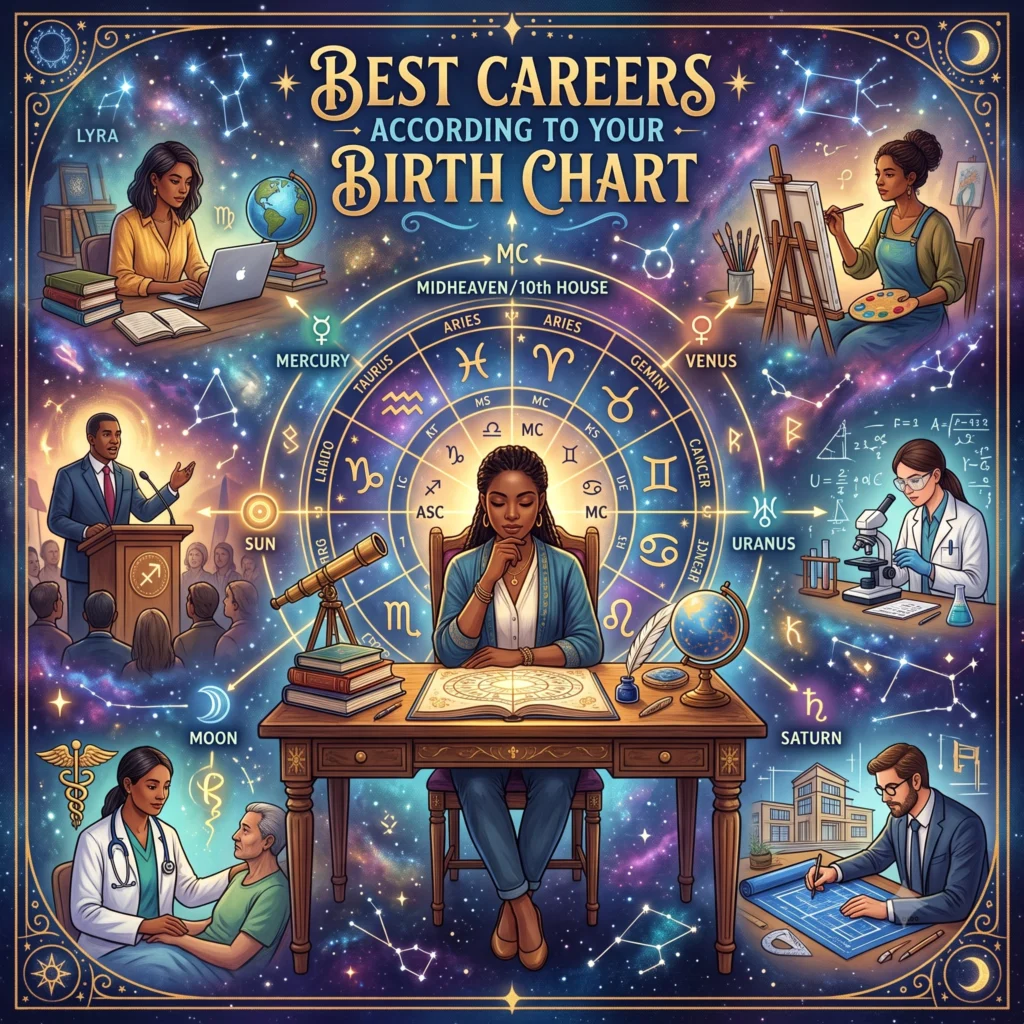
Best Careers According to Your Birth Chart
Your Birth Chart Career path is not something you have to guess at or discover only through years of trial and error. In Vedic astrology, the moment you were born, the sky above you was frozen into a permanent map — a map that shows exactly which planets were sitting in which houses and signs. This map is your birth chart, also called a Kundli. And tucked inside this chart, in very specific places, is a complete blueprint of the kind of work that will make you successful, satisfied, and financially stable.
Most people go through school, choose a college stream because their parents or friends chose it, take up a job because it was available, and only years later realize they are in the wrong field. This blog exists so that doesn’t have to happen to you. By the end of this article, you will understand, step by step, exactly how a birth chart reveals your ideal career — even if right now you don’t know the difference between a “house” and a “sign” in astrology. We are starting from zero, and we are going all the way to a level where you can look at your own chart, or a friend’s chart, and confidently say, “this is the kind of career that suits you.”
This is a long, detailed, and complete guide. Take your time with it. Read it section by section. By the end, the words “Birth Chart Career” will not sound like jargon to you — they will feel like a tool you know how to use.
What Exactly Is a Birth Chart?
Before we can talk about careers, we need to get one thing crystal clear: what is a birth chart, really?
Imagine standing outside at the exact moment you were born, and taking a photograph of the entire sky — not just the visible stars, but the precise positions of the Sun, Moon, and all the planets, plus the point on the horizon where the sky was rising in the east. Now imagine that instead of a photograph, this information is drawn as a diagram, divided into twelve equal slices, like a pizza cut into twelve pieces. Each slice is called a “house,” and each house represents a different area of your life — one house for your body and personality, one for your money, one for your home, one for your career, and so on, all the way through twelve areas of life.
On top of these twelve houses, the planets are placed exactly where they were in the sky at your birth. Each planet also “owns” or “rules” one or two of the twelve zodiac signs (Aries, Taurus, Gemini, Cancer, Leo, Virgo, Libra, Scorpio, Sagittarius, Capricorn, Aquarius, and Pisces), and each house itself falls under a particular zodiac sign depending on your birth time and location.
So your birth chart is really just three layers of information stacked together:
1. The twelve houses — the areas of life.
2. The twelve zodiac signs — the qualities and personality flavors.
3. The nine planets — Sun, Moon, Mars, Mercury, Jupiter, Venus, Saturn, Rahu, and Ketu — the actors who bring energy, action, and events into each house.
When we talk about your Birth Chart Career, we are really talking about how these three layers combine in one specific house of your chart — the 10th house — along with a few supporting houses and planets. Once you understand how to read this one part of the chart, you will have unlocked one of the most practical, real-world uses of astrology.
Why Your Birth Chart Career Reading Actually Matters
You might be wondering: why not just take a career aptitude test, or talk to a career counselor, instead of looking at planets? That’s a fair question, and the honest answer is that a birth chart isn’t meant to replace practical career guidance — it’s meant to add a layer of self-understanding that a personality quiz simply cannot give you.
Aptitude tests measure how you think and behave right now, based on questions you answer about your current preferences. A birth chart, on the other hand, works differently. It doesn’t ask you anything. It simply reflects the placement of planets that were fixed the moment you were born, and Vedic astrologers have observed, tracked, and recorded patterns between these placements and real-life career outcomes for thousands of years. Over centuries, certain combinations kept repeating in the charts of successful doctors, certain other combinations kept repeating in the charts of successful businesspeople, and so on. This is what forms the basis of career astrology.
There’s also a deeper, more personal reason this matters. Many people feel a nagging sense that they are doing the “wrong” work — not because they’re bad at their job, but because something about it doesn’t feel aligned with who they are. A birth chart reading often puts words to a feeling that a person has carried quietly for years. When someone with strong Mercury energy in their chart is stuck in a purely physical, repetitive job, they often feel restless without knowing why. When you show them their chart and explain that Mercury craves communication, analysis, and variety, something clicks. That’s the real value of a Birth Chart Career analysis — not fortune-telling, but self-recognition.
Click Here to Book Consultation With Best Astrologer: Acharya Sakshi Sanjeev Thakur
The 10th House: The Foundation of Your Birth Chart Career
Let’s slow down here, because this is the single most important concept in this entire blog.
In a birth chart, the twelve houses are numbered 1 through 12, starting from the point that was rising on the eastern horizon at your exact birth time. This first house is called the Ascendant or Lagna, and it represents you — your body, your basic personality, how you present yourself to the world. From there, houses are counted anticlockwise, each one representing a different theme of life:
- House 1: Self, body, personality
- House 2: Wealth, family, speech, savings
- House 3: Courage, siblings, short journeys, communication skills
- House 4: Home, mother, emotional foundation, property
- House 5: Intelligence, creativity, children, education
- House 6: Daily work, service, health, competition, debts
- House 7: Marriage, business partnerships, public dealing
- House 8: Transformation, research, sudden events, inheritance
- House 9: Higher learning, luck, philosophy, long journeys, guru
- House 10: Career, profession, status, authority, public image
- House 11: Gains, income, networks, elder siblings, ambitions fulfilled
- House 12: Losses, foreign lands, isolation, spirituality, expenses
Notice house number 10. This is called the karma bhava, literally the “house of action” or “house of career” in Sanskrit. It sits directly opposite the 4th house (home and comfort) — which makes sense symbolically, because career is the part of life where you step out of your comfort zone and into the world to build a public identity, a reputation, and a professional standing.
The 10th house tells us several things about your working life:
- The general nature and direction of your profession.
- Your reputation, authority, and how visible you are in your field.
- Your relationship with bosses, the government, or people in power.
- Whether you’re more suited to a structured job or independent work.
- The timing of major career milestones, when studied alongside planetary periods.
To read the 10th house properly, you need to look at three things together: which zodiac sign falls in the 10th house of your chart, which planet rules that sign (called the “lord of the 10th house”), and whether any planets are physically sitting inside the 10th house itself. Each of these three pieces adds a layer of detail to your Birth Chart Career picture.
The Lord of the 10th House: Directing Your Birth Chart Career
Every zodiac sign is ruled by one planet. Aries and Scorpio are ruled by Mars, Taurus and Libra by Venus, Gemini and Virgo by Mercury, Cancer by the Moon, Leo by the Sun, Sagittarius and Pisces by Jupiter, and Capricorn and Aquarius by Saturn. (Some modern astrologers also give co-rulership of Scorpio to Ketu and Aquarius to Rahu, but the classical rulers above are the ones to focus on as a beginner.)
Whatever sign sits in your 10th house, its ruling planet becomes what’s called the “lord of the 10th house,” and this single planet becomes one of the most important players in your entire career story. Here is the logic, explained simply: if your 10th house falls in Gemini, then Mercury becomes your 10th lord, and wherever Mercury is sitting in your chart — which house, which sign, in the company of which other planets — tells you where your career energy is being “invested” or expressed.
For example, if Mercury (as the 10th lord) is sitting in the 2nd house, your career is likely to be closely tied to wealth accumulation, family business, speech-based professions, or financial expertise, because the 2nd house governs money, family assets, and speech. If that same Mercury were instead sitting in the 9th house, the career would tie more into higher education, publishing, foreign connections, teaching, or law, because the 9th house rules higher learning and long-distance dealings.
This is why two people can have the same 10th house sign but completely different careers — the deciding factor is where their 10th lord has traveled to within the chart, and what condition (strong, weak, combined with benefics or afflicted by malefics) that planet is in.
The Nine Planets as Birth Chart Career Karakas (Significators)
While the 10th house and its lord give you the “address” of your career energy, the nine planets themselves are what Vedic astrology calls “karakas,” or natural significators, for different types of work. Every planet has a natural affinity for certain professions, regardless of which house it rules in your personal chart. Let’s go through each one in detail, because this is where the real, practical career guidance comes from.
Sun (Surya): Authority, Government, and Leadership
The Sun represents authority, government, self-confidence, leadership, and the father figure. People with a strong, well-placed Sun in their birth chart tend to gravitate toward positions where they hold power or public responsibility — this includes government administration, politics, judiciary roles, management positions, and any career where a person is expected to lead rather than follow. The Sun also governs the heart, spine, and vitality in medical astrology, so a well-placed Sun can also support a career in medicine, especially in leadership roles like heading a hospital department. A strong Sun connected to the 10th house is one of the clearest Birth Chart Career signals of natural leadership. If the Sun is weak or afflicted by malefic planets in someone’s chart, that person may struggle with ego clashes at work, difficulty accepting authority, or challenges maintaining a public reputation, and would benefit from remedies to strengthen solar energy.
Moon (Chandra): Public Dealing, Hospitality, and Care
The Moon governs the mind, emotions, the mother, and public sentiment. In career terms, a strong Moon supports professions that involve caring for the public, managing emotions, or working with liquids and hospitality. This includes nursing, counseling and psychology, hospitality and hotel management, the dairy and food industry, nursing homes, childcare, and any business that depends on reading public mood, such as marketing that appeals to emotion. Because the Moon changes sign every two and a half days, it’s considered the fastest-moving and most emotionally sensitive planet, so people with a dominant Moon often need workplaces that feel emotionally safe and nurturing, not harsh or overly competitive. This is a common Birth Chart Career pattern seen in nurses, counselors, and hospitality professionals.
Mars (Mangal): Engineering, Defense, and Physical Action
Mars is the planet of energy, courage, aggression, and physical strength. It naturally rules professions involving action, risk, machinery, weapons, and competition. This includes engineering (especially mechanical, civil, and structural fields), the armed forces and police, sports, surgery (because surgery involves cutting with sharp instruments, which is very Mars-like), real estate and land dealings, and entrepreneurship in high-risk industries. A strong Mars gives someone the courage to take initiative, start new ventures, and physically push through obstacles — which is why so many successful entrepreneurs and athletes have a prominent Mars in their Birth Chart Career profile. When Mars is afflicted, it can show up as workplace conflicts, accidents, or impatience that damages professional relationships.
Mercury (Budh): Communication, Business, and Analysis
Mercury governs intellect, communication, analytical thinking, trade, and versatility. This is the planet most closely tied to professions like writing, journalism, teaching, accounting, business and trade, marketing, computer science and IT, public speaking, and any career that revolves around exchanging information quickly and cleverly. Mercury is also considered neutral and adaptable — a person with strong Mercury can often succeed in more than one field at once, which is why so many writers are also entrepreneurs, or so many teachers are also content creators. If your Birth Chart Career analysis shows a strong Mercury connected to the 10th house, you likely thrive in fast-paced, communication-heavy environments rather than slow, repetitive ones.
Jupiter (Guru): Teaching, Law, Finance, and Wisdom
Jupiter is the planet of wisdom, expansion, higher knowledge, and good fortune. It’s often called the “Guru” planet because it naturally supports careers built around teaching, guiding, or advising others — this includes professors and educators, lawyers and judges, financial advisors and bankers, spiritual teachers and priests, and consultants of every kind. Jupiter also expands whatever it touches, so a well-placed Jupiter connected to career houses often brings growth, promotions, and a widening reputation over time, even if success is slower to arrive at first. People with strong Jupiter tend to do well in careers where ethics, knowledge, and long-term thinking matter more than short-term hustle, and this is one of the most rewarding Birth Chart Career signatures to have.
Venus (Shukra): Arts, Beauty, and Luxury
Venus rules beauty, comfort, relationships, art, and luxury. In career terms, this planet supports professions in fashion and design, the beauty and cosmetics industry, entertainment and the performing arts, hospitality and luxury goods, interior design, jewelry, and any field connected to aesthetics and pleasure. Venus-ruled careers usually involve creating something beautiful or comfortable for other people, or dealing directly with luxury markets. A strong Venus in the birth chart often also brings charm and diplomacy, which helps enormously in client-facing roles, public relations, and sales of premium products — a very recognizable Birth Chart Career pattern among designers and PR professionals.
Saturn (Shani): Discipline, Labor, and Long-Term Structures
Saturn represents discipline, hard work, delay, structure, and service to the masses. Careers connected to Saturn tend to involve long-term commitment, patience, and dealing with large systems — this includes engineering (especially industries like mining, oil, and manufacturing), labor-intensive work, the legal and judicial system, civil services and bureaucracy, real estate, and any career serving the poor, elderly, or working class. Saturn doesn’t usually bring fast success; instead, it rewards people who are willing to work steadily for years before seeing major results, which is why Saturn-dominant careers often peak later in life rather than in youth. If Saturn is strong in someone’s Birth Chart Career profile, they usually have the patience and endurance to succeed in fields others find too slow or too demanding.
Rahu (North Lunar Node): Foreign Connections, Technology, and Unconventional Fields
Rahu is a shadow planet, not a physical body, but it has a very strong influence in modern career astrology because it governs anything foreign, unconventional, technological, or ahead of its time. Careers connected to Rahu include working with foreign countries or multinational companies, careers in emerging technology and the internet, aviation, photography and media, research into unusual or taboo subjects, and any field that didn’t traditionally exist a generation ago, like social media influencing or cryptocurrency trading. A strong Rahu can bring sudden, unconventional success, but it can also bring instability, so people with Rahu-driven careers often need to be more careful about long-term planning than people whose careers are ruled by steadier planets like Saturn or Jupiter. This restless, fast-moving energy is a distinct Birth Chart Career signature of the modern digital age.
Ketu (South Lunar Node): Research, Spirituality, and Specialization
Ketu, the other shadow planet, governs detachment, deep research, spirituality, and highly specialized or niche fields. Careers connected to Ketu include scientific research, spiritual and religious work, astrology and occult sciences, alternative medicine, and highly specialized technical work that requires going deep into one narrow subject rather than being a generalist. People with a strong Ketu often aren’t motivated by money or public recognition the way Sun or Venus-ruled people are; they’re motivated by curiosity and a desire to understand something at its deepest level, which makes them well suited to research labs, spiritual institutions, or highly technical backend roles — a quiet but deeply focused Birth Chart Career path.
Supporting Houses in Your Birth Chart Career Analysis
While the 10th house is the main career house, three supporting houses add important detail to a complete Birth Chart Career analysis.
The 2nd house governs wealth, savings, family resources, and speech. It tells us how money flows into your life and whether your career naturally supports steady accumulation of wealth, or whether your income tends to be irregular. A strong 2nd house connected to career planets often indicates someone suited to finance, banking, or family business.
The 6th house governs daily work, service, competition, and employment itself, as distinct from the 10th house’s focus on status and reputation. If your 6th house is stronger than your 10th house, you may be naturally more suited to being an excellent employee within a structured organization, competing well against colleagues, and thriving in service-based roles, rather than needing to build an independent brand or business.
The 11th house governs income, gains, networks, and the fulfillment of ambitions. A strong 11th house connected to your career indicators often means that your professional success will come significantly through your network — the people you know, professional communities you belong to, and collaborative projects — rather than purely through individual effort.
When all four houses (2, 6, 10, and 11) are considered together, along with their lords and any planets sitting in them, an astrologer builds a much richer, more nuanced picture than looking at the 10th house alone.
The Dashamsha (D10) Chart: Zooming Into Your Birth Chart Career
Here’s a concept that takes career astrology from “basic” to “advanced,” and once you understand it, you’ll genuinely be ahead of most beginners: the Dashamsha chart, also called the D10 chart.
In Vedic astrology, your main birth chart (called the D1 or Rashi chart) is divided mathematically into smaller charts called “divisional charts,” each one built to zoom in on a specific area of life in much finer detail. The D10 chart is created specifically to zoom in on career and professional life. It’s built by dividing each zodiac sign into ten equal parts and recalculating planetary placements based on which of these ten divisions each planet falls into at the time of your birth.
Why does this matter? Because sometimes your main D1 chart might show a fairly ordinary or unclear career picture, but your D10 chart reveals a much stronger, more specific professional signal. Professional astrologers always cross-check the D1 birth chart’s 10th house against the D10 chart before giving a final career reading, because relying on the D1 chart alone can sometimes give an incomplete picture. If the same planet or the same themes show up strongly in both the D1 and the D10 chart, that’s considered a very confirmed, reliable signal about your ideal profession.
For a beginner, you don’t need to calculate a D10 chart by hand — most astrology software and apps generate it automatically once you enter your birth details. What you need to understand is simply this: when a professional astrologer talks about “checking your Dashamsha,” they are doing a more precise, zoomed-in version of exactly the same 10th house and karaka analysis we’ve already covered in this blog, just applied to a more detailed chart.
Birth Chart Career Guide by Ascendant Sign
Now let’s bring everything together in a practical, sign-by-sign way. While a truly accurate reading always requires your full birth chart — not just your Ascendant sign — there are still broad tendencies connected to each of the twelve Ascendant (Lagna) signs that are genuinely useful as a starting point for understanding your Birth Chart Career direction.
Aries Ascendant: Ruled by Mars, Aries risings are natural pioneers. They do well in careers requiring courage, quick decision-making, and physical or competitive energy — engineering, sports, the armed forces, entrepreneurship, and surgery all suit this fiery, action-oriented placement. Aries risings get bored in slow-moving, bureaucratic jobs and thrive when they’re allowed to lead a project from the front.
Taurus Ascendant: Ruled by Venus, Taurus risings value stability, comfort, and beauty. They tend to succeed in finance and banking, the food and agriculture industry, luxury goods, real estate, and the arts. Because Taurus energy is patient and steady, these individuals often build slow but extremely durable careers, and they do best in fields with long-term financial security rather than high-risk, fast-changing industries.
Gemini Ascendant: Ruled by Mercury, Gemini risings are natural communicators. Writing, journalism, teaching, sales, marketing, public relations, and any career involving constant learning and talking suits this placement beautifully. Gemini risings often do well juggling multiple projects or even multiple careers at once, since their mental energy craves variety over routine.
Cancer Ascendant: Ruled by the Moon, Cancer risings are emotionally intuitive and nurturing. Careers in healthcare and nursing, hospitality, food-related businesses, real estate (especially residential), and any caregiving profession suit this placement. Cancer risings do their best work in emotionally safe environments where they feel a sense of belonging with their team or clients.
Leo Ascendant: Ruled by the Sun, Leo risings are natural leaders who crave recognition and authority. Management roles, government service, politics, the entertainment industry, and any career that places them in a visible, authoritative position suits this fiery placement. Leo risings tend to underperform in behind-the-scenes roles where their contribution isn’t publicly recognized.
Virgo Ascendant: Ruled by Mercury, Virgo risings are detail-oriented, analytical, and service-minded. Careers in accounting, healthcare (especially diagnostics and detailed clinical work), editing and research, quality analysis, and any highly precise technical field suit this earthy, meticulous placement. Virgo risings often thrive in roles where perfectionism and attention to detail are genuinely valued rather than seen as a flaw.
Libra Ascendant: Ruled by Venus, Libra risings are diplomatic and relationship-focused. Careers in law (especially mediation and diplomacy), fashion and design, public relations, human resources, and any partnership-based business suit this balanced, people-oriented placement. Libra risings do best in collaborative work environments and often struggle in highly individualistic, cutthroat industries.
Scorpio Ascendant: Ruled by Mars (with Ketu as a secondary influence), Scorpio risings are intense, research-minded, and drawn to hidden or transformative subjects. Careers in research and investigation, psychology, surgery, forensic science, finance and taxation, and the occult sciences suit this deep, penetrating placement. Scorpio risings need work that feels meaningful and deep — surface-level tasks leave them unsatisfied.
Sagittarius Ascendant: Ruled by Jupiter, Sagittarius risings are philosophical, adventurous, and drawn to higher knowledge. Careers in teaching, law, publishing, travel and tourism, spirituality, and international business suit this expansive, freedom-loving placement. Sagittarius risings do best in careers that allow travel, learning, or the freedom to explore new ideas rather than rigid, repetitive routines.
Capricorn Ascendant: Ruled by Saturn, Capricorn risings are disciplined, ambitious, and built for long-term structure. Careers in government administration, engineering, real estate, corporate management, and any field requiring years of patient climbing suit this hardworking placement. Capricorn risings often peak later in life and should avoid getting discouraged by slow early progress, since their success is built for the long run.
Aquarius Ascendant: Ruled by Saturn (with Rahu as a secondary influence), Aquarius risings are unconventional, humanitarian, and drawn to technology and social causes. Careers in technology and innovation, social work and NGOs, science, astrology and unconventional fields, and any career built around community or a larger social mission suit this forward-thinking placement. Aquarius risings tend to reject traditional career paths in favor of fields that let them think differently.
Pisces Ascendant: Ruled by Jupiter, Pisces risings are imaginative, compassionate, and spiritually inclined. Careers in the arts and music, healing professions, spirituality and religious work, film and photography, and any field involving deep emotional or creative expression suit this dreamy, intuitive placement. Pisces risings need careers with meaning and emotional connection — purely mechanical, detail-heavy work often drains them over time.
Click Here to Learn Astrology Online By Acharya Sakshi Sanjeev Thakur
How Planetary Periods (Dasha) Affect Your Birth Chart Career Timing
Knowing which career suits you is only half the picture. The other half is timing — knowing when in your life a particular career opportunity is likely to open up, or when a major shift is likely to happen. Vedic astrology handles this through a system called “Dasha,” most commonly the Vimshottari Dasha system, which divides a person’s life into a sequence of planetary periods, each ruled by one of the nine planets, lasting anywhere from six to twenty years depending on the planet.
Here’s the key idea in simple terms: your birth chart tells you what your career potential looks like, but the Dasha period you’re currently running tells you which part of that potential is “switched on” right now. For example, someone might have a strong Jupiter connected to teaching and higher education in their birth chart, but if they are currently running a Mars period, they may find themselves drawn toward more action-oriented, competitive work during these years, even if their long-term career eventually settles into a Jupiter-ruled field like teaching or consulting once their Jupiter period begins.
This is why so many people notice sudden career shifts at certain ages — a new job, a business opportunity, a promotion, or even a complete career change — and these shifts very often line up with the start of a new planetary period. A good astrologer doesn’t just look at what your chart says about career in general; they look at your current and upcoming Dasha periods to tell you when specific opportunities are more likely to appear, and when it’s wiser to consolidate rather than take big risks.
Common Birth Chart Career Combinations (Yogas) Astrologers Look For
Beyond individual planets and houses, certain specific combinations, called “yogas,” are traditionally associated with exceptional career success in Vedic astrology.
Raja Yoga forms when the lords of “trine” houses (1, 5, 9) and “quadrant” houses (1, 4, 7, 10) join together through conjunction, mutual aspect, or exchange of signs. This combination is considered one of the most powerful indicators of authority, status, and career success, often associated with leadership positions, government recognition, or significant public achievement.
Dhana Yoga forms when the lords of wealth-giving houses (2, 5, 9, 11) combine favorably, and this combination supports careers that bring strong financial reward, even if the field itself isn’t unusual.
Gaja Kesari Yoga forms when Jupiter and the Moon are positioned in specific supportive angles from each other, and it’s traditionally associated with intelligence, good reputation, and success in advisory, teaching, or public-facing roles.
While identifying these yogas precisely requires more advanced chart-reading skill than we can fully cover in this beginner-to-pro guide, it’s useful to know they exist, because if your astrologer mentions one of these terms, you’ll now understand it’s a positive career signal rather than confusing jargon.
Remedies to Strengthen a Weak Birth Chart Career
If a birth chart analysis shows that your career-related planets are weak, afflicted by malefic influences, or poorly placed, Vedic astrology offers several traditional remedies believed to help strengthen the relevant planetary energy. These remedies don’t replace hard work or skill-building — think of them as supportive practices meant to remove obstacles and encourage smoother progress alongside your genuine effort.
For a weak Sun connected to career, remedies traditionally include offering water to the rising sun each morning and wearing ruby (only after proper astrological consultation, since gemstones should never be worn without checking suitability for your specific chart). For Moon-related career struggles, wearing white on Mondays and practicing calm, mindful routines is traditionally recommended. For Mars-related career obstacles, physical exercise, discipline, and traditionally, donating red lentils on Tuesdays are suggested. For Mercury, practicing clear communication and traditionally donating green items on Wednesdays is common. For Jupiter, respecting teachers and elders, and traditionally donating yellow items or turmeric on Thursdays is recommended. For Venus, maintaining harmony in personal relationships and traditionally donating white items on Fridays is suggested. For Saturn, practicing patience, discipline, and traditionally serving the underprivileged or donating black sesame seeds on Saturdays is a common remedy. Chanting the relevant planetary mantras, and consulting a knowledgeable astrologer before making any gemstone or ritual commitment, is always advised, since remedies work best when matched precisely to your individual Birth Chart Career profile rather than applied generically.
Reading Your Own Birth Chart Career: A Step-by-Step Method
Now that you understand every building block, here is a simple step-by-step method you can actually use, either on your own chart or someone else’s, to begin practicing career analysis like a professional.
Step 1: Get an accurate chart. Use your exact birth date, time, and place to generate a Vedic (sidereal) birth chart using any reliable astrology software or app. Accuracy of birth time matters enormously, since even a few minutes’ difference can shift house boundaries.
Step 2: Identify your 10th house sign and lord. Look at which zodiac sign occupies your 10th house, and note which planet rules that sign — this is your 10th lord.
Step 3: Locate your 10th lord. Find which house your 10th lord is currently sitting in in your chart, and note any other planets keeping it company there.
Step 4: Check for planets sitting directly in your 10th house. Any planet physically placed in the 10th house adds its own career flavor on top of the sign and lord.
Step 5: Identify your strongest planet overall. Look across your chart for the planet that appears most powerful — usually the one that’s in its own sign, in a friendly sign, well-aspected by benefics, or placed in an angular house (1, 4, 7, 10) or trine house (1, 5, 9). This planet’s natural career significations (using the karaka list above) often show up strongly in a person’s actual working life, even if it doesn’t rule the 10th house directly.
Step 6: Cross-check with your D10 chart if possible. If your software generates a Dashamsha chart, repeat steps 2 through 5 using that chart, and see which themes repeat across both charts — repeated themes are your strongest, most reliable signals.
Step 7: Consider your current Dasha period. Understand which planetary period you’re currently running, and think about whether that period’s themes are actively shaping your present career phase, or whether you’re still waiting for a more aligned period to begin.
Step 8: Combine, don’t isolate. No single placement tells the whole story. A person may have Mars-ruled action energy but Mercury-ruled communication strength, leading to a career that combines both, like a sports journalist, a legal litigator, or a tech entrepreneur. Look at the full combination rather than picking just one planet and stopping there.
Following these eight steps consistently, on chart after chart, is genuinely how professional astrologers build their Birth Chart Career reading skill over years of practice. The theory in this guide gives you the foundation; the practice of applying it repeatedly to real charts is what will take you from understanding the concept to being able to confidently read a Birth Chart Career profile for yourself or for others.
Bringing It All Together
We started this journey by explaining what a birth chart even is, and we’ve now walked through the entire framework professional Vedic astrologers use to answer one of life’s biggest questions: what work am I actually built for? We covered the twelve houses and why the 10th house is the seat of career, the role of the 10th lord in directing your career energy toward a specific area of life, the nine planetary karakas and the professions each one naturally supports, the supporting houses that add wealth, service, and networking dimensions to the picture, the Dashamsha chart that lets astrologers zoom in with greater precision, sign-by-sign career tendencies for all twelve Ascendants, the role of planetary periods in timing career shifts, the powerful yogas that indicate exceptional success, traditional remedies for strengthening weak career indicators, and finally, a complete step-by-step method for reading a chart yourself.
A Birth Chart Career reading is ultimately a tool for self-understanding. It won’t do the work of building your skills, showing up consistently, or taking opportunities when they arrive — that part is always up to you. But it can offer something incredibly valuable: a sense of alignment, a reason behind the restlessness or satisfaction you’ve felt in past roles, and a clearer direction to walk toward with more confidence. Whether you’re a student choosing a stream, a professional considering a career change, or simply someone curious about your own chart, you now have the complete framework to explore it properly — not as a beginner anymore, but as someone who genuinely understands how it works.
