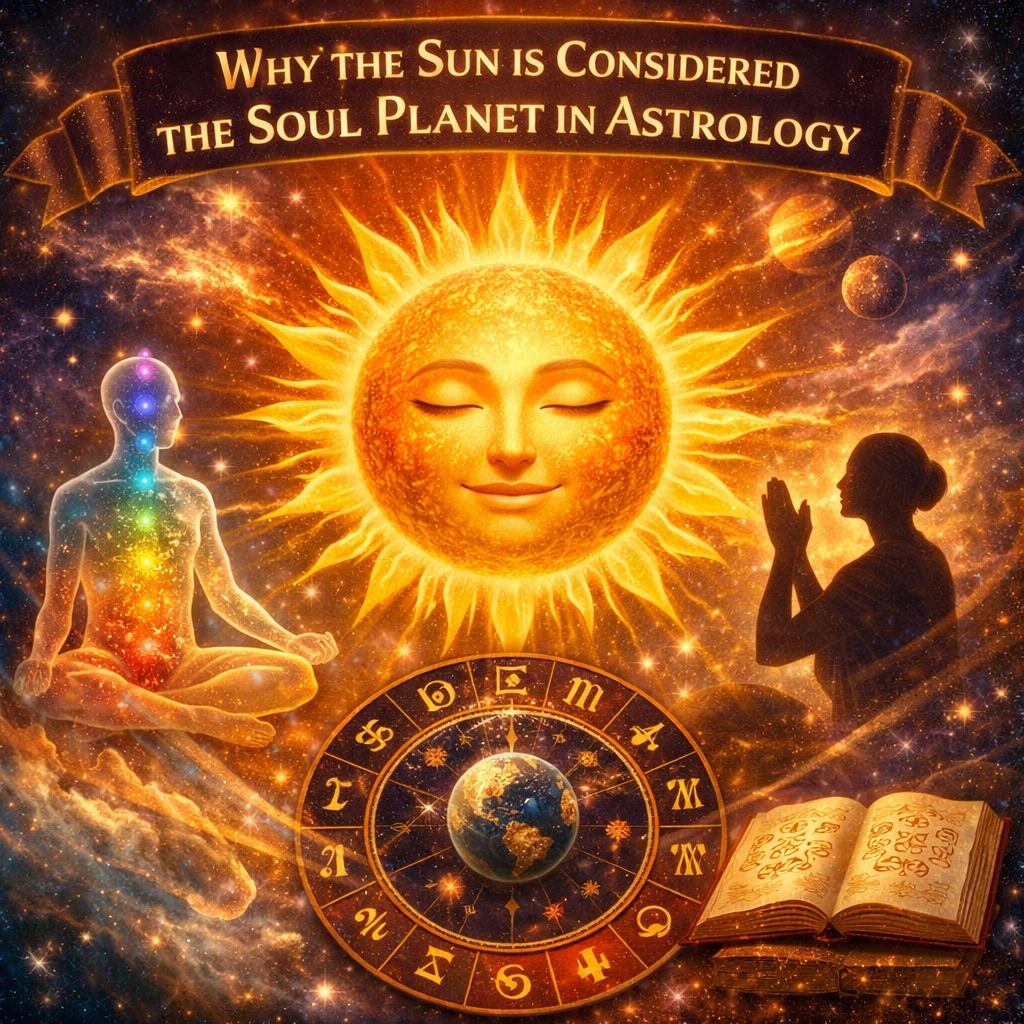
Why the Sun is Considered the Soul Planet in Astrology

Sun soul planet in astrology is one of the most profound and deeply respected concepts in the entire astrological tradition. From ancient Vedic scriptures to modern astrological interpretations the Sun has always been regarded as the source of life consciousness identity and purpose. Just as the physical Sun gives light warmth and energy to the Earth the astrological Sun illuminates the inner world of a human being. It represents the eternal spark that defines who we are beyond roles relationships and material achievements.
In astrology the Sun is not merely a planet that influences events. It is the very core of the horoscope. It symbolizes the Atma which means the soul. This is why sages and astrologers across civilizations have unanimously declared the Sun as the soul planet. Without understanding the Sun one cannot truly understand the native. The Sun tells the story of self realization authority self respect vitality and dharma.
This blog explores in great depth why the Sun is considered the soul planet in astrology. We will examine its spiritual philosophical psychological karmic and practical dimensions. We will also understand how the placement of the Sun shapes destiny leadership health confidence and life direction.

The Ancient Origin of the Sun as the Soul Planet

The concept of Sun soul planet in astrology originates from the oldest spiritual texts known to humanity. In Vedic astrology the Sun is called Surya or Aditya. Surya is worshipped as a deity long before astrology was formalized as a predictive science. The Rigveda contains numerous hymns dedicated to the Sun describing it as the witness of all actions the source of truth and the sustainer of life.

In Vedic philosophy the soul or Atma is self luminous. It does not require anything external to exist. This mirrors the nature of the Sun which shines by its own light. All other planets reflect light just as the mind emotions and intellect reflect the soul. This symbolic parallel is the foundation of why the Sun is associated with the soul.

Ancient astrologers observed that when the Sun was strong in a horoscope the individual possessed clarity purpose honor and moral strength. When afflicted the person struggled with identity low confidence and lack of direction. These observations strengthened the belief that the Sun governs the very essence of being.

Philosophical Meaning of the Sun in Astrology

Sun soul planet in astrology represents the philosophical idea of I am. It answers the question of existence. Who am I Why am I here What is my role in this world These questions are governed by the Sun.
The Moon represents the mind Mercury represents intellect Venus represents desire Mars represents action Jupiter represents wisdom Saturn represents karma but the Sun represents consciousness itself. Without consciousness none of the other functions have meaning. This makes the Sun the central pillar of the horoscope.
The Sun is linked with dharma which means righteous path. A person with a well placed Sun naturally aligns with truth ethics and responsibility. They feel an inner calling to live with integrity. This is why leaders kings administrators and reformers often have powerful Sun placements.

Sun as the Source of Identity and Self Worth

One of the strongest reasons Sun soul planet in astrology is emphasized is because the Sun defines identity. It governs self image confidence ego and self worth. Ego here does not mean arrogance. It means the sense of individuality.
When the Sun is strong the individual knows who they are. They can stand alone. They do not require constant validation. They command respect naturally. Their presence has authority even without words.
When the Sun is weak or afflicted the person may struggle with self doubt dependency fear of authority or issues with father figures. They may seek external approval to compensate for inner emptiness.
Thus the Sun reflects the health of the soul expression in the material world.

Click Here To Book An Appointment With Best Astrologer in India: Acharya Sakshi Sanjeev Thakur

The Sun and the Concept of Atma

In Vedic astrology Atma Karaka is the planet that signifies the soul purpose. While different systems assign Atma Karaka based on degrees the Sun is the natural Atma Karaka for all beings. It is the universal significator of the soul.
The soul is eternal unchanging and radiant. The Sun never changes its nature. It rises every day regardless of human affairs. This consistency reflects the soul journey across lifetimes.
The Sun shows the lessons the soul has chosen to learn in this incarnation. Its house placement reveals the area of life where self realization is most important. Its sign placement shows the style in which the soul expresses itself.

Sun in Astrology and the Father Principle

Another crucial aspect of Sun soul planet in astrology is its association with the father or father like figures. The father represents authority discipline values and direction in early life. This mirrors the role of the Sun as the guiding force.
A harmonious Sun often indicates a supportive father or mentors who help the individual build confidence. A challenging Sun may show struggles with authority independence or self validation.
On a deeper level the father symbolizes the higher self guiding the individual toward purpose. Issues with the Sun often push the native toward self discovery through challenges.

Spiritual Symbolism of the Sun

Across cultures the Sun is worshipped as the supreme soul. In Egypt Ra was the Sun god. In Japan the emperor was considered a descendant of the Sun. In Hinduism Surya is revered as the visible form of divine consciousness.

This universal reverence strengthens the astrological belief that the Sun is not just a planet but a cosmic principle. It represents divine will order and truth.

Meditation on the Sun is believed to awaken soul consciousness. Practices like Surya Namaskar and Gayatri Mantra are designed to align the individual soul with universal consciousness.

Sun and Karma

Sun soul planet in astrology is deeply connected with karma. It represents the karma of leadership power responsibility and authority. Souls with strong Sun placements often carry karmas related to ruling guiding or protecting others.
Such individuals are tested through positions of power. They must learn humility compassion and service. Abuse of power weakens the Sun energy leading to downfall.
A weak Sun may indicate karmic lessons related to self assertion courage and independence. The soul may have avoided responsibility in past lives and now must learn to stand firm.

The Sun in the Twelve Houses

The house position of the Sun reveals where the soul seeks expression.

  • In the first house the soul focuses on self realization identity and leadership
  • In the second house the soul seeks value security and truthful speech
  • In the third house the soul expresses through communication courage and effort
  • In the fourth house the soul seeks emotional stability roots and inner peace
  • In the fifth house the soul shines through creativity intelligence and children
  • In the sixth house the soul learns service discipline and healing
  • In the seventh house the soul evolves through relationships and partnerships
  • In the eighth house the soul undergoes deep transformation and rebirth
  • In the ninth house the soul seeks wisdom philosophy and higher truth
  • In the tenth house the soul fulfills purpose through career and public life
  • In the eleventh house the soul works for collective goals and aspirations
  • In the twelfth house the soul moves toward liberation and spiritual surrender

Each placement shows a unique soul journey.

Click Here To Learn About Planets From The Best Astrologer: Acharya Sakshi Sanjeev Thakur

Sun in Zodiac Signs and Soul Expression

The sign placement of the Sun shows how the soul expresses itself.

  • In Aries the soul is pioneering bold and fearless
  • In Taurus the soul seeks stability beauty and value
  • In Gemini the soul expresses through learning and communication
  • In Cancer the soul is nurturing protective and emotional
  • In Leo the soul shines with confidence creativity and leadership
  • In Virgo the soul serves through precision and healing
  • In Libra the soul seeks balance harmony and justice
  • In Scorpio the soul transforms through intensity and depth
  • In Sagittarius the soul expands through wisdom and truth
  • In Capricorn the soul builds legacy discipline and structure
  • In Aquarius the soul innovates for collective growth
  • In Pisces the soul dissolves into compassion and spirituality

Psychological Role of the Sun

Sun soul planet in astrology also governs psychological health. A balanced Sun gives optimism resilience and inner strength. Such individuals recover quickly from setbacks.

A damaged Sun can result in depression lack of motivation or identity crisis. This is why strengthening the Sun is often recommended for mental clarity and confidence.

Modern psychology also recognizes the importance of a strong sense of self which aligns perfectly with the Sun principle.

Sun and Health [ Sun soul planet ]

The Sun governs vitality immunity bones heart and eyes. A strong Sun gives good stamina and resistance to illness. A weak Sun may cause fatigue low immunity or heart related issues.

Since the Sun represents life force its strength directly impacts physical health.

Remedies to Strengthen the Sun

Strengthening Sun soul planet in astrology is not about ego but about aligning with truth and purpose.

Practices include:

  • Respecting father teachers and authority
  • Waking up early and offering water to the Sun
  • Chanting Gayatri Mantra
  • Living with integrity honesty and discipline
  • Serving society through leadership and guidance

These remedies awaken the soul energy within.

Why the Sun Is the Ultimate Soul Indicator

Among all planets only the Sun represents pure consciousness. It does not borrow light. It does not depend. It simply exists and shines.

This independence is the true nature of the soul. Therefore astrology places the Sun at the center of self realization.

Understanding the Sun means understanding the soul mission.

Conclusion

Sun soul planet in astrology is not a symbolic idea but a lived reality. The Sun defines who we are why we are here and how we express our divine essence. Every horoscope begins with the Sun because every life begins with the soul spark.

When we honor the Sun we honor our true self. When we align with its principles we move closer to purpose fulfillment and inner peace.

Astrology without understanding the Sun is incomplete. Life without soul awareness is directionless. The Sun bridges heaven and earth illuminating the path of consciousness.
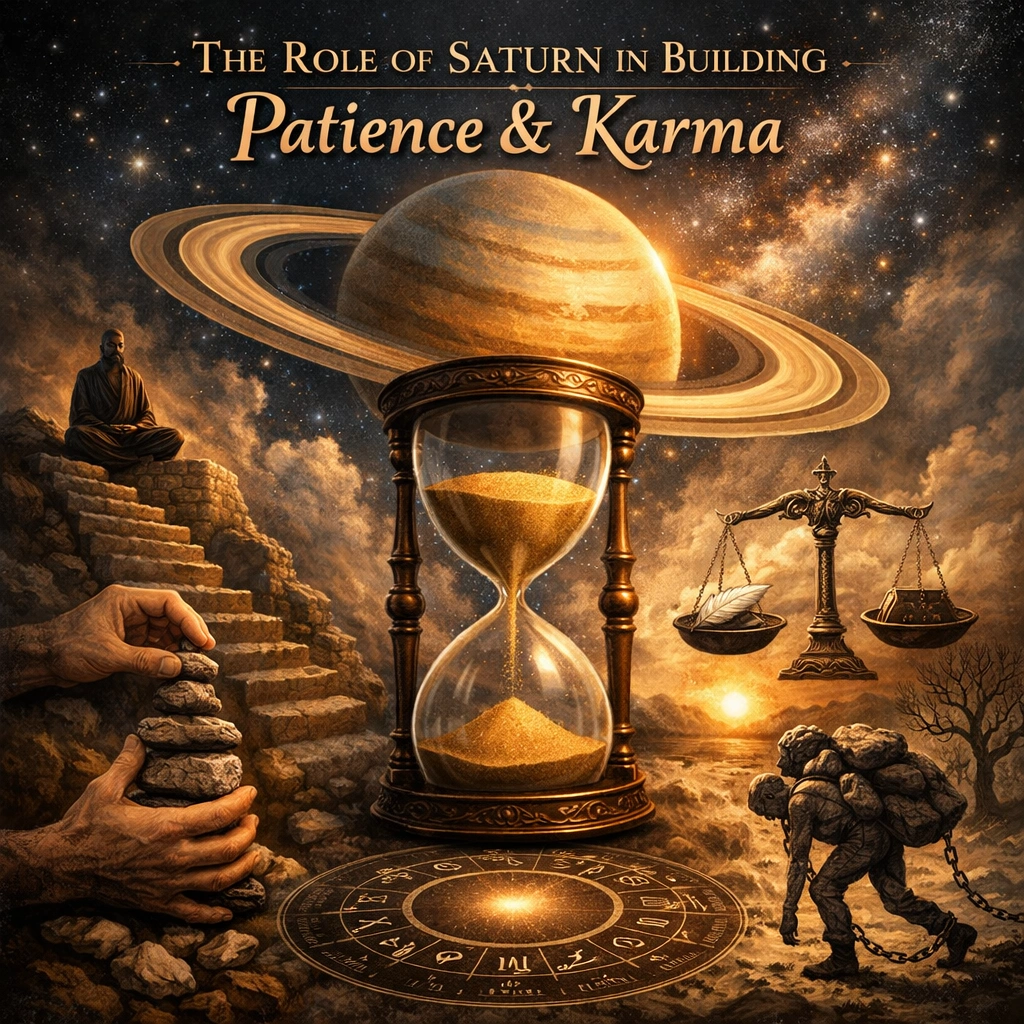
Saturn Karma Patience and the Role of Saturn in Building Patience and Karma

Saturn karma-patience is one of the most misunderstood yet most powerful forces in astrology. From ancient times to modern spiritual practices Saturn has been regarded as the planet that tests refines and matures the human soul. While many people fear Saturn due to its association with delays struggles and responsibilities the deeper truth is that Saturn is the greatest teacher of patience discipline and karmic balance.

Saturn does not deny rewards. Saturn only delays them until the soul is ready to receive them with wisdom humility and responsibility. Through Saturn karma patience a person learns that nothing meaningful in life comes instantly. Every achievement earned through Saturn carries permanence strength and deep inner satisfaction.

In this detailed guide we will explore how Saturn karma patience shapes human life builds character heals karmic debts and leads the soul toward long term success spiritual maturity and lasting peace.

Understanding Saturn Karma Patience in Astrology

Saturn karma-patience represents the cosmic law of cause and effect operating through time. Saturn governs karma time responsibility endurance and moral accountability. It teaches that every action creates a reaction and every thought shapes future experiences.

Unlike fast moving planets Saturn moves slowly across the zodiac. This slow movement symbolizes gradual growth steady learning and long term evolution. Saturn does not rush because life lessons that matter require patience reflection and commitment.

When Saturn influences a person strongly, it often brings challenges that demand discipline, consistency, and emotional resilience. These challenges are not punishments. They are karmic opportunities designed to correct past mistakes, strengthen character, and align the soul with its higher purpose.

Why Saturn Is Called the Lord of Karma

Saturn is known as the lord of karma because it records and delivers the results of past actions. This includes actions from this lifetime as well as previous lifetimes according to Vedic astrology.

Saturn karma patience works through fairness. Saturn never gives more or less than what is deserved. If a person has worked hard ethically and responsibly Saturn rewards them with stability respect and long lasting success. If a person avoids responsibility Saturn teaches lessons through delay struggle and limitation.

This planet does not operate on emotional bias. Saturn is neutral just and exact. It reminds us that true growth happens when we accept accountability for our actions and choices.

Saturn Karma Patience and the Concept of Time

Time is the most important domain of Saturn. Saturn teaches that time is the ultimate truth teller. Shortcuts manipulation and impatience may give temporary results but only efforts aligned with discipline and ethics survive time.

Saturn karma patience shows that delays are not denials. Often Saturn delays success to build inner strength maturity and preparedness. When success arrives under Saturn it stays for life.

People under strong Saturn influence often achieve major success later in life. Their early years may be filled with struggle responsibility or restrictions but these experiences shape wisdom endurance and emotional depth.

Click Here To Book An Appointment With Acahrya Sakshi Sanjeev Thakur

How Saturn Karma Patience Builds Inner Strength

Saturn builds strength not through comfort but through endurance. It teaches the soul how to stand firm during adversity. Saturn karma patience strengthens the nervous system emotional stability and mental resilience. People shaped by Saturn learn to handle rejection without bitterness failure without despair and delay without frustration. They develop a calm mind and a grounded personality. This strength is not loud or flashy. It is quiet steady and deeply rooted. Saturn gives the power to remain composed when others panic and focused when others quit.

Saturn Karma Patience and Discipline in Life

Discipline is the foundation of Saturn energy. Saturn karma patience trains the individual to follow routines respect rules and honor commitments. Whether it is waking up early working consistently saving money or maintaining ethical standards Saturn rewards discipline with long term security. Those who resist discipline often feel restricted by Saturn. Those who embrace it become masters of their destiny.

Saturn Karma Patience and Life Challenges

Life challenges under Saturn are purposeful. Saturn does not create random suffering. Each obstacle serves a karmic function. Common Saturn related challenges include career delays financial responsibility family burdens health discipline emotional isolation or slow progress. These challenges force introspection self correction and maturity. Over time the individual realizes that these experiences shaped their wisdom resilience and self respect.

Saturn Karma Patience in Career and Professional Life

In professional life Saturn karma-patience teaches that real success requires consistent effort ethical conduct and long term vision. People under Saturn influence may experience slow career growth frequent testing phases or responsibility without immediate recognition. However once Saturn rewards them they gain authority respect and stability. Saturn favors professions related to law administration engineering research agriculture labor management and spiritual teaching.

Click Here To Learn Astrology By Best Astrologer In India: Acharya Sakshi Sanjeev Thakur

Saturn Karma Patience and Financial Growth

Saturn governs wealth that is earned not inherited. Financial growth under Saturn is slow but stable. Sudden gains are rare but long term security is strong. Saturn teaches budgeting saving patience and responsible financial planning. Those who respect money value effort and avoid shortcuts receive Saturn blessings in finances.

Saturn Karma Patience in Relationships

In relationships Saturn teaches commitment loyalty and emotional maturity. Saturn karma patience may delay marriage or bring relationships that demand responsibility. These relationships may not be emotionally expressive but they are stable loyal and enduring. Saturn teaches that love is not just emotion but duty respect and consistency.

Saturn Karma Patience and Emotional Healing

Emotionally Saturn heals through acceptance and self awareness. It teaches the individual to sit with discomfort understand emotional patterns and release dependency. Saturn karma-patience builds emotional independence inner peace and self trust.

Saturn Karma Patience and Spiritual Growth

Spiritually Saturn is a master teacher. It guides the soul toward humility surrender and inner silence. Meditation service simplicity and detachment are Saturn virtues. Saturn karma-patience purifies the soul by removing ego illusions and aligning the individual with higher truth.

Saturn Karma Patience and Past Life Karma

Many Saturn challenges are linked to unresolved past-life karma. Saturn brings people situations and experiences that mirror unfinished lessons. By responding with patience integrity, and responsibility, the soul clears karmic debt and evolves spiritually.

Saturn Karma Patience During Saturn Transits

Major Saturn transits such as Saturn return and Saturn sade sati activate deep karmic lessons. These periods feel intense but they are transformative. Saturn karma-patience during these phases leads to life redefining growth.

Saturn Karma Patience and Saturn Return

Saturn return occurs around ages twenty nine and fifty eight. It marks maturity accountability and life direction clarity. Those who resist change suffer. Those who embrace responsibility rise.

Saturn Karma Patience and Saturn Sade Sati

Saturn sade sati tests emotional strength discipline and inner faith. Though challenging it removes false structures and builds inner stability.

Saturn Karma Patience and Health Lessons

Saturn governs bones joints teeth nerves and chronic conditions. Health issues under Saturn teach discipline routine and self care. Long term wellness comes through consistent habits.

Saturn Karma Patience and Detachment

Saturn teaches detachment not rejection. It teaches how to remain grounded without emotional dependency. This detachment creates freedom peace and inner strength.

Saturn Karma Patience and Success Later in Life

Many great leaders thinkers and spiritual masters rose late in life due to Saturn influence. Their wisdom depth and authority were shaped through patience and struggle. Saturn ensures success is meaningful and lasting.

Saturn Karma Patience and Ethical Living

Ethics honesty and integrity are Saturn values. Shortcuts manipulation and dishonesty lead to Saturn corrections. Ethical living attracts Saturn blessings.

Saturn Karma Patience and Self Respect

Saturn teaches self respect through responsibility. When you honor commitments and face truth you gain inner dignity. This self respect becomes unshakable confidence.

Saturn Karma Patience and Letting Go of Ego

Saturn dismantles ego illusions. It humbles the soul and replaces arrogance with wisdom. True power emerges through humility.

Saturn Karma Patience and Life Purpose

Saturn reveals life purpose through challenges. Your struggles show where your soul needs growth. Once lessons are learned Saturn supports fulfillment.

Saturn Karma Patience as a Blessing

Though feared Saturn is a blessing. It gives strength clarity wisdom and peace. Saturn karma patience transforms suffering into mastery.

Final Thoughts on Saturn Karma Patience

Saturn karma-patience is not about punishment but preparation. It teaches that true success requires effort responsibility and time. Those who walk with Saturn emerge wiser stronger and spiritually aligned. When you respect Saturn embrace discipline and practice patience life unfolds with stability dignity and lasting fulfillment.

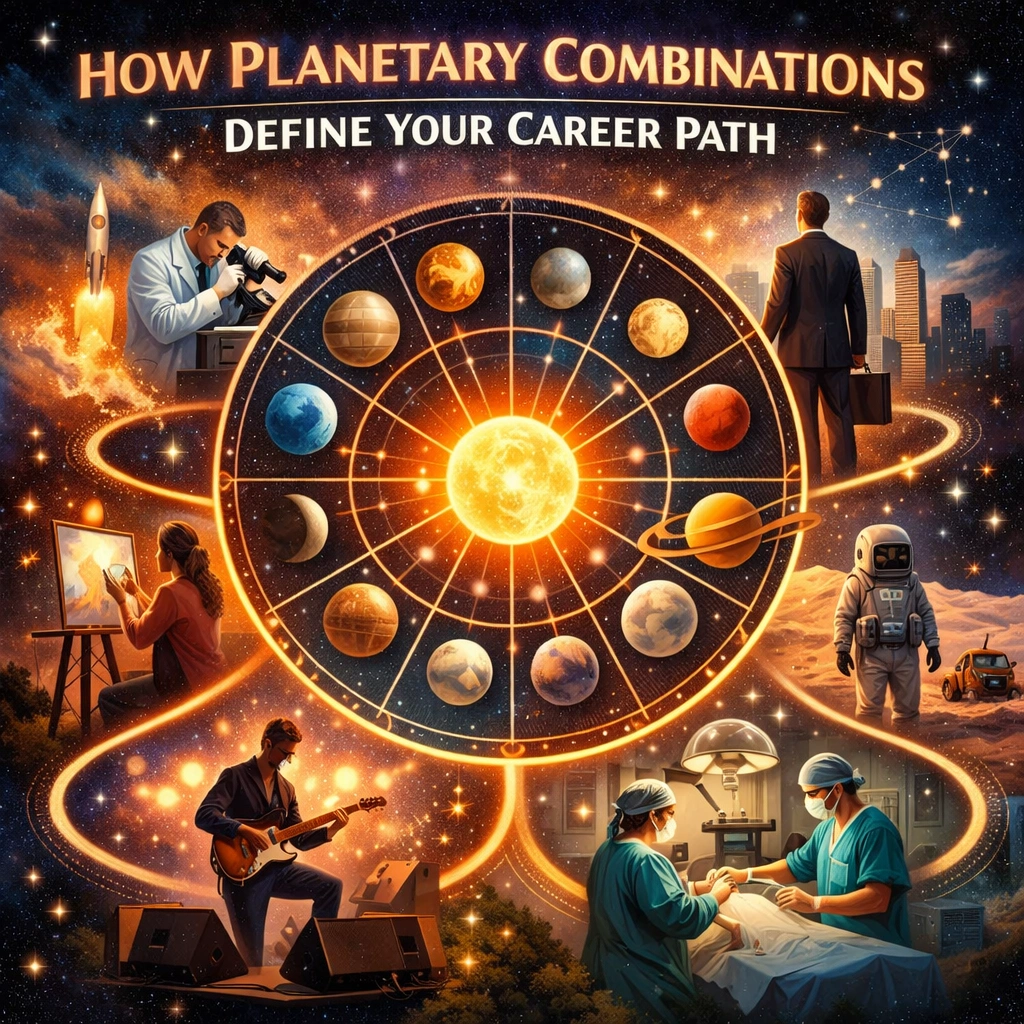
How Planetary Combinations Define Your Career Path

Introduction

Planetary Combinations and Career are fundamental in understanding how your professional life unfolds according to Vedic astrology. Every person has unique energies and talents that can be unlocked through the study of planetary influences in the birth chart. In this deep exploration of how planets shape career destiny you will understand the ancient wisdom of astrology and practical ways to apply it in modern life.

This extensive guide will cover core principles of astrology, detailed significance of planets in career path evaluations, essential combinations that determine success fields, and advice on strengthening career prospects through awareness and remedies rooted in Vedic traditions.

Click Here To Book An Appointment With Acharya Sakshi Sanjeev Thakur

What Are Planetary Combinations and Career Influences

Planetary Combinations and Career refer to the alignment of planets in your birth chart that create specific results in your profession. Vedic astrology career evaluation studies the relationship between the Sun Moon Mercury Mars Jupiter Venus Saturn Rahu and Ketu in the twelve houses of the horoscope. Each house is linked to specific aspects of life including work, income, reputation, fulfillment and challenges.

Your birth chart is a snapshot of the sky at the moment of birth and contains clues about aptitude leadership qualities communication skills stability creativity and ambition. Planetary strengths in career houses can shape your professional strengths and potential obstacles.

Understanding the Birth Chart in Career Path Astrology

A birth chart reveals the blueprint of your life encoded in planetary positions. Career path astrology focuses on certain houses and planets that influence your vocation profession and job fulfillment. The main houses you must consider are:

  • The Tenth House of vocation and public life
  • The Sixth House of job environment health and service
  • The Second House of finances speech and values
  • The Eleventh House of gains and achievements

Each of these houses reveals dimensions of your work life. For example a strong Tenth House shows leadership position high recognition and career success whereas a strong Sixth House reveals work ethic resilience and ability to navigate rivals and challenges.

Vedic Astrology Career Key Planets and Meanings

In Vedic astrology career Mars represents energy drive and courage to take action. Mercury influences communication analytical skills learning and adaptability. Jupiter influences wisdom teaching guidance and success through knowledge. Venus brings creativity harmony and aesthetic talents. Saturn reflects discipline persistence patience and ability to work long hours. Rahu and Ketu show transformative lessons unusual career paths and karmic experiences.

Let us explore how these planets shape career outcomes.

Sun and Career Purpose

The Sun governs personal identity authority and leadership. In Planetary Combinations and Career the Sun empowers those inherently suited to lead manage and take responsibility. A strong Sun in career houses often reveals a path in government services corporate leadership politics or positions where confidence and recognition are essential.

Moon and Emotional Fulfillment

The Moon represents emotions intuition sensitivity and creativity. In career path astrology the Moon influences jobs involving nurturing communication arts and public interaction. Moon strengths support careers in counseling teaching media caregiving and hospitality where emotional intelligence is important.

Mercury and Communication

Mercury is the planet of intellect language and learning. A strong Mercury in career houses enhances analytical reasoning communication skills analytics and marketing. People with strong Mercury may find success in writing editing research technology business and linguistics.

Venus and Creative Expression

Venus governs beauty creativity luxury and refined tastes. In Planetary Combinations and Career a strong Venus suits roles in art design fashion music hospitality real estate and industries related to art and comfort.

Mars and Drive

Mars denotes courage initiative energy and physical strength. When well placed Mars supports entrepreneurship careers sports military engineering construction and areas where physical coordination and persistence are important.

Jupiter and Wisdom

Jupiter links to wisdom ethics teaching spirituality law and expansion. Those with strong Jupiter often feel drawn to education law medicine philosophy mentoring and community leadership.

Saturn and Discipline

Saturn calls for persistence discipline long term projects and responsibility. In career evaluations Saturn shapes people who achieve success through structure hard work management administration and strategic planning.

Rahu Ketu and Unusual Paths

Rahu rules innovation disruption foreign elements and unconventional careers. Ketu represents detachment mysticism and past life influences. Together they can shape unique vocational paths breaking norms and exploring spiritual entrepreneurship technology or healing arts.

Houses and Career Path Astrology Interpretations

Tenth House Career

The Tenth House is the most crucial for Planetary Combinations and Career insights. It reveals vocation reputation authority and public life. Understanding the lord of the tenth house and planetary aspects on it provides strong clues about your career direction.

For example a well placed Jupiter as the tenth lord emphasizes careers in teaching law and wisdom based services. A strong Mars as tenth lord brings leadership in entrepreneurship construction sports or defense.

Sixth House Work and Service

The Sixth House defines your daily work life environment conflicts work ethic problem solving and service. Planets here shape how you approach workload adversity routine and colleagues. For instance a strong Mercury here enhances analytical problem solvers whereas Saturn here brings reliability discipline and organizational efficiency.

Second House Finances

The Second House governs income family support and communication style. Strong benefics like Venus and Jupiter in the second house improve financial support creative speech and communication skills. Challenging planets might ask for focused skills and patience to earn steadily.

Eleventh House Gains and Aspirations

The Eleventh House influences gains achievements and networks. Benefic presence here encourages good income flow friendships collaborations and fulfillment of career desires. A strong Moon in the eleventh house favors creative collaborations and community support.

Common Planetary Combinations That Define Career Patterns

1. Sun Mercury Conjunction

A Sun Mercury conjunction enhances leadership communication and managerial skills. This combination supports careers in business networking education management technology or any role requiring communicative authority.

2. Venus Mars Conjunction

This mix of Venus creative harmony and Mars energy drive brings success in creative fields entrepreneurship entertainment media design and arts. It supports roles demanding passion creativity courage and networking.

3. Jupiter Saturn Combination

A blend of wisdom and discipline often signals strong long term success through structured growth. People with this combination excel in institutions law medicine teaching financial planning and leadership roles requiring perseverance.

4. Rahu in Tenth House

Rahu in the tenth house can bring sudden success foreign exposure unconventional careers technology and innovation sectors. You may excel in fields others consider unusual creative or futuristic.

5. Jupiter in Tenth House

Jupiter as a tenth lord brings powerful guidance in careers connected to teaching law spirituality higher knowledge consultancy and mentorship roles.

6. Saturn in Sixth House

Saturn in the sixth house supports careers where discipline adversity management and patience matter. You excel in administrative roles process optimization labor management and structured projects.

Strength, Weakness, Opportunities and Threat Analysis Through Planets

In career path astrology your strengths appear through benefic planet placements in career houses. Opportunities show where your talents can flourish. Weaknesses reveal areas to improve or avoid haste. Threats appear as malefic placements without supportive aspects.

For instance a strong Mercury offers analytical excellence while a weak Mercury can cause indecision or confused communication. Saturn gives discipline yet can create slow progress without patience. Rahu can bring innovation or confusion without clarity of purpose.

How to Use Planetary Combinations for Career Decisions

Understanding your chart helps guide right career choices timing transitions and strategic planning. Steps include:

  • Identify your tenth house and its lord
  • Analyze benefic and malefic influences on career houses
  • Recognize natural talents indicated by strong planets
  • Evaluate periods and cycles favoring career growth
  • Use remedies to strengthen weak planetary influences

Remedies to Enhance Career Prospects

In Vedic tradition certain practices help strengthen planetary influences supporting career growth:

Mantras

Chanting specific mantras related to beneficial planets like Jupiter or Mercury can enhance wisdom and communication. Recitation with focus and devotion increases mental clarity and confidence.

Gemstones

Wearing appropriate gemstones with advice from an expert can help align your energy with favorable planetary vibrations. For example an Emerald for Mercury or Yellow Sapphire for Jupiter under proper guidance.

Charity and Service

Serving others especially on days connected to planets like Thursday for Jupiter improves karmic balance and fosters opportunities.

Meditation and Discipline

Meditation increases clarity creativity focus and patience which support career advancement irrespective of chart complexities.

Real Life Examples of Planetary Combinations and Career

Case One

A person with strong Jupiter and Venus in career houses often excels in education design and community leadership because they blend wisdom creativity and service.

Case Two

A strong Mars in the tenth house may choose entrepreneurship technology or physical pursuits showing strong leadership and energy.

Case Three

Rahu in the tenth house often leads to careers in technology innovation digital media or foreign collaboration reflecting unconventional success.

Career Planning With Transits

Planetary transits influence how opportunities unfold over time. For example favourable Jupiter transit through career houses can bring recognition promotions and growth while Saturn transit can bring structured learning and long lasting results.

Tracking transits helps choose right timing for job changes entrepreneurship or academic pursuits.

Click Here To Learn Astrology With Acharya Sakshi Sanjeev Thakur

FAQs About Planetary Combinations and Career Path

What is the most important house for career?

The tenth house remains central but the sixth second and eleventh houses also shape your work life.

Can planetary combinations change career outcomes?

Yes awareness and effort help you align with your potentials while remedies reduce limitations.

Is birth chart analysis necessary for career decisions?

It offers deep insight but should complement education experience and self awareness.

Conclusion

Understanding Planetary Combinations and Career through Vedic astrology career principles helps you decode your vocation identity talent potential and professional timing. By studying planets in your birth chart you receive clarity on strengths challenges opportunities and ideal growth paths.

Astrology is a tool for consciousness and self discovery that supports informed career planning not rigid predestined outcomes. With deeper knowledge of planetary influences you can make empowered choices and live a career life that aligns with your inner purpose aspirations and fulfillment.

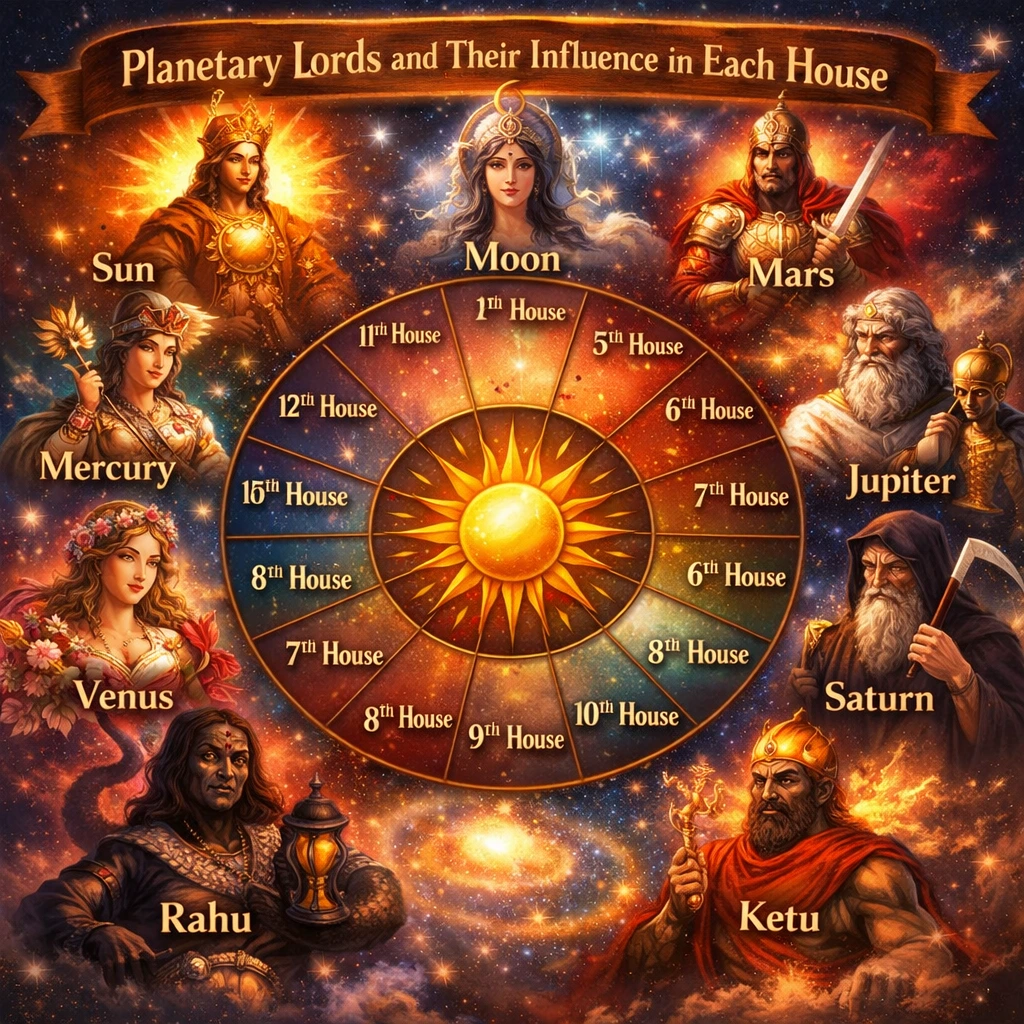
Planetary Lords and Their Influence in Each House

In Vedic astrology, understanding Planetary Lords is fundamental to interpreting a horoscope. Every house in a birth chart is governed by a planet, and the planet’s nature, placement, and relationship with other planets shape the life of the native. The influence of planets on each house provides deep insight into career, health, relationships, wealth, and spirituality. In this guide, we will explore Planetary Lords and Their Influence in Each House, giving you a detailed understanding of how planetary positions affect various aspects of life.

What Are Planetary Lords

A Planetary Lord is the ruling planet of a house in your birth chart. Each house represents a specific area of life, and its lord determines the results associated with that house. For example, the Sun rules leadership, authority, and self-confidence, while the Moon influences emotions, mind, and nurturing tendencies.

The position of the Planetary Lord, whether in its own house, exalted, debilitated, or in conjunction with other planets, affects the overall results of that house. The strength and influence of a Planetary Lord are crucial for predictions in astrology.

Influence of Planetary Lords in Astrology

The influence of planets on each house is multifaceted. It is not only the placement of the planets but also their aspects, conjunctions, and retrograde motion that play a role in shaping outcomes. A strong Planetary Lord can enhance the positive traits of a house, whereas a weak or afflicted lord may bring challenges.

Planetary influences are interpreted in two ways:

  1. Positive Influence: When the lord is well-placed and unafflicted, it supports growth, prosperity, and fulfillment in that house.
  2. Negative Influence: When the lord is weak, afflicted, or in an unfavorable position, it may create obstacles, delays, or challenges related to the house matters.
Click Here To Book An Appointment With Acharya Sakshi Sanjeev Thakur

Planetary Lords and Their Influence in Each House

1st House – Self and Personality

The 1st house, also called the Lagna or Ascendant, represents self, personality, health, and physical appearance. Its lord governs how a person expresses themselves, their confidence, and general well-being.

  • Influence: A strong 1st house lord enhances vitality, charisma, and leadership qualities. If afflicted, it can bring health issues or low self-esteem.
  • Example: Mars as the 1st house lord gives courage, assertiveness, and energy, whereas a weak Mars may cause impulsiveness and temper issues.

2nd House – Wealth and Family

The 2nd house represents wealth, family, speech, and accumulated resources. Its Planetary Lord governs financial stability and family relationships.

  • Influence: A strong 2nd house lord brings wealth, harmonious family life, and eloquence in speech.
  • Example: Venus as the 2nd house lord can indicate comfort, luxury, and artistic talent in speech.

3rd House – Courage and Siblings

The 3rd house relates to courage, communication, siblings, and short journeys. Its lord reflects the native’s mental strength, determination, and relationships with siblings.

  • Influence: A powerful 3rd house lord enhances confidence, communication skills, and successful ventures.
  • Example: Mercury as the 3rd house lord provides intellectual abilities and effective communication.

4th House – Home and Mother

The 4th house signifies home, mother, property, and emotional stability. Its Planetary Lord influences domestic comfort, emotional security, and property matters.

  • Influence: A strong 4th house lord gives peace at home, property gains, and emotional stability.
  • Example: Moon as the 4th house lord enhances emotional intelligence and a nurturing home environment.

5th House – Education and Creativity

The 5th house represents education, creativity, intelligence, and children. Its lord plays a significant role in shaping mental faculties and creative expression.

  • Influence: A strong 5th house lord ensures academic success, creative talents, and a positive relationship with children.
  • Example: Jupiter as the 5th house lord enhances wisdom, intelligence, and spiritual learning.

6th House – Health and Service

The 6th house governs health, enemies, debts, and service. Its Planetary Lord influences how a person manages health and overcomes challenges.

  • Influence: A strong 6th house lord provides the ability to fight diseases, manage conflicts, and overcome debts.
  • Example: Mercury as the 6th house lord gives analytical skills to solve health or work-related issues.

7th House – Marriage and Partnerships

The 7th house is associated with marriage, partnerships, and business relationships. The Planetary Lord of this house determines the quality of relationships and partnerships.

  • Influence: A strong 7th house lord brings harmony in marriage, successful partnerships, and business prosperity.
  • Example: Venus as the 7th house lord enhances love, romance, and marital satisfaction.

8th House – Transformation and Occult

The 8th house signifies transformation, longevity, inheritance, and occult sciences. Its lord governs hidden matters, inheritance, and spiritual growth.

  • Influence: A well-placed 8th house lord can lead to deep insights, longevity, and financial gains through inheritance.
  • Example: Mars as the 8th house lord can give courage to face challenges but may also bring accidents if weak.

9th House – Luck and Spirituality

The 9th house represents luck, spirituality, higher education, and long journeys. Its lord is crucial for fortune, wisdom, and spiritual inclination.

  • Influence: A strong 9th house lord enhances luck, success in higher studies, and spiritual growth.
  • Example: Jupiter as the 9th house lord brings fortune, ethical values, and spiritual knowledge.

10th House – Career and Status

The 10th house is associated with career, reputation, and achievements. Its Planetary Lord influences professional life and social standing.

  • Influence: A strong 10th house lord ensures career success, recognition, and leadership abilities.
  • Example: Sun as the 10th house lord enhances authority, career growth, and leadership qualities.

11th House – Gains and Networking

The 11th house represents gains, friendships, and social networks. Its lord affects income, aspirations, and social connections.

  • Influence: A powerful 11th house lord provides financial gains, strong networking, and fulfillment of desires.
  • Example: Mercury as the 11th house lord favors financial growth through communication-related ventures.

12th House – Expenditure and Spiritual Liberation

The 12th house governs expenses, foreign travels, isolation, and spiritual liberation. Its Planetary Lord affects losses, expenditure, and spiritual pursuits.

  • Influence: A strong 12th house lord supports spiritual growth, foreign opportunities, and controlled expenditures.
  • Example: Jupiter as the 12th house lord enhances spiritual wisdom and successful foreign journeys.
Click Here To Learn Astrology Online

How Planetary Lords Shape Your Life

The placement of Planetary Lords in a horoscope is a key determinant of life experiences. For instance, a strong Jupiter can bring wisdom and fortune, while a weak Saturn may create delays and obstacles. Understanding these influences can help in planning career, relationships, finances, and health remedies.

Remedies to Balance Planetary Lords

  1. Gemstones: Wear gemstones corresponding to weak Planetary Lords after astrological consultation.
  2. Mantras: Chant mantras for planetary strengthening. For example, chanting Sun or Moon mantras enhances energy and emotional balance.
  3. Charity and Rituals: Performing specific rituals or donating to related causes strengthens the planetary energy.
  4. Color Therapy: Wearing colors linked with the planet can positively influence its effects.

Conclusion

Understanding Planetary Lords and Their Influence in Each House provides deep insight into the life of an individual. Every house has its significance, and the lord of the house governs how that life area manifests. By analyzing the strength, position, and aspects of Planetary Lords, astrologers can predict career, health, relationships, financial stability, and spiritual growth.

Astrology not only predicts outcomes but also provides remedies to balance planetary influences. By focusing on planetary strengths and mitigating weaknesses through gemstones, mantras, colors, and rituals, one can lead a harmonious and successful life.

The knowledge of Planetary Lords is a gateway to understanding the cosmic blueprint of life and aligning personal efforts with celestial energies.

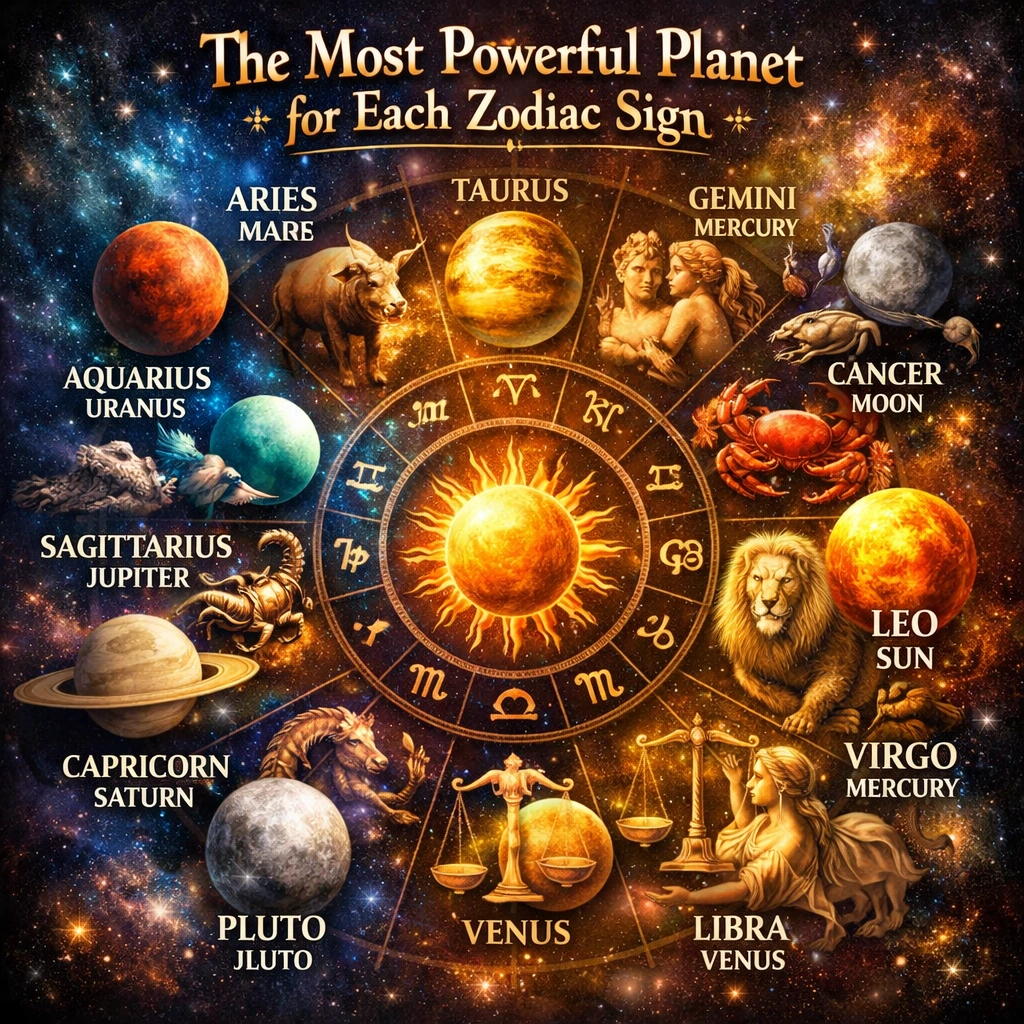
The Most Powerful Planet for Each Zodiac Sign

The most powerful planet for each zodiac sign plays a defining role in shaping personality destiny mindset emotional patterns and life direction. In astrology planets are not just celestial bodies they are energetic forces that govern thoughts actions karma strengths and weaknesses. Every zodiac sign resonates strongly with a particular planet that acts as its primary source of power guidance and expression.

Understanding the most powerful planet for each zodiac sign allows you to recognize your natural strengths challenges and life purpose. It also helps you make better decisions related to career relationships health finances and spiritual growth. This knowledge becomes even more impactful when applied to remedies planetary balancing and self awareness.

In this detailed guide we will explore the most powerful planet for each zodiac sign in depth. You will learn why a specific planet dominates a sign how it expresses itself positively and negatively and how its strength or weakness influences your life journey.

Astrology works on the principle that planets are living energies. When a planet becomes powerful in a sign it enhances the natural traits of that sign and directs the native toward certain life experiences. Let us begin this journey through all twelve zodiac signs and their most powerful planetary rulers.

Click Here To Book Appointment With Acharya Sakshi Sanjeev Thakur

Aries Zodiac Sign and Its Most Powerful Planet

The most powerful planet for Aries zodiac sign is Mars. Mars represents energy courage action aggression ambition and raw strength. Aries being the first sign of the zodiac carries the spark of creation and initiation which aligns perfectly with Mars fiery nature.

Mars gives Aries natives leadership qualities fearlessness and the drive to move ahead without hesitation. Aries individuals are natural initiators. They do not wait for permission or validation. The power of Mars pushes them to act first and think later. This makes them excellent pioneers entrepreneurs athletes and warriors.

When Mars is strong in Aries the native becomes confident decisive and highly competitive. They have a powerful physical presence and mental sharpness. Such individuals are capable of handling pressure taking risks and fighting obstacles head on.

However an imbalanced Mars can make Aries natives impatient aggressive short tempered and impulsive. They may struggle with anger management and conflicts. Learning discipline and emotional control helps Aries channel Mars energy productively.

Mars teaches Aries the lesson of controlled power. When used wisely it becomes the greatest strength of this sign

Taurus Zodiac Sign and Its Most Powerful Planet

The most powerful planet for Taurus zodiac sign is Venus. Venus symbolizes love beauty luxury comfort pleasure and stability. Taurus is an earth sign that values security material growth and emotional consistency which makes Venus its perfect planetary ruler.

Venus blesses Taurus natives with charm artistic talent and a strong appreciation for beauty. These individuals are naturally drawn to music art fashion food and aesthetics. They possess a calm and composed demeanor that makes others feel safe and comforted around them.

A strong Venus gives Taurus financial stability relationship harmony and refined taste. Taurus natives often succeed in professions related to finance luxury real estate art and design. Their patience and determination allow them to build wealth slowly but securely.

When Venus is weak Taurus may become overly possessive indulgent lazy or resistant to change. They may struggle with attachment issues and material obsession.

Venus teaches Taurus the balance between enjoyment and responsibility. When this planet is empowered Taurus becomes a symbol of grace strength and enduring success.

Gemini Zodiac Sign and Its Most Powerful Planet

The most powerful planet for Gemini zodiac sign is Mercury. Mercury governs communication intelligence learning logic and adaptability. Gemini being an air sign thrives on curiosity mental stimulation and exchange of ideas making Mercury its dominant force.

Mercury gives Gemini natives sharp intellect quick thinking and excellent communication skills. They are natural speakers writers teachers marketers and negotiators. Their minds move fast allowing them to multitask and adapt to changing situations effortlessly.

A strong Mercury makes Gemini witty expressive analytical and socially active. These individuals can connect with people from all backgrounds and excel in fields involving media technology education and commerce.

When Mercury is afflicted Gemini may experience anxiety restlessness overthinking or lack of focus. They may struggle with consistency and emotional depth.

Mercury teaches Gemini the importance of clarity purpose and mindful communication. When aligned properly this planet becomes the source of brilliance and innovation for Gemini.

Cancer Zodiac Sign and Its Most Powerful Planet

The most powerful planet for Cancer zodiac sign is the Moon. The Moon represents emotions intuition nurturing memory and the subconscious mind. Cancer being deeply emotional and sensitive finds its greatest strength through lunar energy.

The Moon gives Cancer natives strong intuition emotional intelligence and caregiving abilities. They are deeply connected to family home and traditions. Their emotional depth allows them to understand others feelings without words.

A strong Moon makes Cancer compassionate protective and spiritually receptive. These individuals often excel in healing professions counseling hospitality and creative arts. Their nurturing nature creates safe spaces for others.

When the Moon is weak Cancer may become overly emotional insecure moody or dependent. They may struggle with emotional boundaries and past attachments.

The Moon teaches Cancer emotional balance self care and inner security. When empowered Cancer becomes a pillar of emotional strength and unconditional love.

Leo Zodiac Sign and Its Most Powerful Planet

The most powerful planet for Leo zodiac sign is the Sun. The Sun represents authority vitality confidence soul purpose and leadership. Leo ruled by the Sun naturally seeks recognition expression and creative fulfillment.

The Sun gives Leo natives charisma confidence and a commanding presence. They are natural leaders performers and motivators. Their warmth and generosity attract admiration and loyalty.

A strong Sun blesses Leo with success recognition and inner strength. These individuals often rise to positions of authority and influence. They have a strong sense of identity and purpose.

When the Sun is afflicted Leo may become arrogant egoistic or overly dependent on validation. They may struggle with humility and emotional vulnerability.

The Sun teaches Leo authentic leadership and self awareness. When balanced Leo shines as a source of inspiration courage and creativity.

Virgo Zodiac Sign and Its Most Powerful Planet

The most powerful planet for Virgo zodiac sign is Mercury. In Virgo Mercury operates in a more analytical practical and detail oriented manner compared to Gemini.

Mercury gives Virgo natives sharp observation skills logical thinking and problem solving abilities. They are perfectionists who seek order efficiency and improvement in everything they do.

A strong Mercury makes Virgo intelligent disciplined and service oriented. These individuals excel in healthcare research analytics education and administration. Their attention to detail ensures accuracy and reliability.

When Mercury is weak Virgo may become overly critical anxious or self doubting. They may struggle with over analysis and mental stress.

Mercury teaches Virgo discernment acceptance and mental clarity. When aligned Virgo becomes a master of precision wisdom and service.

Libra Zodiac Sign and Its Most Powerful Planet

The most powerful planet for Libra zodiac sign is Venus. Venus governs relationships harmony beauty justice and diplomacy. Libra being the sign of balance and partnerships resonates deeply with Venusian energy.

Venus gives Libra natives charm elegance and social intelligence. They have a natural ability to mediate resolve conflicts and create harmony. Their aesthetic sense is refined and artistic.

A strong Venus makes Libra successful in relationships law arts fashion and public relations. These individuals value fairness and mutual respect.

When Venus is afflicted Libra may become indecisive people pleasing or emotionally dependent. They may avoid confrontation at the cost of self respect.

Venus teaches Libra self worth balanced relationships and inner harmony. When empowered Libra becomes a symbol of grace fairness and love.

Scorpio Zodiac Sign and Its Most Powerful Planet

The most powerful planet for Scorpio zodiac sign is Mars. In classical astrology Mars rules Scorpio representing intensity transformation power and resilience.

Mars gives Scorpio natives immense emotional strength courage and determination. They possess the ability to regenerate after crises and face life darkest challenges fearlessly.

A strong Mars makes Scorpio strategic focused and magnetic. These individuals excel in research psychology investigation healing and leadership roles requiring emotional strength.

When Mars is imbalanced Scorpio may become controlling secretive or destructive. They may struggle with jealousy anger and power struggles.

Mars teaches Scorpio discipline emotional mastery and constructive use of power. When aligned Scorpio becomes a force of transformation and inner strength.

Sagittarius Zodiac Sign and Its Most Powerful Planet

The most powerful planet for Sagittarius zodiac sign is Jupiter. Jupiter symbolizes wisdom expansion faith abundance and higher learning.

Jupiter gives Sagittarius natives optimism philosophical thinking and a love for exploration. They seek truth meaning and growth in all aspects of life.

A strong Jupiter blesses Sagittarius with luck wisdom and moral integrity. These individuals excel in education spirituality travel law and teaching.

When Jupiter is weak Sagittarius may become overconfident irresponsible or dogmatic. They may struggle with discipline and follow through.

Jupiter teaches Sagittarius humility purpose and ethical growth. When empowered Sagittarius becomes a beacon of wisdom and inspiration.

Capricorn Zodiac Sign and Its Most Powerful Planet

The most powerful planet for Capricorn zodiac sign is Saturn. Saturn represents discipline karma responsibility structure and perseverance.

Saturn gives Capricorn natives patience resilience and long term vision. They are hardworking individuals who understand the value of time effort and discipline.

A strong Saturn makes Capricorn successful authoritative and respected. These individuals excel in leadership management governance and entrepreneurship.

When Saturn is afflicted Capricorn may experience delays fear self doubt or emotional rigidity. They may struggle with work life balance.

Saturn teaches Capricorn patience accountability and inner strength. When aligned Capricorn becomes a symbol of mastery and enduring success.

Aquarius Zodiac Sign and Its Most Powerful Planet

The most powerful planet for Aquarius zodiac sign is Saturn in classical astrology. Saturn governs structure innovation responsibility and social order.

Saturn gives Aquarius natives originality intellectual depth and humanitarian vision. They seek to reform systems and contribute to collective progress.

A strong Saturn makes Aquarius disciplined visionary and socially conscious. These individuals excel in science technology activism and leadership roles.

When Saturn is weak Aquarius may feel detached rebellious or emotionally distant. They may struggle with authority and consistency.

Saturn teaches Aquarius balance between freedom and responsibility. When empowered Aquarius becomes a visionary force for societal transformation.

Pisces Zodiac Sign and Its Most Powerful Planet

The most powerful planet for Pisces zodiac sign is Jupiter. Jupiter represents spirituality compassion wisdom and divine connection.

Jupiter gives Pisces natives deep intuition empathy and spiritual insight. They are sensitive souls connected to higher consciousness and creative realms.

A strong Jupiter makes Pisces compassionate imaginative and spiritually inclined. These individuals excel in healing arts creativity spirituality and counseling.

When Jupiter is weak Pisces may become escapist confused or overly idealistic. They may struggle with boundaries and practicality.

Jupiter teaches Pisces faith grounding and purposeful compassion. When aligned Pisces becomes a channel of divine love and wisdom.

Click Here To Learn About Planets Online

Final Thoughts on Planetary Power and Zodiac Signs

Understanding the most powerful planet for each zodiac sign helps you unlock your natural potential and life purpose. Every planet carries lessons strengths and challenges that shape your journey.

When you honor the ruling planet of your zodiac sign through awareness discipline and balance you align yourself with cosmic flow. This alignment brings clarity growth and fulfillment in all areas of life.

Astrology is not about fate alone but about conscious evolution. By strengthening your dominant planet you transform obstacles into stepping stones and move closer to your highest self.

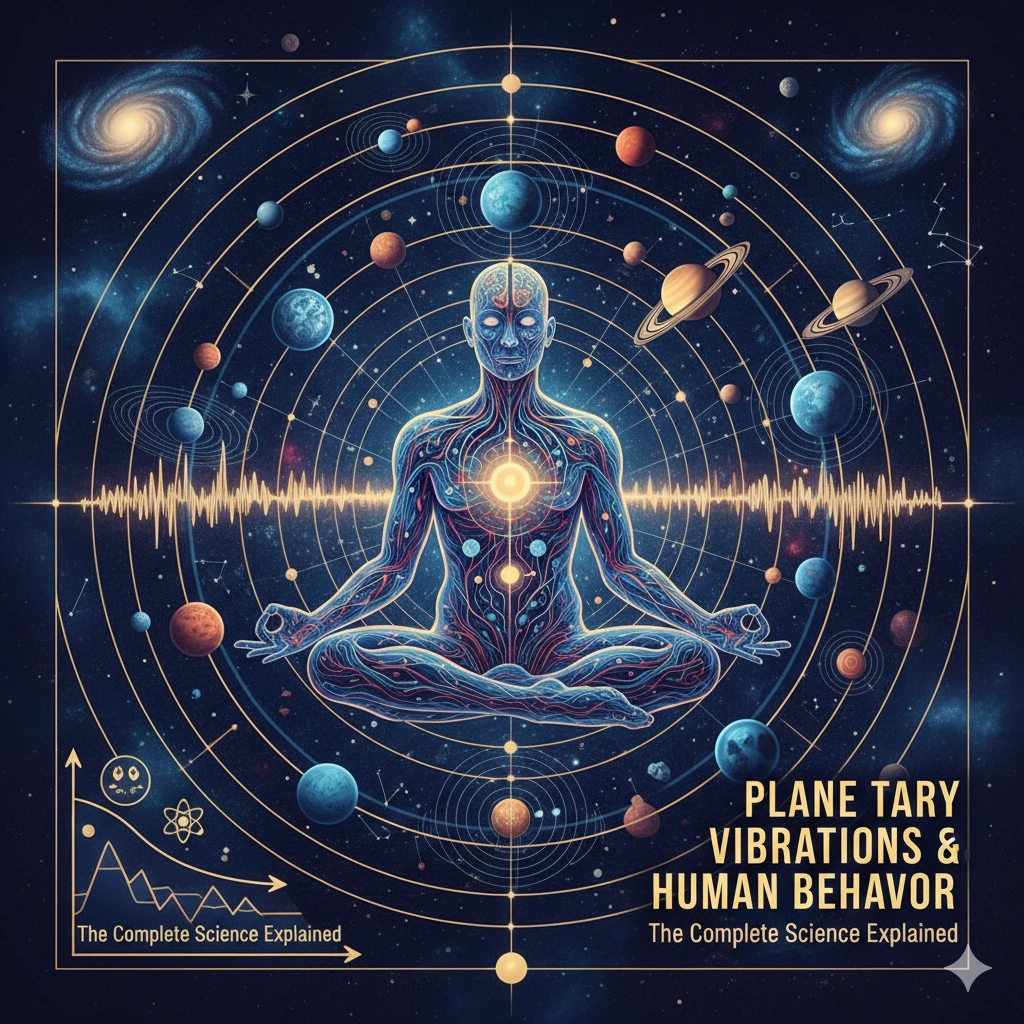
Planetary Vibrations and Human Behavior The Complete Science Explained

Planetary Vibrations have fascinated thinkers scientists mystics and astrologers for centuries. The idea that cosmic waves from planets can influence the inner landscape of human behavior emotions personality and destiny may sound mystical but when studied deeply it is a blend of astronomy psychology energy science and ancient Vedic knowledge. Understanding Planetary Vibrations is not about blind belief. It is about recognizing how the universe communicates through energy patterns and how the human mind and body receive and respond to those signals.

In this extensive guide we will explore the science behind Planetary Vibrations the reason they affect human behavior the evidence that supports this connection and how you can align yourself with these cosmic energies to lead a balanced empowered and meaningful life. The goal is not to overwhelm but to bring clarity to a topic that has often been misunderstood. By the end of this blog you will have a deep and logical understanding of how Planetary Vibrations play an active role in shaping the mental emotional and behavioral patterns of human beings.

Table of Contents

What Are Planetary Vibrations A Complete Breakdown

Planetary Vibrations are energy frequencies emitted by the planetary bodies of our solar system. Every planet is in constant motion and every planet carries its own electromagnetic field gravitational signature and cosmic radiation. These forces are subtle but powerful. They travel across space and interact with Earth and with every living organism on it including human beings.

To understand Planetary Vibrations we must look at three scientific pillars:

1. Electromagnetic Frequencies

Planets like the Sun Jupiter and Saturn emit strong electromagnetic waves. These waves move through the solar system and influence Earth’s magnetic field. Human brain waves are also electromagnetic. This creates a natural resonance between cosmic waves and human neurological activity.

2. Gravitational Pull

Every planet exerts gravity. Even though their gravitational pull on humans is small compared to Earth it still contributes to environmental rhythms similar to how the Moon influences tides. Humans being made of more than seventy percent water are also sensitive to gravitational rhythms.

3. Cosmic Radiation

Planets absorb and reflect solar radiation which reaches Earth in varying degrees. Radiation interacts with human DNA circadian rhythm and hormonal balance. Even tiny variations can produce noticeable behavioral changes.All these combined form what ancient Vedic astrologers classified as graha vibrations or Planetary Vibrations.

Why Planetary Vibrations Influence Human Behavior The Science Explained

Planetary Vibrations influence human behavior because humans are energetic beings. The mind the emotions and even the physical body operate on frequency. The universe operates on frequency. When the frequency of a planet interacts with the frequency of a human being it produces measurable and sometimes predictable behavioral outcomes.

Let us explore the key scientific reasons behind this interaction.

Planetary Vibrations and the Human Brain

The human brain functions through electrical impulses. These impulses generate waves such as alpha beta theta and delta waves. Planets also emit electrical and magnetic waves. When two waves interact they either synchronize amplify or disturb each other.

For example

  • The Sun enhances energy confidence discipline and vitality through solar radiation
  • The Moon impacts emotional balance memory and sensitivity through tidal frequency interaction
  • Saturn’s slow vibration affects patience responsibility stability and karmic learning
  • Jupiter expands optimism wisdom and growth patterns through its large magnetic field

Human behavior is not random. It is a direct response to internal and external frequencies.

Planetary Vibrations and Hormonal Influence

Hormones regulate behavior. Cosmic radiation influences hormone secretion particularly

  • Melatonin
  • Serotonin
  • Cortisol
  • Dopamine

If a planet’s vibration triggers a hormonal rise or fall it automatically alters thought patterns behavior decisions and reactions.

For example

  • Lunar days often elevate emotional sensitivity due to melatonin fluctuations
  • Solar flares can temporarily increase aggression or irritability due to cortisol spikes

Ancient astrologers understood this long before modern science.

Planetary Vibrations and DNA Response

Research shows that DNA behaves like an antenna that receives and transmits energy. Cosmic vibrations can cause micro changes in DNA folding patterns. Though small these changes influence how a person reacts to stress love conflict opportunity and life events.

Your temperament is not only genetic. It is cosmic.

Click Here To Book Appointment With Acharya Sakshi Sanjeev Thakur

How Ancient Civilizations Understood Planetary Vibrations

Planetary Vibrations are not a new concept. Several civilizations studied them deeply.

1. Vedic Astrology

The Vedic texts describe nine planets known as Navagraha which emit specific vibrations. These vibrations were correlated with personality traits life events karma and psychological tendencies.

2. Greek Astrology

Greek philosophers believed that planets represent archetypal forces that govern human nature.

3. Egyptian Astronomy

Egyptians aligned temples with planetary movements believing that cosmic energy enhances human consciousness.

4. Chinese Astrology

Chinese metaphysics connects planets to five elements and each element influences human emotions and behavior.

Across continents the message was the same
Planets influence people because humans are part of the same energetic universe.

Planetary Vibrations and Personality Traits

Planetary Vibrations are not just momentary influences. They shape deeper aspects of personality. Let us explore each major planetary vibration and its behavioral connection.

Sun Vibration

Represents

  • Identity
  • Power
  • Vitality
  • Confidence

People strongly influenced by solar vibrations tend to be

  • Ambitious
  • Leadership focused
  • Purpose driven

The sun vibration strengthens willpower and determination.

Moon Vibration

Represents

  • Emotional intelligence
  • Sensitivity
  • Memory
  • Intuition

Individuals influenced by lunar vibrations experience

  • Mood cycles
  • Deep empathy
  • Strong imagination

The moon vibration governs feelings and emotional patterns.

Mercury Vibration

Controls

  • Logic
  • Communication
  • Insight
  • Analytical thinking

A strong Mercury vibration leads to

  • Quick decision making
  • Sharp memory
  • Strong business intelligence
Venus Vibration

Represents

  • Love
  • Beauty
  • Relationships
  • Creativity

People influenced strongly by Venus vibration are

  • Artistic
  • Harmonious
  • Emotionally expressive
Mars Vibration

Represents

  • Energy
  • Passion
  • Assertiveness
  • Drive

Strong Mars vibration creates

  • Courage
  • Determination
  • Competitive behavior
Jupiter Vibration

Represents

  • Wisdom
  • Learning
  • Spiritual growth
  • Prosperity

Individuals with strong Jupiter vibrations become

  • Teachers
  • Advisors
  • Visionaries
Saturn Vibration

Represents

  • Discipline
  • Hard work
  • Structure
  • Karma

Saturn vibration shapes

  • Responsibility
  • Realism
  • Practicality
Rahu and Ketu Vibrations

These shadow planets influence

  • Obsession
  • Breakthroughs
  • Intuition
  • Spiritual transformation

Rahu vibration gives ambition and futuristic thinking while Ketu vibration opens spiritual doors.

Planetary Vibrations and Human Emotions

Your emotional response system is strongly shaped by cosmic frequency waves. Each planet has emotional signatures.

Sun creates enthusiasm
Moon creates sensitivity
Mercury creates clarity
Venus creates affection
Mars creates intensity
Jupiter creates optimism
Saturn creates seriousness
Rahu creates excitement
Ketu creates detachment

These emotional indicators help astrologers predict how an individual might react to different events in life.

Learn About Astrology With Acharya Sakshi Sanjeev Thakur

Planetary Vibrations and Life Events

Certain planetary alignments trigger specific human experiences.

Career growth is often connected to Sun Mars and Jupiter vibrations.
Relationships are strongly influenced by Venus and Moon vibrations.
Challenges and blockages are shaped by Saturn Rahu and sometimes Mars vibrations.
Spiritual breakthroughs are connected to Ketu and Jupiter vibrations.

These influences are not coincidences. They are vibrational interactions.

Scientific Evidence Supporting Planetary Vibrations Influence

Although astrology is often viewed as spiritual numerous scientific fields support the theory.

  1. Quantum physics
    states everything is energy and everything vibrates.
  2. Neuroscience
    confirms brainwaves are influenced by electromagnetic fields.
  3. Astronomy
    proves planets emit unique frequencies.
  4. Chronobiology
    shows cosmic rhythms regulate human biological clocks.
  5. Epigenetics
    shows environmental energy alters gene expression.

Modern science is catching up with what ancient sages already knew.

How to Align Yourself with Planetary Vibrations

Alignment means adjusting your personal frequency to match beneficial planetary frequencies and neutralizing the negative ones. You can align with Planetary Vibrations through various methods.

1. Meditation

Meditation stabilizes brain waves making you more receptive to positive vibrations.

2. Mantras

Mantras produce sound frequencies that resonate with specific planetary vibrations.

3. Colors and Gemstones

Every planet vibrates with a color and gemstone. Wearing them creates resonance.

4. Lifestyle Choices

Eating habits sleeping patterns and work discipline align you with specific planets.

5. Cosmic Awareness

Simply being aware of planetary transitions can help you prepare emotionally and mentally.

Planetary Vibrations and Spiritual Growth

Planetary Vibrations are not only about behavior or daily events. They guide the soul through its karmic lessons.

  • Jupiter expands consciousness
  • Saturn teaches discipline
  • Ketu dissolves illusion
  • Rahu pushes for evolution

Spiritual growth becomes easier when you understand these forces rather than resisting them.

The Future of Planetary Research

As scientific instruments become more advanced we will soon be able to measure subtle cosmic frequencies more accurately. This will help merge astrology and science into one unified system of cosmic psychology.

Topics currently being researched

  • Interplanetary magnetic field effects on mental health
  • Cosmic energy impact on collective consciousness
  • Solar cycles and emotional cycles
  • Brainwave synchronization with planetary frequencies

The future of humanity is cosmic.

Conclusion The Human Life is a Symphony of Planetary Vibrations

Planetary Vibrations are not superstition. They are a universal reality woven into the fabric of life. Humans are receivers and transmitters of energy. Planets are cosmic broadcasters. When their frequencies meet they produce patterns which manifest as personality traits emotions thoughts decisions events and spiritual evolution.

The more we understand these vibrations the more we understand ourselves. The more we align with cosmic energy the more balanced peaceful and purposeful our life becomes.You are not separate from the universe.
You are part of its rhythm.
You are a living expression of Planetary Vibrations.

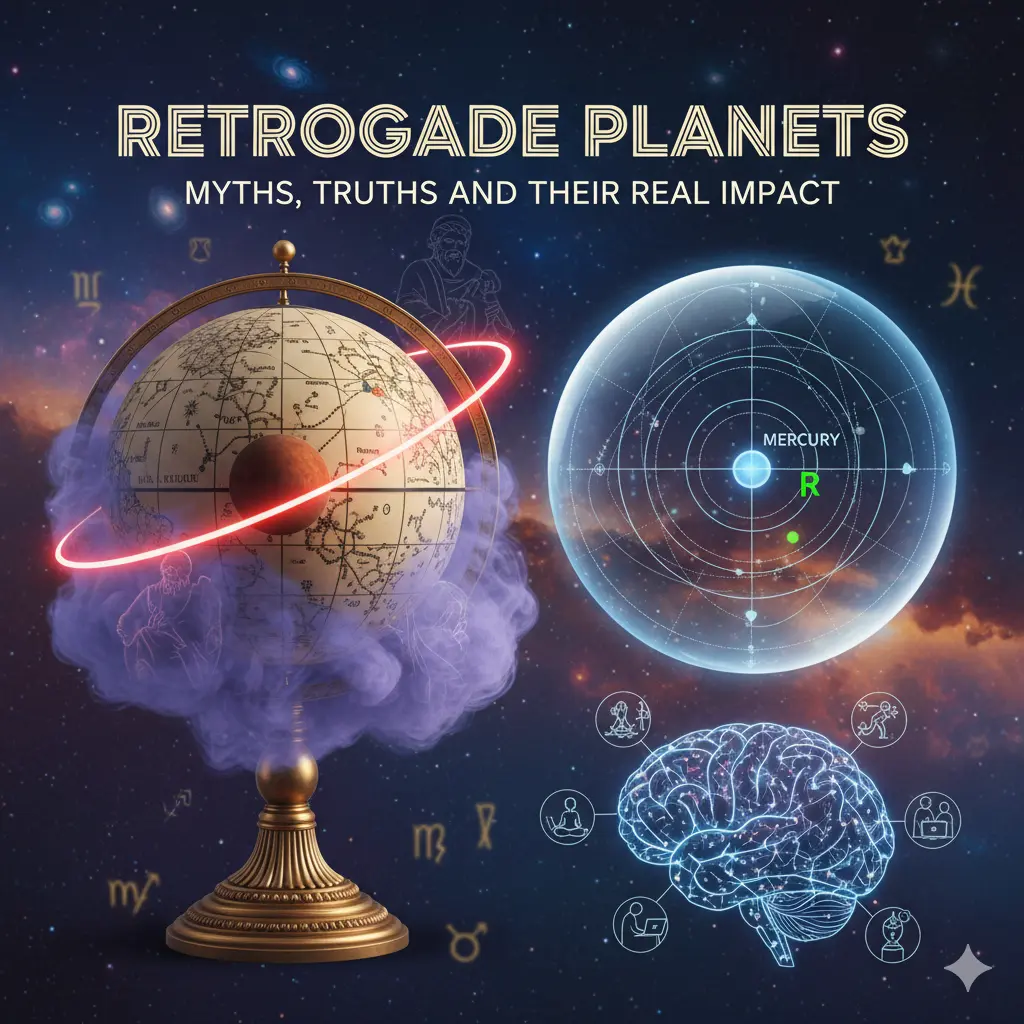
Retrograde Planets: Myths, Truths, and Their Real Impact

Retrograde Planets have fascinated and perplexed people for centuries. The term retrograde often invokes fear or caution among astrology enthusiasts and casual observers alike. Understanding Retrograde Planets is crucial for anyone who wants to explore astrology with clarity. Many myths surround these celestial movements, and while some truths are scientifically grounded, others are symbolic and influence personal experiences through planetary energies. This blog aims to explore Retrograde Planets myths truths and their real impact on different aspects of life.

What Are Retrograde Planets

Retrograde Planets occur when a planet appears to move backward in the sky from our perspective on Earth. This optical illusion happens due to the relative positions and speeds of Earth and the other planets in their orbits around the Sun. Retrograde motion does not mean a planet physically reverses its orbit; it is a perspective-based phenomenon.

The concept of Retrograde Planets is deeply rooted in astrology. In Vedic astrology as well as Western astrology, retrograde periods are thought to influence human behavior, decision-making, and experiences. People often associate retrogrades with obstacles or delays, but this interpretation is only a partial truth. Understanding Retrograde Planets requires looking beyond myths and exploring their symbolic significance and planetary influence on our lives.

Common Myths About Retrograde Planets

Retrograde Planets Only Bring Bad Luck

One of the most pervasive myths about Retrograde Planets is that they are harbingers of misfortune. Many believe that during Mercury Retrograde or any other retrograde period, all aspects of life are negatively affected. This belief is misleading. While Retrograde Planets can bring challenges or delays, they also offer opportunities for reflection, introspection, and realignment.

Retrograde Planets Affect Everyone the Same Way

Another myth suggests that Retrograde Planets influence everyone uniformly. In reality, the impact of retrograde periods varies depending on individual birth charts, planetary positions, and current planetary transits. What may feel like a disruption for one person could be a time of growth and progress for another. Astrology emphasizes personalized interpretation rather than blanket predictions.

Retrograde Planets Stop Progress

Many fear that Retrograde Planets completely halt progress. However, retrogrades are periods that encourage reassessment rather than cessation. These periods allow individuals to revisit past decisions, reconsider their paths, and make more informed choices. Retrograde Planets offer a chance to slow down, evaluate priorities, and correct course where needed.

The Truth Behind Retrograde Planets

Retrograde Planets as Opportunities

The truth about Retrograde Planets is that they create opportunities for inner growth. Retrogrades prompt introspection, encouraging individuals to examine unresolved issues and unfinished projects. For example, Mercury Retrograde is often associated with communication review, reflecting on past conversations, and re-evaluating agreements. Similarly, Venus Retrograde provides a chance to reassess relationships, self-love, and creative pursuits.

Retrograde Planets Influence Personal Reflection

Retrograde Planets are best understood as catalysts for reflection rather than external chaos. They bring attention to aspects of life that require healing or adjustment. Mars Retrograde may trigger a review of personal ambitions, while Saturn Retrograde encourages examination of responsibilities and long-term goals. Recognizing the reflective nature of Retrograde Planets helps reduce anxiety and builds a proactive approach to astrology.

Retrograde Planets and Time Perception

Retrograde Planets also impact how we perceive time and progress. During retrogrades, events may seem delayed or misaligned, but these moments often provide clarity that prevents future mistakes. By revisiting the past and evaluating patterns, individuals gain a better understanding of their life journey and how to navigate challenges more effectively.

Click Here To Learn Astrology Online

The Real Impact of Retrograde Planets on Life

Retrograde Planets and Relationships

Retrograde Planets can significantly affect relationships, both romantic and professional. Venus Retrograde often prompts a re-evaluation of personal relationships, highlighting unresolved issues and emotional needs. Partners may revisit old conflicts, fostering opportunities for resolution and deeper understanding. Similarly, Mercury Retrograde can lead to miscommunication, but it also offers chances to correct misunderstandings and strengthen bonds.

Retrograde Planets and Career Decisions

In the professional realm, Retrograde Planets influence career decisions and work dynamics. Mercury Retrograde may create delays in communication or project timelines, but it encourages meticulous review and attention to detail. Saturn Retrograde provides a period to reflect on long-term career goals and responsibilities, ensuring that choices align with personal growth and stability. Retrograde Planets highlight areas where patience and strategy are essential.

Retrograde Planets and Personal Growth

The impact of Retrograde Planets extends to personal growth and spiritual development. Jupiter Retrograde encourages introspection on beliefs, values, and life philosophy. Individuals may reassess their ambitions, educational pursuits, or moral compass during this period. Similarly, Neptune Retrograde promotes spiritual awareness, helping people distinguish between illusions and reality. Retrograde periods facilitate learning and self-improvement rather than causing mere obstacles.

Retrograde Planets and Financial Decisions

Financial matters are also influenced by Retrograde Planets. Mercury Retrograde may cause delays in contracts, negotiations, or investments, but it provides an opportunity to double-check details and avoid costly mistakes. Jupiter Retrograde can trigger reflection on financial planning, spending habits, and long-term wealth strategies. Recognizing these periods as opportunities for careful assessment ensures that financial decisions are more informed and resilient.

Retrograde Planets and Zodiac Signs

Different zodiac signs experience Retrograde Planets uniquely, based on their inherent traits and planetary affinities.

Aries: Aries, being action-oriented, may feel frustrated during Mars Retrograde. The retrograde encourages patience and careful planning rather than impulsive action.
Taurus: Taurus experiences Venus Retrograde deeply, affecting love, aesthetics, and values. Reflection on relationships and personal desires becomes central.
Gemini: Mercury Retrograde, ruling Gemini, can impact communication and mental clarity. This is an ideal period to revisit ideas and projects rather than launch new ones.
Cancer: Retrograde Planets highlight emotional introspection for Cancer. Past experiences and family matters may surface, offering a chance to heal old wounds.
Leo: Leos may feel the influence of Retrograde Planets on creativity and self-expression. Revisiting unfinished creative projects can be highly rewarding.
Virgo: Virgos experience Mercury Retrograde intensely, as it rules their sign. Attention to detail, planning, and analytical review becomes essential during this period.
Libra: Venus Retrograde affects relationships and partnerships for Libra. Reflection on balance, harmony, and social connections takes precedence.
Scorpio: Pluto Retrograde prompts deep transformation for Scorpio. Revisiting past challenges allows growth and empowerment.
Sagittarius: Jupiter Retrograde encourages Sagittarians to reassess life goals, philosophical beliefs, and higher learning pursuits.
Capricorn: Saturn Retrograde prompts Capricorns to evaluate career, responsibility, and long-term structures in life.
Aquarius: Uranus Retrograde can trigger sudden insights and unconventional approaches. Reflection on change and innovation is emphasized.
Pisces: Neptune Retrograde encourages Pisces to confront illusions and seek spiritual clarity. Dreams, intuition, and creative expression are highlighted.
Click Here To Book Appointment With Acharya Sakshi Sanjeev Thakur

Tips to Navigate Retrograde Planets

Understanding how to navigate Retrograde Planets can reduce stress and maximize their positive impact.

  1. Review Past Decisions
  2. Reassess Relationships and Communication
  3. Avoid Major Launches During Mercury Retrograde
  4. Embrace Reflection and Introspection
  5. Be Patient and Flexible

By embracing these practices, Retrograde Planets can become catalysts for growth rather than sources of anxiety.

Conclusion

Retrograde Planets are often misunderstood due to myths and fear-based interpretations. The truth is that Retrograde Planets provide a unique opportunity for reflection, reassessment, and personal growth. They influence relationships, career, finances, and spiritual development in meaningful ways. Rather than fearing Retrograde Planets, one should embrace their lessons and recognize their real impact on life. By understanding the myths, truths, and practical implications of Retrograde Planets, individuals can navigate life more consciously and make informed decisions aligned with cosmic energies.

Retrograde Planets are not obstacles; they are opportunities in disguise. Their influence on personal growth, decision-making, and reflection offers a deeper understanding of life and the universe. By acknowledging Retrograde Planets and their planetary influence, one can unlock insights, strengthen relationships, and make strategic choices for long-term success.

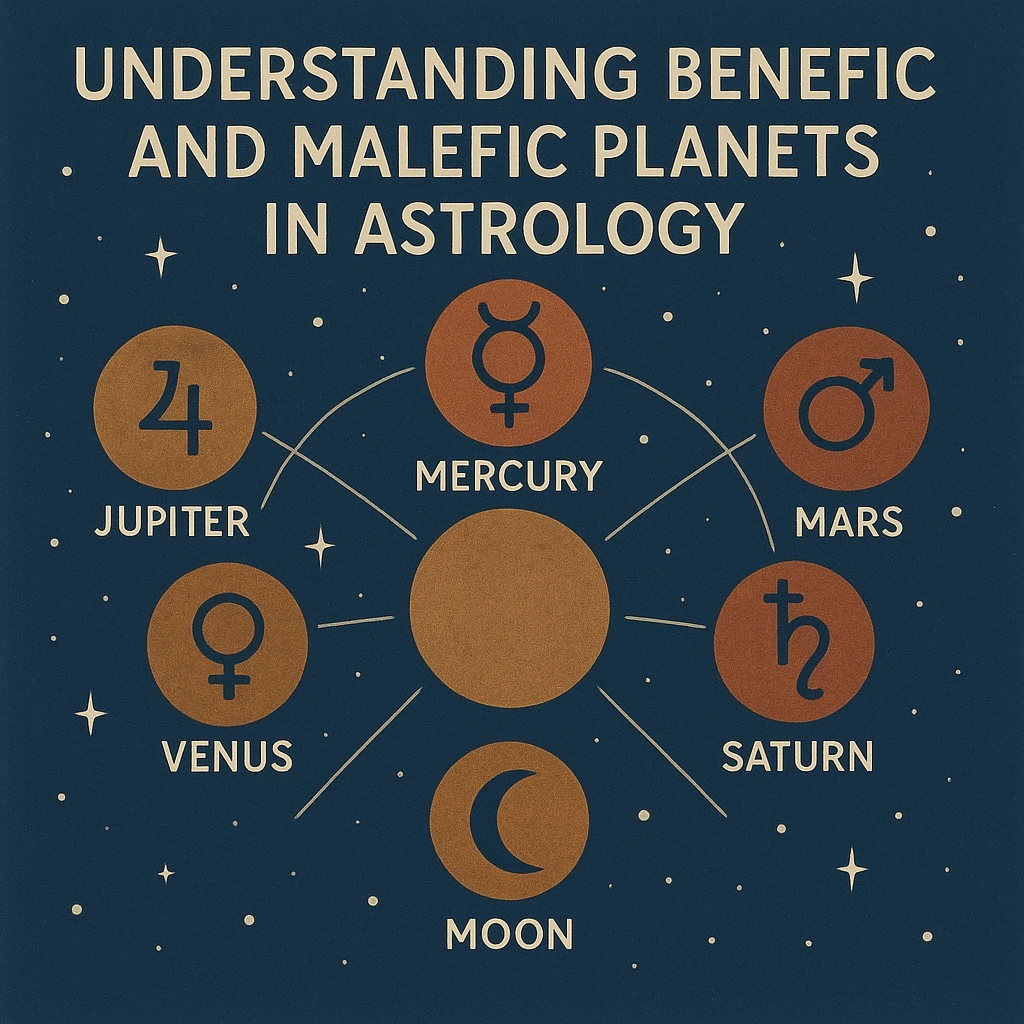
Understanding Benefic and Malefic Planets in Astrology

In astrology the term benefic and malefic planets carries deep meaning for how celestial bodies influence our lives. When we talk about benefit, growth, ease and harmony we are pointing to benefic planets. When we confront challenge, limitation, struggle and transformation we are referring to malefic planets. Understanding benefic and malefic planets gives you a richer view of your natal chart, transits, and the patterns that shape your journey. In this article we will explore what these terms mean, how they are defined in classical and Vedic astrology, the key planets involved, how they act in your chart, and how you can work with their energies consciously.

What Are Benefic and Malefic Planets

The classification of planets into benefic and malefic is rooted in traditional astrological thought. According to the article “What are Benefic and Malefic Planets in Astrology?” the benefic planets are those whose influences are generally positive or easeful in nature whereas the malefic planets bring difficult, challenging or transformative energies.

Essentially:

  • Benefic planets support growth, harmony, blessing, expansion.
  • Malefic planets provoke challenge, restriction, difficulty, transformation.
    However it is crucial to note that benefic does not always mean entirely trouble-free, and malefic does not always mean purely negative. Much depends on placement, aspects, chart context. For instance even a traditionally benefic planet can underperform if afflicted; a malefic planet placed well can channel its energy into constructive growth.

In many traditions, the benefic and malefic classification helps astrologers quickly sense the tone of a planet’s influence in a chart. But it is never the whole story.

Why This Classification Matters

Understanding benefic and malefic planets matters for several reasons:

  1. Chart interpretation: It gives you a shorthand for what a planet tends to offer naturally. If a planet is a natural benefic and well-placed you may expect more ease in the area it governs; if a planet is a natural malefic and poorly placed you may anticipate learning through difficulty.
  2. Transit and progression work: When a malefic planet is transiting a key point in your chart you might brace for a testing period, whereas a benefic transit may bring opportunity or ease.
  3. Remedial & awareness work: Knowing which planets in your chart lean benefic or malefic helps you understand where you might be gifted or where you might face lessons and thus apply awareness, work, or remedial techniques accordingly.
  4. Holistic growth: Rather than simply hoping for “good” planets, this framework invites you to embrace both benefic and malefic influences as parts of growth. As one commentary puts it: benefic planets invite love, joy, abundance; malefic planets invite us to face fears, overcome obstacles and evolve.

Thus the concept is less about “good versus bad” and more about the nature of influence: ease and expansion vs. challenge and transformation.

The Natural Benefic Planets

Let’s look in detail at the planets traditionally considered benefic.

Jupiter, The Greater Benefic

Jupiter is often called the “Greater Benefic” in classical astrology. It represents growth, expansion, optimism, wisdom, faith and generosity. When Jupiter is well placed and well aspected in a chart, you tend to see areas of expansion, long-term growth, blessing, and a sense of purpose. According to one source Jupiter supports your good practices and appears where you can learn, grow and expand.

Yet even Jupiter has its cautions: if over-emphasised, it can expand problems as well as blessings.

Venus, The Lesser Benefic

Venus is traditionally the “Lesser Benefic”. It governs love, harmony, relationships, beauty, art, comfort and balance. When Venus is positively conditioned you may find ease in relationships, aesthetics, social-interaction, pleasure and creative expression. One article notes Venus makes life more enjoyable and motivates seeking pleasure.

Other Potential Benefics (Luminaries)

While Jupiter and Venus are the main benefics in many systems, luminaries like the Sun and the Moon can also display benefic qualities depending on condition. For example, the Moon when waxing is considered more benefic in some Vedic charts.

The Natural Malefic Planets

Turning now to the traditional malefic planets.

Saturn, The Greater Malefic

Saturn is known as the “Greater Malefic”. It brings discipline, limitation, delay, structure, responsibility, endurance. In one description: Saturn’s cold and constrictive energy represents obstacles, endings, discipline and long-term growth through challenge.

That does not mean Saturn is “bad”, its lessons are often the most lasting and constructive if embraced.

Mars, The Lesser Malefic

Mars is the “Lesser Malefic” in many traditions. It brings assertiveness, conflict, fire, drive, war-energy, impulsiveness. When positively placed, Mars gives courage and action; when afflicted, it can bring aggression or accidents. One source notes its dryness and heat are destructive to growth if uncontrolled.

Neutral or Variable Planets

Planets like Mercury (communication, intellect) may act as benefic or malefic depending on situation. Outer planets like Uranus, Neptune, Pluto are treated differently in modern astrology and may not consistently fall into classical benefic/malefic categories.

Key Factors That Modify the Influence

The classification of benefic vs malefic is foundational but it is by no means deterministic. Several factors modify how a planet actually expresses in a chart. Let us examine these.

Sign Placement, Strength & Exaltation/Debility

Where a planet resides (which zodiac sign, its exaltation or debility status) affects its strength and expression. A normally malefic planet in exaltation may act more constructively. A normally benefic planet in debility may struggle. For example: “well-placed malefics can produce constructive outcomes; poorly conditioned benefics may underperform.”

House Placement and Chart Context

In Vedic astrology especially the house lordship, sign lordship, house position, and aspects matter greatly. A planet may rule a troublesome house and thus act as an “accidental malefic” even if naturally benefic. One resource notes: “lords of third, sixth, eleventh tend to give malefic results irrespective of natural nature.”

Aspects, Conjunctions & Conditions

A planet’s effect is mediated by which planets it is conjunct, which aspects it receives, and its dignity in divisional charts (like navamsa). For instance if Jupiter is afflicted by Saturn or Mars it may not behave as pure benefic. Texts remark that even benefic planets can lose much of their beneficence if they occupy ‘cruel’ subdivisions or afflictions.

Sect, Day/Night Chart & Timing

Classical astrology emphasises sect (day vs night births) in determining influence of planets. One article says: “In diurnal charts Jupiter stronger benefic; in nocturnal charts Venus becomes stronger benefic; likewise Mars vs Saturn in varying roles.”

Transits and Active Periods (Dashas)

The timing of when a planet’s natal or transit position becomes active (for example via dashas in Vedic astrology) matter. A malefic transit may trigger lessons, endpoints, restructuring. A benefic transit may usher in ease and opportunity. Recognising these phases helps one align consciously rather than be taken by surprise.

How to Interpret Benefic and Malefic Planets in a Chart

Here is a structured approach you can follow when you see a planet in the natal chart and ask “Is this benefic or malefic?” or “How will this planet behave for this person?”

  1. Identify the planet’s natural nature,  Is it traditionally benefic (Jupiter, Venus) or malefic (Saturn, Mars)?
  2. Check placement, Which house and sign is it in? Is that sign one of the planet’s own, exalted, friendly or enemy?
  3. Check lordship, Does the planet rule any key houses (especially 1,4,7,10 or trines and quadrants)? Does its house lordship alter its natural nature (accidental benefic or malefic)?
  4. Check aspects/conjunctions, Are there benefic or malefic aspects influencing it? Is it under affliction?
  5. Check divisional charts (for Vedic astrology), Where is it in navamsa or other vargas?
  6. Check timing/transit factors, Is the planet going through a dasha, transit, retrograde phase, etc? What is the sect of the birth chart?
  7. Frame the expected influence, Rather than simply positive or negative, ask: What lessons or gifts is this planet likely to bring for this person? If benefic, how might it shine? If malefic, how might it challenge and also teach?

As one commentary put it: the benefic and malefic planets each have roles, benefics invite love, joy, abundance; malefics challenge us to face fears, overcome obstacles and evolve.

Examples of Benefic and Malefic Planet Influences

Let’s work through some hypotheticals to make the idea concrete.

  • Suppose Venus (a natural benefic) is placed in Libra in the 7th house within a harmonious aspect to Jupiter. That suggests ease in relationships, social harmony, artistic gifts, a largely benefic result.
  • Conversely if Venus is debilitated or conjunct Saturn in the 12th house with hard aspects, it may struggle; the benefic nature is constrained and the person may face lessons around love and value.
  • Suppose Mars (a natural malefic) is placed in Aries in the 1st house with supporting aspects. While Mars is malefic by nature, in this case it may produce courage, initiative and assertiveness rather than pure adversity.
  • Suppose Saturn is placed in the 4th house of home and comfort but is well-exalted, the person may face early hardship but eventually develop deep stability and maturity.

In another scenario a normally benefic planet like Jupiter rules the 8th house (death, transformation) for a given ascendant. That makes Jupiter an “accidental malefic” for that chart, because of the nature of the house it rules. As one reddit commenter summarised:
“Mars and Saturn by nature are malefics. Jupiter and Venus by nature are benefics … Mercury, Moon, and Sun are neither naturally one or another but can be benefic or malefic depending on other factors.”

The Role of Benefic and Malefic Planets in Various Schools of Astrology

Western Astrology

In Western astrology the idea of benefic and malefic planets still appears, though modern practitioners may emphasise psychological growth rather than strictly “good/bad” labels. As one article puts it: “planets are also assigned to two groups in many types of astrology: benefic and malefic planets.”

Vedic Astrology (Jyotish)

In Vedic astrology the benefic vs malefic distinction is more formalised. Many classical texts specify natural benefics, natural malefics, neutral planets and how they operate according to ascendant, house lordships, dashas, etc. One site summarises: “In Vedic astrology planets behave as benefics and malefics based on the houses they own … broad classification of planets in terms of their nature has also been mentioned in our ancient astrology texts.”

Traditional/Classical Astrology

Ancient astrologers like Claudius Ptolemy in the Tetrabiblos grounded this classification in elemental theory, stating that planets with “hot and moist” humours were more benefic (Jupiter and Venus) and those with “dry and cold” humours were more malefic (Mars and Saturn).

Practical Tips for Working with Benefic and Malefic Planets

Here are some actionable suggestions for how to engage with the energies of benefic and malefic planets in your chart.

For Benefic Planets:

  • Recognise and amplify their strengths: If Jupiter is well-placed, lean into growth opportunities, learning, travel, faith and expansion.
  • Don’t take their ease for granted: Even benefics can underperform if neglected or afflicted. Check their condition.
  • Be mindful of over-indulgence: Benefic planets can expand problems as well as blessings if unchecked (e.g., Jupiter’s “too much” side).
  • Use rem­edies or practices where relevant: Some Vedic traditions may suggest strengthening a benefic planet via mantra, charity, or offering when it is weak.

For Malefic Planets:

  • Don’t fear them: Malefics are not “evil”, they often usher in important growth and maturity through challenge.
  • Reframe the narrative: When Mars or Saturn is active, ask “What lesson is being offered? What do I need to master?” rather than simply worrying.
  • Build resilience: Use the energies of malefics for transformation, discipline, and long-term stability rather than avoidance.
  • Apply remedial work if desired: If a malefic is heavily afflicted in your chart (in Jyotish context) you might explore mantra, gem remedies, careful timing of decision-making etc.

Balanced Approach:

  • View the benefic-malefic classification as a tool not a verdict. It gives orientation, but the full context matters.
  • Always read the planet in its chart: Consider sign, house, lordship, aspects, chart sect, timing.
  • Integrate both sides: A “perfectly benefic” chart is rare; most lives involve a mix of ease and challenge and it is the integration of both that fosters growth.
  • Keep the long term in view: Malefics may feel heavy in the moment but yield lasting strength; benefics may feel light now but require grounding for sustained benefit.

Common Myths and Misunderstandings

Here are some myths around benefic and malefic planets and clarifications.

Myth: Benefic means always good and malefic always bad

Clarification: While benefic planets tend toward positive influence, they can still underperform or create issues if afflicted. Malefic planets can cause hardship but also may build character, resilience and structure. One site states: “Other planets … are considered malefic or benefic depending on where they show up” which emphasises nuance.

Myth: A malefic planet means doom in your life

Clarification: A malefic planet may signal challenge, but also the possibility of transformation, growth and maturity. The key is how you respond to its activation. A well-placed Saturn may help build long-term success rather than just suffering.

Myth: Only natural benefics are good in every situation

Clarification: Even natural benefics can become accidental malefics depending on house lordship and placement. For example, Jupiter ruling 8th house may behave more like a malefic in that context.

Myth: Modern astrology ignores benefic and malefic classification

Clarification: While some modern astrologers emphasise psychological symbolism over the older good/bad labels, the concept remains widely used, especially in Vedic and traditional Western astrology.

Click Here To Learn About Astrology From Acharya Sakshi Sanjeev Thakur

How to Use This Knowledge in Your Own Chart

Here is a step-by-step process you can use to apply the concept of benefic and malefic planets in your own natal chart or when doing a reading for someone else.

  1. List the planets in the natal chart and note each one’s sign and house.
  2. Mark which are natural benefics (Jupiter, Venus) and natural malefics (Saturn, Mars).
  3. For each planet ask:
    • What sign and house is it in?
    • Which houses does it rule (lordship)?
    • What aspects or conjunctions are present?
    • What is its strength (own sign, exalted, friendly sign, debilitated, enemy sign)?
    • Is this chart a day-birth or night-birth (sect) and how might that matter?
  4. Classify the planet’s likely influence:
    • If benefic and well-placed → expect gift, expand, ease.
    • If benefic but afflicted → gift exists but may be delayed or require effort.
    • If malefic and poorly placed → challenge, restructuring, transformation needed.
    • If malefic but well placed → potential to channel difficult energy into productive growth.
  5. Consider timing: Which planetary periods (dashas), transits, progressions are active? A malefic transit may feel heavy now but is part of a longer growth process.
  6. Frame advice or strategy: If a benefic planet is active, lean into opportunities, growth, expansion. If a malefic is active, lean into discipline, restructure, awareness of challenge, use caution.
  7. Remedial & conscious work: Use tools such as journaling, meditation, ritual, intention-setting, how to work with the planet rather than fight it. Accept the nature of its influence and ask “How can I use this energy in service of growth?”

Case Study: Putting It All Together

Let us walk through a hypothetical person: Suppose in someone’s chart the usual benefic planet Jupiter rules the 4th house, is placed in Sagittarius in the 10th house, with a trine aspect to Venus. Meanwhile Mars (a usual malefic) is placed in Gemini in the 7th house, conjunct Rahu (the North Node) and afflicted by Saturn.

Jupiter scenario
  • Jupiter is natural benefic, ruling 4th house (home, comfort), placed in its own sign (Sagittarius) in the 10th (career) with smooth aspect to Venus. Good placement.
  • Interpretation: The person can expect growth through home, public reputation, nurturing career that connects with inner values. Jupiter’s benefic nature expresses well here.
  • Strategy: Lean into expansion in public life, perhaps teaching, travel, philosophy, building a home or public platform aligned with values.
Mars scenario
  • Mars is a malefic, placed in the 7th house (relationships) in Gemini, conjunct Rahu (makes it more intense) and afflicted by Saturn (restriction, delay). Challenging placement.
  • Interpretation: The person may face conflicts, impulsiveness, or energetic relationship dynamics. Mars in 7th may trigger partnerships marked by assertiveness or battles. Its malefic nature emphasises challenge.
  • Strategy: Focus on conscious channeling of Mars energy: sports, assertive but fair communication, relationship awareness, avoid impulsiveness, cultivate patience and discipline (Saturn’s lesson). Use this phase to build constructive relational skills.
Balanced reading

Even though Mars is malefic and has a difficult position, the presence of the conjunction and Saturn affliction suggests an opportunity: to learn how to assert self in partnership in a mature way. The malefic energy becomes growth-fuel. Jupiter meanwhile gives a positive anchor: the person has a strong growth path in career/public life that may help buffer relational turbulence.

Thus the benefic and malefic planet classification informs both strengths and challenges, and how to work with them.

Click Here To Book Appointment With Acharya Sakshi Sanjeev Thakur

The Spiritual Dimension of Benefic and Malefic Planets

Beyond day-to-day events, benefic and malefic planets also carry deeper spiritual lessons.

  • Benefic planets invite us to open, expand, trust, love, grow. They help us access our potential, align with purpose, feel abundant.
  • Malefic planets invite us to face shadow, discipline, confront limitation, accept impermanence, build resilience. They often lead to inner growth, spiritual maturity, transformation. One commentary states:
    “Benefic planets invite us to embrace love, joy, and abundance while malefic planets challenge us to face our fears, overcome obstacles, and evolve.”

In this sense one can see life as the play of benefic and malefic energies. Neither is “bad” in the ultimate sense; both are part of the soul’s journey. A malefic planet might push you into discomfort, but that discomfort often precipitates a breakthrough. A benefic planet might support you, but the real value comes when you consciously steward that ease rather than take it for granted.

Summary and Final Thoughts

The concept of benefic and malefic planets offers a powerful lens through which to view astrological influences. By recognising which planets tend naturally toward ease and which toward challenge, and by examining placement, aspects, timing and context, you gain richer insight into a chart. Rather than simply categorising planets as “good/bad”, the focus is on how each planet’s energy is expressed in your life and how you can work with it.

Key take-aways:

  • Benefic planets: Jupiter, Venus (and some luminaries in favourable condition), growth, harmony, ease.
  • Malefic planets: Saturn, Mars, challenge, discipline, transformation.
  • Condition matters: sign, house, aspects, strength, lordship all affect expression.
  • Timing and context matter: active transit, dasha, sect, chart placement all shape how the energy shows up.
  • The classification is a guiding framework, not a rigid verdict.
  • Both benefic and malefic planets serve the soul’s growth: benefics through support and expansion; malefics through challenge and maturity.
  • Use this knowledge practically: identify your planets, interpret based on placement, work consciously with their energies, integrate both light and shadow.

If you’ve ever wondered why certain periods of life feel easy and expansive while others feel heavy and testing the answer may very well lie in how the benefic and malefic planets are moved in your chart at that moment. Armed with awareness you can begin to navigate your chart, your transits and your inner world with greater clarity, intentionality and meaning.

Planetary Influence on Your Destiny and Personality

The notion of planetary influence rests on the principle that the cosmos and human experience reflect each other. According to astrological traditions, the planets are far more than mere physical bodies: they symbolize archetypal energies. By examining where each planet was at the moment of a person’s birth and how it moves thereafter, astrologers believe one can gain insight into that person’s character, life challenges, potentials, and destiny. 

When we speak of planetary influence on personality and destiny, we mean that each planet corresponds to a sphere of life and an area of experience: identity, communication, relationships, drive, growth, discipline, and transformation. Knowing how these manifest can help you understand your own strengths, challenges, style of self‐expression, and life purpose.

How planetary influence works in a birth chart

Before diving into individual planets, it helps to understand how planetary influence shows up in a birth chart (natal chart) and life.

Birth Chart as Blueprint

Your birth chart is a map of the sky at the moment you were born: the zodiac signs, houses, and planetary placements create a unique template for your personality. Each planet in your chart reflects a particular “voice” or “energy” in your psyche.

Planet + Sign + House = Interpretation

The way a planet influences you depends on three factors:

  • Which zodiac sign it sits in (coloring its expression)
  • Which house of the chart it occupies (area of life)
  • What aspects it forms with other planets (interaction of energies)
Personal vs Generational Planets

Some planets have a quick cycle through the zodiac and influence more personal, day‐to‐day traits (inner or personal planets). Others move slowly and influence broader life themes or generational patterns.

Why this matters

By recognizing how each planet influences your personality and life themes, you can become more self‐aware, make empowered decisions, and work consciously on your growth. It is not fatalistic: planetary influence suggests tendencies, not deterministic fate.

Now we will go through the main planets one by one, describing how each one influences your destiny and personality, what key traits are associated, and practical reflections for you.

The Sun: Core identity and life purpose

The Sun is fundamental in the scheme of planetary influence because it represents your core self, your identity, vitality, and sense of purpose.

Personality traits (Sun influence):
  • It shows how you express yourself and stand in the world.
  • It reflects ego, leadership potential, confidence, and self‐will.
  • When strong, you feel aligned with who you are; when challenged, you may wrestle with identity issues or purpose.
Destiny theme (Sun influence):

In the context of destiny, Sun‐planetary influence shows where you are meant to shine, what your life theme might be about, and how you take center stage (in your own life or in relation to others).

Practical reflections:
  • Ask: Where do I feel naturally confident and alive?
  • What gives me a sense of purpose?
  • Are there areas where I suppress my self‐expression or doubt my identity?

Working with the Sun’s influence means discovering your authentic self and stepping into that with integrity.

The Moon: Emotions, instincts and inner world

The Moon’s planetary influence concerns your inner emotional world, subconscious patterns, instincts, and how you respond to life emotionally. 

Personality traits (Moon influence):

  • How you feel, how you nurture yourself and others.
  • Your habits, comfort zones, emotional needs.
  • Your reactive self, how you instinctively respond to situations.

Destiny theme (Moon influence):
The Moon influences your emotional journey: what kind of emotional security you seek, where you may need to grow in terms of sensitivity or self‐care, and how you handle change or instability.

Practical reflections:

  • Notice your emotional patterns: What situations trigger strong responses?
  • Where do you seek comfort or retreat?

How well do you manage your inner world?
Working with Moon influence means building emotional intelligence, nurturing yourself, and honouring your inner rhythms.

Click Here To Learn About Planetary Influence

Mercury: Communication, intellect, mental process

Mercury’s planetary influence addresses how you think, communicate, learn, and interact with information. 

Personality traits (Mercury influence):

  • The speed and style of your mind.
  • How you express your ideas, speak, write, listen.
  • How you make decisions and solve problems.

Destiny theme (Mercury influence):
Mercury’s role in destiny is tied to how you process information and communicate your purpose. Good Mercury placement supports clarity of thought, good communication skills, versatility. Challenged Mercury may bring confusion, scattered thinking, difficulty in expressing yourself.

Practical reflections:

  • What is my preferred mode of thinking/learning?
  • Do I express my thoughts clearly?

Where do I struggle to communicate or make sense of things?
Working with Mercury influence means sharpening your mind, improving how you convey yourself, and aligning your communications with your true self.

Venus: Love, relationships, values and harmony

Venus’s planetary influence is about attraction, values, beauty, relationships, pleasure, material comforts. 

Personality traits (Venus influence):

  • How you relate in love and partnerships.
  • What you value (in people, art, aesthetics, comfort).
  • Your sense of harmony, diplomacy, grace.

Destiny theme (Venus influence):
For destiny, Venus tells you where relationship themes or value themes will show up: what you attract, how you give and receive love, what you find beautiful and worth aiming for. A well‐placed Venus can bring ease in relationships and an appreciation of life’s pleasures; a challenged one may bring lessons in self‐worth, boundaries or dependency.

Practical reflections:

  • What do I truly value in life and relationships?
  • How do I handle love, affection, and self-esteem?

Do I experience harmony or tension in my close relationships?
Working with Venus influence means cultivating healthy relationships, aligning your values with actions, and embracing what you love with balance.

Click Here To Book Appointment With Acharya Sakshi Sanjeev Thakur

Mars: Drive, ambition, courage and assertion

Mars’s planetary influence brings action, assertion, energy, courage, conflict and ambition. 

Personality traits (Mars influence):

  • How you pursue goals, handle competition, express anger, assert yourself.
  • Your physical energy, your will to act.
  • Your approach to risk, conflict, and challenge.

Destiny theme (Mars influence):
In the realm of destiny, Mars shows how you handle your drive, where you must take action, and where you may face challenge or confrontation. Mars energy supports initiatives, leadership, bold steps, but when mismanaged can bring rashness, aggression, impatience.

Practical reflections:

  • Where do I feel energetic and motivated?
  • Where do I resist taking action or avoid confrontation?
  • How do I handle assertiveness and anger?

Working with Mars influence means channeling your drive in constructive ways, harnessing your courage, and respecting the power of action aligned with purpose.

Jupiter: Expansion, growth, wisdom and opportunity

Jupiter’s planetary influence is about expansion, growth, abundance, optimism, philosophy, and wisdom. 

Personality traits (Jupiter influence):

  • The drive to explore, learn, grow, aim higher.
  • Optimism, generosity, faith, vision.
  • The search for meaning, higher truths, broader perspective.

Destiny theme (Jupiter influence):
In terms of destiny, Jupiter points to where you may experience luck, growth, opportunity, and where you are meant to expand your horizons. A well‐conditioned Jupiter encourages learning, travel, philosophical or spiritual growth; a poorly placed Jupiter can bring excess, overconfidence, or superficiality.

Practical reflections:

  • What broad vision or higher purpose drives me?
  • Where do I feel I can grow and expand?

How do I handle opportunities and abundance?
Working with Jupiter influence means embracing growth, expanding your mind, and aligning ambition with integrity and meaning.

Saturn: Discipline, responsibility, structure and life lessons

Saturn’s planetary influence is about discipline, time, responsibility, structure, boundaries, and maturity. 

Personality traits (Saturn influence):

  • How you handle limitation, delay, responsibility, authority.
  • Your sense of duty, capacity for perseverance, realism.
  • Your experiences of challenge, obstacles, and how you mature through them.

Destiny theme (Saturn influence):
In destiny terms, Saturn points to where your life lessons will be, where you must show patience and endurance, where you build your foundations. A well-placed Saturn helps you build lasting structures; a challenged one may bring blockages, fear, restriction, or heavy burdens.

Practical reflections:

  • What areas of life feel like they demand discipline from me?
  • Where do I fear failure or feel restricted?
  • How do I respond to responsibilities and long-term goals?

Working with Saturn influence means embracing maturity, long-term efforts, learning from challenge, and building responsibly.Saturn’s planetary influence is about discipline, time, responsibility, structure, boundaries, and maturity. 

Personality traits (Saturn influence):

  • How you handle limitation, delay, responsibility, authority.
  • Your sense of duty, capacity for perseverance, realism.
  • Your experiences of challenge, obstacles, and how you mature through them.

Destiny theme (Saturn influence):
In destiny terms, Saturn points to where your life lessons will be, where you must show patience and endurance, where you build your foundations. A well-placed Saturn helps you build lasting structures; a challenged one may bring blockages, fear, restriction, or heavy burdens.

Practical reflections:

  • What areas of life feel like they demand discipline from me?
  • Where do I fear failure or feel restricted?
  • How do I respond to responsibilities and long-term goals?

Working with Saturn influence means embracing maturity, long-term efforts, learning from challenge, and building responsibly.Saturn’s planetary influence is about discipline, time, responsibility, structure, boundaries, and maturity. 

Personality traits (Saturn influence):

  • How you handle limitation, delay, responsibility, authority.
  • Your sense of duty, capacity for perseverance, realism.
  • Your experiences of challenge, obstacles, and how you mature through them.

Destiny theme (Saturn influence):
In destiny terms, Saturn points to where your life lessons will be, where you must show patience and endurance, where you build your foundations. A well-placed Saturn helps you build lasting structures; a challenged one may bring blockages, fear, restriction, or heavy burdens.

Practical reflections:

  • What areas of life feel like they demand discipline from me?
  • Where do I fear failure or feel restricted?
  • How do I respond to responsibilities and long-term goals?

Working with Saturn influence means embracing maturity, long-term efforts, learning from challenge, and building responsibly.

Uranus: Innovation, change, originality and freedom

Although sometimes less emphasised in basic astrology, Uranus’s planetary influence is about innovation, change, revolution, originality, and the need for freedom. 

Personality traits (Uranus influence):

  • A desire to break free of convention, to innovate, to experiment.
  • Unpredictability, originality, rebelliousness, sudden insights.
  • A sensitivity to technology, group consciousness, and the new.

Destiny theme (Uranus influence):
In terms of destiny, Uranus shows where you may experience sudden changes, awakenings, breakthroughs, or where you must embrace freedom and authenticity. Its influence can disrupt the status quo, but also liberate.

Practical reflections:

  • Where in my life do I feel the need to break free or reinvent?
  • How comfortable am I with change, the unexpected?
  • What original path is calling me?

Working with Uranus influence means embracing authenticity, change as growth, and using innovation to align with your deeper truth.

Neptune: Dreams, intuition, spirituality and imagination

Neptune’s planetary influence deals with spirituality, dreams, intuition, imagination, dissolution of boundaries and the unseen. 

Personality traits (Neptune influence):

  • Sensitivity, empathy, imagination, mystical leanings.
  • A tendency to idealise, to merge with others, or to blur boundaries.
  • A capacity for creativity, fantasy, deep healing or spiritual insight.

Destiny theme (Neptune influence):
For destiny, Neptune signals where you may be drawn to spiritual or creative paths, where you may need to develop discernment, manage illusions, and merge personal ego with larger consciousness. Strong Neptune influence can bring profound spiritual growth; mismanaged it may bring confusion, escapism or lack of boundaries.

Practical reflections:

  • What inspires me beyond the material world?
  • Where do I feel connected to something larger?
  • How do I handle illusions, dreams, and idealism?

Working with Neptune influence means cultivating spiritual or creative awareness, grounding imagination, and aligning your inner life with purpose.

Pluto: Transformation, power, regeneration and depth

Pluto’s planetary influence is about transformation, rebirth, power dynamics, depth psychology and the cycles of death and renewal. 

Personality traits (Pluto influence):

  • Intensity, desire for transformation, power, psychological insight.
  • Confrontation with shadows, depth, regeneration, profound change.
  • Influence of hidden forces, extreme experiences, catalysts for growth.

Destiny theme (Pluto influence):
In destiny terms, Pluto points to where you will experience major transformation, where you must confront your own power (and its misuse), where you may regenerate and evolve. It is rarely easy but often profound.

Practical reflections:

  • Where have I faced deep change or crisis and emerged transformed?
  • What are the hidden parts of me that I must bring into the light?

How do I handle power, within myself and in relation to others?
Working with Pluto influence means embracing growth through transformation, psychological healing, and reclaiming your power in service of your higher purpose.

How the combined planetary influence shapes your unique personality

It’s not just one planet that defines you but the combined interplay of all the planetary influences in your chart. Some key points:

  • A chart may show one or two dominant planets whose influence is especially strong (via house placement, aspects, rulership).
  • Different planets can “take turns” being more prominent in different life phases (transits, progressions).
  • The integration of all the planetary energies gives you your unique blend of traits: identity (Sun), emotions (Moon), mind (Mercury), relationships (Venus), drive (Mars), growth (Jupiter), discipline (Saturn), freedom (Uranus), spirituality (Neptune), transformation (Pluto).
  • Recognising which planets influence your personality more heavily can help you understand your strengths and challenges.

For instance, someone with strong Mars and Saturn influence may have disciplined ambition, while someone with strong Venus and Jupiter may seek expansion through relationships and beauty.

Practical steps for working with planetary influence

To make this knowledge of planetary influence actionable, here are some steps you can use:

  1. Get your birth chart: Use reliable astrologer or software to generate your natal chart (requires date, time, place of birth).
  2. Identify dominant planets: See which planets are in prominent positions (angular houses, ruling your Ascendant or Midheaven, making many aspects).
  3. Reflect on traits: For each dominant planet ask: How do I already exhibit the traits of this planet? Where do I feel blocked or challenged in this theme?
  4. Set intentions aligned with planetary themes: For example, if your Venus is prominent but in a difficult placement, you might work on self‐worth and healthy relationships.
  5. Track transits and cycles: Planets moving through your chart will activate certain areas. Awareness helps you respond consciously rather than react blindly.
  6. Integrate rather than identify: Recognize that you are more than one planet or one sign. Planetary influence gives a framework, the goal is growth, not labeling.

Common misunderstandings about planetary influence

It’s worth addressing a few myths:

  • It is not deterministic: Planetary influence suggests patterns and potentials, not fixed fate. You always have choice and agency.
  • No planet is purely “good” or “bad”: Every planet has a constructive and a challenging side. For example, Saturn can discipline and build, or restrict and imprison.
  • Influence is about inner work, not external blame: As one commentator said: “When I struggle with something in my life… it’s not because I think some planet is messing me up… but I use the chart as a guidebook to grow.” 
  • Chart interpretation matters: The sign, house, aspects, and rulership matter. Saying “Mercury rules communication so I’ll always be a writer” is simplistic.
  • Planetary influence works in context: Birth chart + transits + personal choices + environment all mix together.

Summary and key take-aways

In summary:

  • Planetary influence begins with the idea that the planets symbolise energies that shape personality traits and life themes.
  • Each planet (Sun, Moon, Mercury, Venus, Mars, Jupiter, Saturn, Uranus, Neptune, Pluto) has distinct domains of influence.
  • How strong the influence is depends on how prominent the planet is in your chart, how it is placed, and how you respond to it.
  • By understanding these influences you can gain self-awareness, work on your challenges, and harness your strengths more consciously.
  • The goal is not to be ruled by the planets, but to align with their energies in a conscious, empowered way.

Misconceptions About Lal Kitab You Shouldn’t Believe

Lal Kitab misconceptions have unfortunately spread widely, leading many curious seekers to misunderstand or dismiss this fascinating branch of astrology prematurely. In this blog post, we will explore and debunk the most common misconceptions about Lal Kitab, explain the correct view, and help you approach Lal Kitab with a balanced and respectful mindset.

Introduction

Lal Kitab is often surrounded by whispers, skepticism, and confusion. On one hand, many people swear by its remedies and insights; on the other, detractors label it superstition or worse. The truth lies somewhere in between. If you have ever hesitated to explore Lal Kitab because of rumors or fears, this blog is for you. We begin by setting a foundation: what is Lal Kitab, where did it come from, how it works in principle, before diving into specific misconceptions about Lal Kitab and clarifying them.

What Is Lal Kitab?

Before addressing misunderstandings, let’s briefly revisit what Lal Kitab is and how it differs from other astrological systems.

  • Origin & Meaning
    Lal Kitab literally means “Red Book” (Lal = red, Kitab = book).
    It is a set of texts in Urdu/Hindi, combining astrology and palmistry, often referred to as “astro-palmistry.”
  • Structure & Principles
    The books present verses (farmans or upayas) with remedies tied to planetary positions, and emphasize karmic debts, behavioral adjustments, and relatively simple actions for mitigation.
    Unlike many Vedic astrology systems, Lal Kitab sometimes uses simplified charts, different emphasis on houses, and may connect planetary positions with palm lines.
  • Scope & Remedies
    Lal Kitab aims for practicality. Many remedies are modest: feeding animals, donating edible items, adjusting one’s conduct, or certain symbolic acts.
    Its strength lies in making astrology more accessible to common people who may find classical astrology too elaborate or ritualistic. 

Because of its mix of mystique, non-traditional approach, and remedy-oriented nature, Lal Kitab is ripe for myths and misconceptions. Let’s confront the major ones.

Common Lal Kitab Misconceptions (and the Truths)

Below are frequent Lal Kitab misconceptions along with explanations that aim to clarify and correct them.

Misconception 1: Lal Kitab Is Black Magic or Dark Arts

Belief (Misconception):
Many people assume Lal Kitab is connected to black magic, tantra, or occult rituals. They fear that using its remedies is akin to manipulating supernatural forces.

Reality (Truth):
Lal Kitab is fundamentally an astrological system grounded in karmic laws, planetary influences, and behavioral change, not dark arts. Its remedies are meant to appease planetary energies ethically rather than “force” outcomes.

There is no necessity for harmful rituals or manipulative spells in true Lal Kitab practice. If someone presents it that way, that is likely a misuse or misinterpretation. Thus, the association of black magic with Lal Kitab is a misunderstanding born out of fear, sensationalism, or ignorance.

Misconception 2: Lal Kitab Remedies Can Cause Harm or Backfire

Belief (Misconception):
People often worry that if they misapply a remedy or do it incorrectly, they will “invoke a curse,” worsen their situation, or face negative backlash.

Reality (Truth):
Genuine Lal Kitab remedies are simple, benign, and safe as long as they are followed in spirit (with sincerity) and under guidance. They are not mystical incantations demanding perfect ritual.

However, problems can arise if someone uses a remedy blindly without chart analysis or context. A remedy that is not relevant to one’s chart or planetary condition may appear to “not work” or even seem counterproductive. Some writers caution that using a remedy indiscriminately (without personalized analysis) may yield no benefit or confusion. 

Hence the risk is not mystical, but practical and interpretive. Always consult someone experienced rather than applying remedies mechanically.

Misconception 3: Lal Kitab Is Only for the Poor or Desperate

Belief (Misconception):
A persistent notion is that Lal Kitab is for those in crisis, financial distress, or people who have exhausted conventional remedies.

Reality (Truth):
Lal Kitab is for all kinds of seekers—those facing hardship as well as people simply wanting guidance, balance, growth, or self-improvement. Its simplicity allows a wide audience to benefit. 

If someone portrays Lal Kitab as a last-resort tool, that is a marketing angle rather than reality.

Misconception 4: Lal Kitab Predictions Always Focus on Negative Events

Belief (Misconception):
Because many discussions of Lal Kitab revolve around afflictions, challenges, and remedy, people conclude that Lal Kitab only forecasts trouble or doom.

Reality (Truth):
While Lal Kitab does highlight challenges (so one can prepare or mitigate), it also points to auspicious possibilities, strengths, and growth paths. It’s not purely “doom and gloom.” Many practitioners emphasize that the system supports turning challenges into opportunities. 

The remedial aspect is part of the lens, it is a system of resolution, not just the prediction of negative events.

Misconception 5: Lal Kitab Contradicts Vedic Astrology Entirely / It Is Unreliable

Belief (Misconception):
Some critics argue Lal Kitab is contradictory to Vedic astrology or inherently unreliable because it simplifies or disregards classical rules.

Reality (Truth):
Lal Kitab is distinct from, though related to, Vedic astrology. It does have different techniques, priorities, and interpretations. The differences do not necessarily make it “wrong”, they make it a parallel path. 

One documented difference: Lal Kitab sometimes ignores or deemphasizes the Ascendant sign (Lagna) in its calculations, a key in Vedic astrology. Some critics point this out as a divergence. 

Moreover, “unreliable” often comes from improper application, misunderstandings, or exaggerated claims, not from the system itself. As with any discipline, expertise matters.

Misconception 6: Lal Kitab Remedies Are Just Superstitious, No Logic

Belief (Misconception):
Skeptics may claim Lal Kitab remedies are nothing but superstition, lacking rational basis or evidence.

Reality (Truth):
While it is true that modern science may not validate all Lal Kitab remedies under experimental protocols, many remedies follow symbolic logic or behavioral psychology, especially when tied to karmic change.

For example, acts of giving, feeding, improving conduct, or being mindful can shift one’s mindset and social dynamics. Some remedies are symbolic, but they are also behavioral nudges. 

That said, one must be cautious to avoid unthinking literalism (i.e. doing something just because it’s prescribed, without understanding). Remedies are better when they are explained, contextualized, and personalized.

Misconception 7: Lal Kitab Remedies Give Instant Results / “Magic Pill” Thinking

Belief (Misconception):
Many expect that performing a remedy will bring immediate transformation overnight, like magic.

Reality (Truth):
Lal Kitab emphasizes patience, consistency, sincerity, and correct alignment with one’s chart. Some remedies may show quick effects, but many require sustained effort. 

Thinking of remedies as shortcuts undermines their purpose. They are more like support, not miracle cures.

Misconception 8: Lal Kitab Is Irrelevant in Modern Life

Belief (Misconception):
Because astrology, remedies, and tradition can feel “old,” some say Lal Kitab has no relevance in today’s tech saturated world.

Reality (Truth):
The principles in Lal Kitab, karma, personal responsibility, behavioral adjustment, symbolic acts, are timeless in many ways. Even if one does not believe in planetary influence, many remedies encourage positive conduct, generosity, and introspection. 

For those who do believe in astrology, Lal Kitab remains popular among many modern astrologers and seekers. Its appeal lies in adaptability and simplicity compared to more ritual-heavy systems.

Why These Lal Kitab Misconceptions Persist

Understanding why these misconceptions flourish helps us deal with them more compassionately:

  1. Mystery and secrecy
    Lal Kitab has mystical aura; many practitioners do not openly explain, making outsiders fill gaps with imaginations.
  2. Marketing exaggeration
    Some astrologers make dramatic claims (e.g. “I can fix anything in 7 days”) to attract clients, fueling skepticism.
  3. Uninformed use by novices
    When beginners attempt remedies without solid foundation, failures reinforce fears and myths.
  4. Cultural stigma against astrology
    In many circles, astrology is dismissed or scorned, so myths become protection or attack weapons.
  5. Translation, transmission errors
    As Lal Kitab is translated and interpreted, distortions creep in, reinforcing misconceptions.
Click Here To Book Appointment With Acharya Sakshi Sanjeev Thakur

How to Approach Lal Kitab Wisely: Best Practices

To benefit from Lal Kitab while avoiding pitfalls, here are guidelines:

1. Use a skilled, trustworthy practitioner

Do not rely solely on impromptu internet remedies. A competent Lal Kitab astrologer will examine your full chart, context, and personalize recommendations.

2. Understand the reasoning behind remedies

Ask: why is this remedy being suggested? What planetary context? It helps avoid blind following.

3. Do not treat remedies as magical shortcuts

Be patient. Combine remedy, introspection, good behavior, and your own effort.

4. Avoid expecting perfection

Lal Kitab does not promise to erase all problems. It offers ways to mitigate, soften, or transform them.

5. Use common sense

If a remedy seems unethical, harmful, or superstitious beyond belief, reconsider it.

6. Combine with other good practices

Use remedy as a complementary support, not instead of health care, personal discipline, ethical decision making, or real effort.

Click Here To Book Your Ultimate Lal Kitab Report

Illustrative Examples & Case Studies (Hypothetical)

Below are illustrative (hypothetical or simplified) examples showing how misconceptions might mislead, and how the right view helps.

Example 1: The “Backfire” Fear

A person sees Jupiter afflicted in the 6th house and is told: “You must throw red cloth into flowing water or it will backfire.” They hesitate, worried about harm. The truth: the remedy is symbolic, not dangerous. If done with respect, it is unlikely to cause harm. Failure or weak results are more likely due to mismatch of remedy, timing, or sincerity, not mystical backfire.

Example 2: “Only for Crisis”

A middle class professional who is not in crisis thinks Lal Kitab is irrelevant to them. They ignore its guidance. Later, they hit a career challenge. A balanced practitioner might have offered preventive guidance earlier. This shows dismissal is unnecessary.

Example 3: “Contradicts Vedic Astrologer”

A Vedic astrologer criticizes a Lal Kitab remedy as invalid because it ignores one of the Vedic rules. But the Lal Kitab practitioner explains that his remedy comes from a different interpretive tradition. Both may offer value; divergence does not equal invalidity.

Further Thoughts & Caveats

  • Lal Kitab is not a substitute for professional help (medical, psychological, legal). It is an aid in a spiritual or metaphysical domain, not material domain exclusively.
  • Remedies should never be coercive, unethical, or harmful to others.
  • Do not expect all remedies to show visible effects. Some changes are internal, subtle, or slow.
  • The legitimacy of Lal Kitab (like all astrology) depends heavily on integrity, skill, sincerity of the practitioner.
  • Use discernment: if someone asks for exorbitant fees or makes impossible promises, that is a red flag.

Summary & Conclusion

Lal Kitab is a fascinating, rich branch of astrological tradition combining planetary insight and symbolic remedy. Yet many misconceptions about Lal Kitab cloud its reputation and discourage genuine seekers.

To recap, we have debunked assertions that:

  • Lal Kitab is black magic
  • Remedies inherently backfire
  • It is only for desperate people
  • It always focuses on negative predictions
  • It contradicts mainstream astrology so must be invalid
  • Remedies are purely superstitious
  • Results are instant
  • It is irrelevant to modern life

In place of those myths, the real truths are:

  • Lal Kitab is a system rooted in karmic thinking, planetary logic, and symbolic action
  • Remedies are intended to be safe, modest, and practical
  • It is accessible to all, not just the desperate
  • It offers balance, positive insights, and avenues for growth
  • It differs from, but does not necessarily oppose, Vedic astrology
  • Many remedies make psychological and behavioral sense
  • Results depend on consistency, sincerity, and context
  • Its principles remain meaningful even today

If you approach Lal Kitab with respect, curiosity, critical thinking, and an open mind, you can benefit from its wisdom while avoiding the pitfalls of blind belief or fear.