


Table of Contents
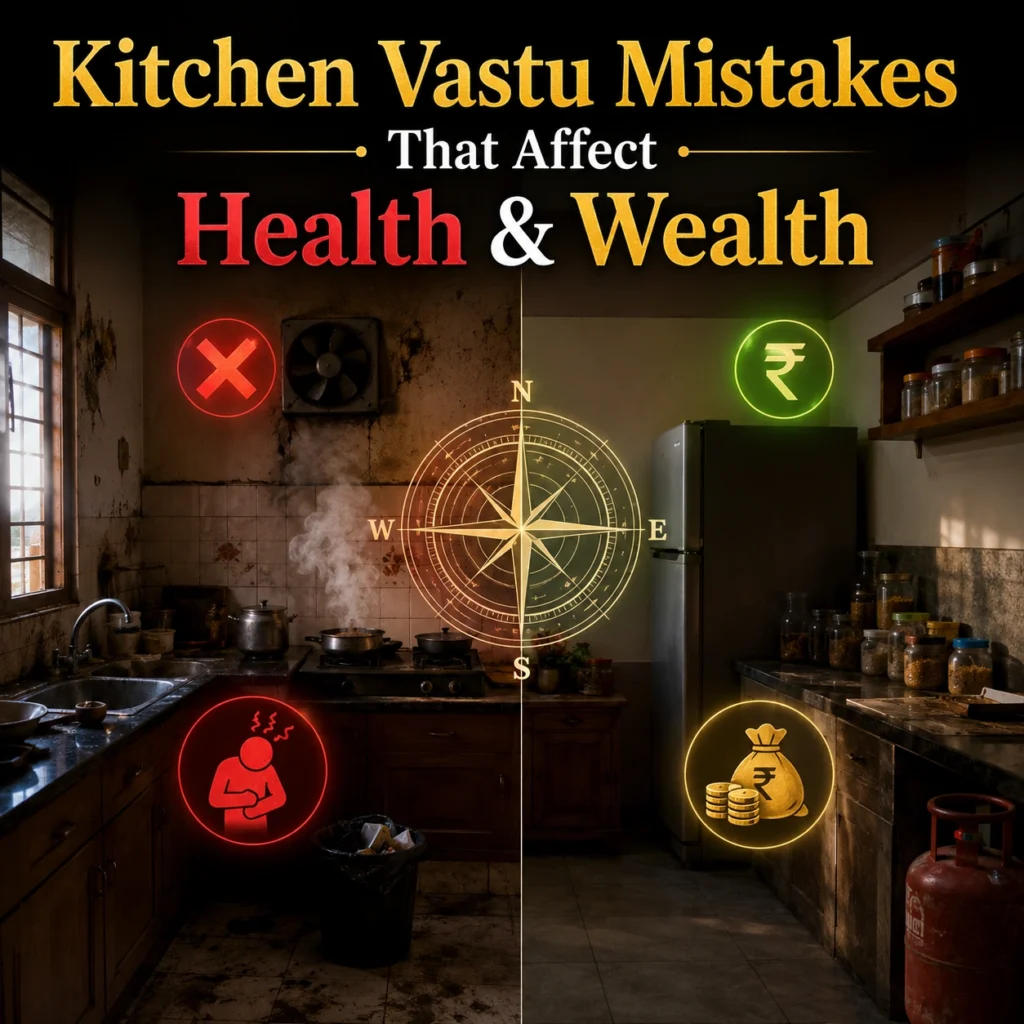
Kitchen Vastu Mistakes That Affect Health & Wealth
Kitchen Vastu is one of the most important yet most ignored parts of home design. Most people spend months choosing the colour of their bedroom walls or the design of their living room sofa, but they rarely give the same attention to their kitchen. This is a big problem, because in Vastu Shastra, the kitchen is considered the source of nourishment, prosperity, and family well-being. If Kitchen Vastu is disturbed, it does not just affect the taste of your food, it can silently affect your health, your finances, your relationships, and even the peace of mind in your home.
If you have never studied Vastu Shastra before, do not worry. This blog is written specifically for complete beginners. By the time you finish reading, you will understand exactly what Kitchen Vastu means, why it matters, which common Kitchen Vastu mistakes people make without realising it, and how you can correct them, even if you cannot rebuild or renovate your kitchen. We will explain every single point in simple language, step by step, the way a teacher explains a new subject to a student who has zero background knowledge. By the end, you will be able to look at any kitchen, including your own, and tell whether it follows correct Vastu principles or not.
What Is Vastu Shastra? Quick Basics Before We Begin
Before we talk about mistakes, let us understand a few basic ideas of Vastu Shastra, because everything else in this blog depends on these basics.
Vastu Shastra is an ancient Indian science of architecture and design. It is based on the idea that every direction in space carries a specific type of energy, and every object, room, or activity is connected to one of five natural elements: fire (Agni), water (Jal), air (Vayu), earth (Prithvi), and space or sky (Aakash). When a room is built and used in harmony with the correct direction and the correct element, positive energy flows freely through the house. When a room is built against these natural rules, energy gets blocked or becomes negative, and this is believed to show up as problems in health, money, relationships, or peace of mind.
The eight directions used in Vastu Shastra are North, South, East, West, North-East (Ishan), South-East (Agneya), South-West (Nairutya), and North-West (Vayavya). Each direction is ruled by a different element and a different planet or deity, and each is considered suitable for different rooms and activities. For example, the North-East is considered the direction of water and spiritual energy, so it is ideal for a pooja room, not for a kitchen. The South-East is ruled by Agni, the fire element, which is why it is considered the best direction for a kitchen, since cooking itself is a fire-based activity.
Understanding this one idea, that every direction has an element, and every element should be placed in a direction that matches it, is the foundation of all Kitchen Vastu rules that we are about to discuss.
Why Kitchen Vastu Matters for Health and Wealth
You may be wondering, why does a kitchen specifically affect both health and wealth? The answer lies in what a kitchen represents. The kitchen is the place where food is prepared, and food is the most basic form of nourishment for the human body. In Vastu Shastra, it is believed that food cooked in a kitchen with balanced energy carries positive vibrations, and this positive energy is passed on to everyone who eats that food. On the other hand, food cooked in a kitchen with disturbed energy, whether due to wrong direction, wrong colours, or wrong placement of the stove and sink, is believed to carry that disturbance forward, affecting the digestion, immunity, and overall health of the family members.
The connection to wealth is slightly different but equally important. In Vastu Shastra, the kitchen is closely linked to Agni, the fire element, which also symbolically represents energy, transformation, and abundance. A well-placed kitchen is believed to support steady financial growth, savings, and prosperity, while a poorly placed kitchen is associated with unnecessary expenses, financial instability, and difficulty in saving money. This is why, when people consult an astrologer or a Vastu expert about recurring health issues or persistent money problems in the family, one of the very first things that gets examined is the kitchen.
Keeping this connection between Kitchen Vastu, health, and wealth in mind, let us now go through the most common Kitchen Vastu mistakes that people make, one by one, and understand exactly why each one is considered a mistake and how it can be corrected.
Click Here To Book Vastu Consultation From Vastu Expert Ms Harshita Thakur
Mistake 1: Kitchen Located in the North-East Direction
This is one of the most serious and most common Kitchen Vastu mistakes. The North-East direction, known as Ishan in Vastu Shastra, is ruled by water and spiritual energy. It is considered the most sacred zone of the house, ideally reserved for a pooja room, meditation corner, or an open, clutter-free space that allows positive energy to enter the home.
When a kitchen, which is ruled by fire, is placed in this water-and-spiritual zone, it creates what Vastu experts call an elemental clash between fire and water. This clash is believed to disturb the overall energy balance of the home. Families living in homes where the kitchen is in the North-East often report frequent health issues, especially related to the head, eyes, and mental peace, along with a general feeling of restlessness or lack of clarity in decision-making, which can indirectly affect financial decisions and career growth as well.
If your kitchen is already built in the North-East and you cannot move it due to structural or budget reasons, do not panic. There are simple remedies. You can place a small bowl of sea salt in the corner of the kitchen, since salt is believed to absorb negative energy, and replace it with fresh salt every fortnight. You can also introduce the wood element by placing potted plants like money plants or bamboo near the kitchen entrance, and use bright lighting to keep the space active and positive. Keeping the North-East corner of the kitchen extremely clean and free of clutter is essential.
Mistake 2: Cooking Stove Placed in the Wrong Direction
The cooking stove is the single most important object in Kitchen Vastu because it directly represents Agni, the fire element. According to Vastu Shastra, the stove should always be placed in the South-East corner of the kitchen. If South-East is not possible, the second-best option is placing the stove in a way that it is positioned in the South-East portion of the kitchen space itself, even if the kitchen as a whole is elsewhere in the house.
A very common mistake is placing the stove in the North-East corner of the kitchen, or directly in the centre. When the stove is in the North-East, it creates the same fire-water clash we discussed earlier, but this time concentrated on the exact spot where food is cooked daily, which intensifies its effect. A stove placed in the exact centre of the kitchen is also considered inauspicious because the centre of any room, known as Brahmasthan, should ideally remain open and unobstructed, and placing a fire source there is believed to create instability in the household.
Another important rule connected to stove placement is the direction the cook faces while cooking. Ideally, the person cooking should face East while preparing food. Facing East while cooking is associated with better health outcomes and positive energy absorption into the food itself, since East is the direction of the rising sun, representing new beginnings and vitality. If facing East is not possible, facing North is considered the next best option. Cooking while facing South is generally avoided in Vastu Shastra, as South is associated with Yama, the direction of endings, and is believed to create a subtle sense of unease that can affect digestion and mood over time.
If your stove is already fixed in a direction that goes against these rules, a simple and widely recommended remedy is to place a small mirror on the wall behind or beside the stove in a way that reflects the cook’s face while they are cooking. This is believed to symbolically double the fire energy in a positive, controlled way and help neutralise the negative placement.
Mistake 3: Stove and Sink Placed Too Close or Facing Each Other
This is a mistake almost every modern kitchen makes without realising it, mainly because of how compact modern kitchen designs have become. The stove represents fire, and the sink represents water. These two elements are naturally opposing forces, and when they are placed directly next to each other, facing each other, or in a straight line, it is believed to create constant friction between the two elements, which shows up as tension and conflict within the household, along with fluctuating health and digestive issues among family members who eat food cooked in that kitchen.
The correct Vastu Shastra guideline is to maintain a minimum gap between the stove and the sink, ideally with the kitchen platform or slab, or even a chopping board area, placed between them as a buffer. The stove should be in the South-East, and the sink should ideally be placed in the North-East or North portion of the kitchen, since sinks and water-related fittings belong naturally in water-associated zones.
If your current kitchen design already has the stove and sink very close together and rebuilding is not an option, you can place a small piece of wood, like a wooden chopping board or a wooden divider, between the two as a symbolic buffer. Wood is considered a neutral, balancing element between fire and water in Vastu Shastra, and this simple addition can help reduce the negative effect of this common Kitchen Vastu mistake.
Mistake 4: Main Entrance Door Directly Facing the Kitchen
When the main entrance door of the house opens directly into the view of the kitchen, especially the stove, it is considered a significant Kitchen Vastu mistake. The main door is the primary entry point for energy, both positive and negative, coming into the home. When this energy flows directly into the kitchen and hits the stove, it is believed to disturb the fire element, making it unstable, which in turn is associated with unpredictable expenses, sudden financial losses, and a general sense of instability in the household’s income.
Additionally, from a purely practical standpoint, having your kitchen visible right from the main entrance is often considered inappropriate in terms of privacy and first impressions when guests visit, which adds a practical layer to this Vastu concern.
The remedy for this Kitchen Vastu mistake, if you cannot physically move either the door or the kitchen, is to install a curtain, a decorative screen, or a half-partition between the main door and the kitchen entrance. This breaks the direct line of energy flow and is considered an effective way to neutralise this issue. Keeping the stove itself out of direct line of sight from the main door, even if the kitchen entrance is visible, also significantly reduces the negative impact.
Mistake 5: Kitchen Directly Below or Above the Pooja Room or Bedroom
In multi-storey homes, it is common to overlook what is directly above or below the kitchen. However, Vastu Shastra places importance on vertical alignment as well, not just the direction of the room on a single floor.
If the kitchen is located directly below a pooja room, this is considered a serious mismatch, since the pooja room represents pure spiritual and water energy, while the kitchen below it constantly generates fire energy that rises upward, symbolically disturbing the sanctity of the worship space above. Similarly, a kitchen located directly below a bedroom, especially below the spot where a person sleeps, is believed to expose that person to the rising heat and fire energy throughout the night while they rest, which is associated with disturbed sleep, irritability, and long-term health issues related to stress.
If you are currently living in a home with this exact layout and moving is not an option, the recommended remedy is to reduce fire-related activity concentrated directly under the affected room. For example, avoid placing the stove exactly beneath the pooja room or the bed above; shift it, if possible, to another corner of the kitchen that does not fall directly below these spaces. Using calming, cool-toned decor and salt remedies in the kitchen can also help balance the excess fire energy rising upward.
Mistake 6: Wrong Colour Scheme Used in the Kitchen Vastu Space
Colour plays a much bigger role in Kitchen Vastu than most people realise. Since the kitchen is ruled by the fire element, the ideal colours for kitchen walls, tiles, and cabinets are warm, energising shades like light orange, red, pink, yellow, or brown. These colours are believed to support and strengthen the fire element in a positive, controlled way, encouraging good digestion, positive family interactions during meals, and steady financial energy.
A very common Kitchen Vastu mistake is choosing colours like black, dark blue, or grey for kitchen walls or cabinets simply because they look modern and trendy in interior design. However, in Vastu Shastra, black and dark blue are associated with the water element and with Shani, the planet linked to restriction and heaviness. Using these colours extensively in a fire-ruled room like the kitchen is believed to suppress the natural fire energy, which can manifest as low energy levels, sluggish digestion among family members, and a feeling of financial stagnation, where money comes in but somehow never feels like it is enough or growing.
If your kitchen already has dark-coloured tiles, cabinets, or countertops that cannot be easily changed, you do not need to redo the entire kitchen. Simply introducing warm-coloured accessories, such as orange or yellow curtains, a red dish towel, warm-toned kitchen canisters, or a small yellow light fixture, can help visually and energetically balance the excess of dark colours already present.
Mistake 7: Kitchen Placed Under a Staircase
In smaller homes and apartments where space is limited, it is common to see kitchens tucked under a staircase to save space. Unfortunately, this is considered a notable Kitchen Vastu mistake. A staircase represents constant movement and a downward-and-upward flow of energy, and the space directly beneath it is generally considered a zone of pressure and instability in Vastu Shastra, since the weight and movement above are believed to symbolically “press down” on whatever is placed underneath.
Placing a kitchen, which needs stable, grounded, positive energy for the fire element to function well, in this kind of pressured zone is believed to lead to a feeling of being constantly rushed or stressed while cooking, and over time, this can translate into digestive issues for the family and a sense that money is earned but slips away just as quickly, almost like it is “moving” the same way the staircase above is moving.
If your kitchen is already positioned under a staircase and rebuilding is not feasible, a helpful remedy is to hang a wind chime or a small bright light at the base of the staircase to keep the energy in that zone active and light rather than heavy and pressing. Ensuring excellent lighting in the kitchen itself, along with keeping the space extremely well-organised and clutter-free, also helps offset this Kitchen Vastu mistake.
Mistake 8: Overhead Beam Directly Above the Stove
Exposed structural beams running across the ceiling are common in many homes, especially older constructions or homes with false ceilings removed for renovation. In Vastu Shastra, having an overhead beam directly above the cooking stove is considered a significant mistake because the beam is believed to exert a downward, oppressive energy exactly onto the fire element below it, similar to the staircase issue mentioned earlier, but even more direct and concentrated since it sits right above the exact spot where food is prepared daily.
This is associated with the person who cooks feeling unusually tired, stressed, or irritated while cooking, even without an obvious reason, and over time, this can extend to headaches or health complaints connected to the person who spends the most time in that kitchen. It is also linked to a subtle sense of being “held back” financially, almost like invisible pressure limiting growth.
If moving the stove away from directly under the beam is not possible due to plumbing or gas-line constraints, a simple and commonly recommended remedy is to hang two hollow bamboo flutes, tied together with a red thread at a slight upward angle, on the beam directly above the stove. Bamboo flutes are traditionally believed to visually and energetically “break” the pressing-down effect of a beam. Installing a false ceiling panel to visually hide the beam is another practical remedy that also improves the room’s appearance.
Mistake 9: Toilet or Bathroom Adjacent to or Above the Kitchen
This Kitchen Vastu mistake is unfortunately quite common in compact modern apartment layouts, where plumbing lines are grouped together for construction convenience, often placing the kitchen and a bathroom right next to each other or directly stacked on top of one another across floors.
A bathroom is associated with waste elimination and impure water energy, while the kitchen is associated with nourishment and the pure fire element. Having a bathroom directly adjacent to or above the kitchen is believed to allow this impure energy to seep into the space where food is prepared, which is linked to recurring digestive problems, minor but persistent illnesses, and a general sense of “things not going as planned” financially, almost as if resources are quietly draining away, similar to how a bathroom drains water.
Since changing plumbing layouts is expensive and often impractical, the standard remedy is to ensure the shared wall between the kitchen and the bathroom is treated with extra care, keeping it completely sealed against any moisture leakage, and placing a small indoor plant or a bowl of salt against that shared wall on the kitchen side to help absorb any negative seepage of energy. Keeping the bathroom door closed at all times, especially during cooking hours, is also a simple and effective practice.
Mistake 10: Water Storage or Fixtures in the South-East Zone
We have already established that the South-East belongs to the fire element and is the ideal zone for the stove. A related but often overlooked mistake is placing water storage containers, a water purifier, a water filter, or even a refrigerator, which is sometimes treated as a water-associated appliance due to its cooling function, in this South-East fire zone.
When water-related items are placed in the fire zone, it creates the same fundamental elemental clash discussed throughout this blog, fire and water fighting for dominance in the same physical space, which Vastu Shastra associates with emotional ups and downs among family members and inconsistency in financial planning, where sometimes money is saved well and other times it is spent impulsively, without a clear pattern.
The correct placement for water storage, water purifiers, and similar fixtures is the North or North-East zone of the kitchen, keeping a clear physical separation from the stove and the South-East corner. If your water purifier or storage unit is currently installed in the South-East due to plumbing constraints, try to maintain at least an arm’s length of distance from the stove, and avoid placing them in a way where the water source and the stove face each other directly.
Mistake 11: Refrigerator Placed in the Wrong Direction
The refrigerator is one of the most frequently misplaced appliances in Kitchen Vastu, mainly because people place it wherever there is convenient empty space rather than thinking about direction. The ideal placement for a refrigerator is the South-West or North-West corner of the kitchen, never directly in the North-East, and ideally not directly beside the stove either, since the cooling function of the fridge and the heating function of the stove are, once again, an example of opposing elements placed too close together.
A refrigerator placed poorly is associated in Vastu Shastra with erratic financial patterns, since the fridge is considered a storage unit symbolically linked to the storage of resources and food security in the home. When it sits in a disturbed zone, it is believed to reflect instability in how the family manages and stores its resources and savings over time.
If your refrigerator is currently in a less-than-ideal spot and moving it is difficult due to space constraints, ensure it is kept clean, well-organised, and never left empty, since an empty or messy fridge is considered symbolically linked to lack and disorder, while a full, organised fridge is associated with abundance, regardless of exact direction.
Mistake 12: Kitchen Platform Attached to the Wrong Wall
The kitchen platform, or slab, where most food preparation happens, has its own set of Vastu Shastra guidelines. Ideally, the platform should be attached to the East or South wall of the kitchen, allowing the person cooking to naturally face East while working at the counter, which, as discussed earlier, is the most favourable direction for cooking.
A common mistake is having the platform attached to the North wall, forcing the cook to face South while preparing food, which we have already discussed as the least favourable direction in Kitchen Vastu. Over time, this seemingly small layout decision is believed to contribute to a persistent low-level stress during meal preparation, which some Vastu practitioners link to digestive sensitivity in the family and a subtle undercurrent of financial worry, even when the actual financial situation is objectively fine.
If your kitchen platform is fixed on the North wall and cannot be relocated, the practical remedy is to adjust your standing position slightly, even shifting your body angle while cooking, so that you are facing East or North as much as possible rather than directly South, and to use a small East-facing mirror near the stove as discussed earlier to help balance this layout issue.
Mistake 13: Storing Grains or Money Items in the Wrong Zone
Many families keep a small section of the kitchen dedicated to storing grains, pulses, spices, or even a small cash box for household expenses. In Vastu Shastra, the South-West zone of the kitchen is considered the most favourable direction for storage of heavier items, including grains and pulses, since the South-West is ruled by the earth element and is associated with stability and accumulation.
A common Kitchen Vastu mistake is storing these items in the North-East zone, which, as we discussed earlier, should remain light, open, and clutter-free. Storing heavy grain containers, sacks, or storage jars in North-East is believed to block the flow of positive energy meant to enter the home through this sacred zone, and this blockage is specifically linked in Vastu Shastra to difficulty in saving money, even when income levels are healthy, since the very zone meant to represent free-flowing abundance gets physically and energetically congested.
The remedy here is straightforward: reorganise your kitchen storage so that heavier items like grains, rice, and pulses are shifted to the South-West or West zone of the kitchen, while the North-East corner is kept as open and light as possible, perhaps used only for very light, frequently used items, or left empty altogether.
Mistake 14: Broken Utensils and Damaged Fixtures Left Unrepaired
This mistake is less about direction and more about the overall energy maintenance of the kitchen, but it is considered just as important in Kitchen Vastu. Cracked tiles, broken utensils kept “just in case,” a leaking tap, a stove burner that does not light properly, or a wobbly cabinet door are all considered signs of stagnant, deteriorating energy in the space.
Since the kitchen is directly connected to nourishment and prosperity, allowing these small damages to remain unrepaired for long periods is believed to symbolically represent “leaking” resources and neglected well-being. Many Vastu practitioners specifically point to a continuously dripping tap in the kitchen as one of the clearest symbolic representations of money quietly slipping away without the family even noticing where it went.
The remedy for this Kitchen Vastu mistake is simply consistent maintenance. Repair leaking taps immediately, replace broken utensils rather than storing them, fix or replace cracked tiles when possible, and ensure all kitchen appliances are in proper working order. This is one of the easiest and most cost-effective Kitchen Vastu corrections anyone can make, and it often has a surprisingly noticeable effect on the overall feel of the kitchen.
Mistake 15: Poor Ventilation and Lack of Natural Light
A kitchen without proper ventilation or natural light is considered a serious Kitchen Vastu mistake because stagnant air and darkness are both associated with the accumulation of negative energy. Cooking naturally produces smoke, steam, and heat, and if this cannot escape properly through a window or exhaust system, it is believed to trap negative energy inside the kitchen along with the physical smoke and moisture.
From a purely practical health standpoint as well, poor ventilation in a kitchen is linked to respiratory issues over time due to smoke and cooking fumes lingering in the air, along with increased dampness that can lead to mould growth, which has its own well-documented health consequences. So in this particular Kitchen Vastu mistake, the spiritual guidance and practical health science are essentially pointing to the exact same solution.
The remedy is to ensure your kitchen has at least one window, ideally in the East or South-East wall, allowing morning sunlight to enter, along with a functional exhaust fan or chimney above the stove to remove smoke and steam efficiently. If natural light is limited due to the building’s structure, compensate with bright, warm-toned artificial lighting kept on throughout the day while cooking.
Mistake 16: Dustbin Placed in the Wrong Corner
It might seem like a very minor detail, but the placement of the kitchen dustbin is specifically addressed in Kitchen Vastu guidelines. The dustbin represents waste and should never be placed in the North-East corner, the sacred zone we have discussed multiple times, nor should it be placed directly next to the stove, since waste and fire placed too closely together is considered another version of the same energetic imbalance we have covered throughout this blog.
An uncovered or overflowing dustbin left in the kitchen for long periods is also considered a source of stagnant negative energy, quite understandably, since it is also simply unhygienic from a health perspective, again showing how Vastu Shastra guidance and basic health practices frequently align.
The ideal placement for a kitchen dustbin is the South or South-East corner, kept covered at all times, and emptied daily rather than allowed to accumulate. This is one of the simplest Kitchen Vastu corrections to implement immediately, with no cost involved at all.
Mistake 17: Kitchen Door That Creaks or Does Not Close Properly
A kitchen door that creaks loudly, sticks, or does not close and open smoothly is considered a subtle but meaningful Kitchen Vastu mistake. Doors and entrances represent the flow of energy into and out of a space, and when this flow is physically obstructed or accompanied by a jarring sound every single time, it is believed to disrupt the smooth, positive energy that should ideally move in and out of the kitchen throughout the day.
While this may sound like a very minor practical issue rather than a deep Vastu principle, Vastu Shastra places significant importance on these everyday sensory experiences, since a home is not just lived in visually but also through sound, touch, and daily habitual movement. A door that creaks every time someone enters the kitchen creates a repeated, subtle stress signal that, according to Vastu Shastra, accumulates over time into a generally uneasy atmosphere in the space where the family’s food is prepared.
The remedy here is refreshingly simple and purely practical: oil the hinges, tighten loose screws, and repair or replace the door if it is warped or misaligned. There is no complex ritual needed for this particular Kitchen Vastu mistake, just basic, timely home maintenance.
Mistake 18: Mirror Placed in the Kitchen Incorrectly
Mirrors are powerful tools in Vastu Shastra because they are believed to double or reflect the energy of whatever they face. We already discussed how a mirror placed correctly, reflecting the stove from the side, can be a remedy for certain Kitchen Vastu mistakes. However, a mirror placed incorrectly can also become a Kitchen Vastu mistake in itself.
Specifically, a mirror that directly faces the stove head-on, rather than being placed to the side, is considered problematic, because it is believed to excessively multiply the fire energy in an uncontrolled way, rather than the balanced, gentle reflection achieved by a side placement. Excessive, uncontrolled fire energy in Vastu Shastra is associated with sudden anger, irritability among family members, and impulsive financial decisions, essentially an excess of the same fire quality that, in moderation, is meant to represent energy and drive.
If you have a mirror in your kitchen that directly faces the stove, the simple correction is to reposition it so that it reflects the stove from an angle, ideally positioned on a side wall rather than the wall directly behind or opposite the stove.
Mistake 19: Dining Area Placed Wrong Within an Open Kitchen
With the growing popularity of open-plan kitchens that include an attached dining or breakfast counter, this has become an increasingly relevant Kitchen Vastu consideration. The ideal placement for a dining area within or adjacent to the kitchen is the West or North zone, with family members ideally facing East or North while eating, similar to the preferred cooking direction discussed earlier.
Placing the dining table in the South-East corner, too close to the stove, is considered a mistake because it merges the cooking zone and the eating zone too tightly, not allowing the fire energy from cooking to settle before the family sits down to eat. This is loosely associated with rushed, distracted mealtimes and, over time, with digestive discomfort, since the meal is being consumed almost within the same energetic field as the active cooking fire rather than a calmer, separate zone.
If your open kitchen layout already has the dining table close to the stove and cannot be redesigned, try to maintain even a small physical gap or a low partition, such as a counter-height divider, between the active cooking zone and the seating area, and encourage family members to sit facing East or North during meals as a simple daily practice.
Mistake 20: Neglecting Regular Cleaning and Decluttering
Our final and perhaps most universally applicable Kitchen Vastu mistake is simply allowing the kitchen to become cluttered, disorganised, or unclean over time. No matter how perfectly a kitchen is designed according to every directional rule we have discussed in this blog, if the space itself is messy, overcrowded with unused items, or unclean, the positive energy that correct placement is meant to invite gets overshadowed by the physical and energetic weight of clutter.
Vastu Shastra teaches that energy needs room to move and circulate freely through a space, and a kitchen packed with unused appliances, expired food items, overflowing shelves, and general disorganisation blocks this circulation, regardless of how correctly the stove, sink, and refrigerator are positioned according to direction. This is sometimes the most overlooked Kitchen Vastu mistake precisely because it feels like an ordinary housekeeping issue rather than a “Vastu” issue, but experienced Vastu Shastra practitioners consistently emphasise that cleanliness and order are foundational, without which even perfect directional placement will not deliver its full positive effect.
The remedy is consistent, gentle discipline: dedicate a little time regularly to decluttering your kitchen, discard expired items promptly, keep frequently used tools easily accessible and out of the way of daily movement, and maintain general cleanliness as a daily habit rather than an occasional deep clean. This single practice, more than any other single remedy discussed in this blog, is considered by many Vastu Shastra practitioners to have the most immediate and noticeable positive impact on the overall feel of the kitchen.
How Kitchen Vastu Mistakes Connect to Health, Specifically
Now that we have gone through the individual mistakes in detail, let us step back and understand, as a beginner, how all of this ties together specifically on the health side. Throughout traditional Vastu Shastra teaching, the kitchen’s energy is believed to transfer into the food cooked there, and that food is what nourishes the body of every family member who eats it regularly. When the fire element governing the kitchen is disturbed, whether through wrong direction, colour, or placement, the effects are commonly associated with digestive disturbances, since digestion in Ayurvedic thinking, which is closely linked with Vastu Shastra, is itself considered a “fire” process within the body, referred to as Agni.
Beyond digestion, disturbed Kitchen Vastu is also traditionally linked to sleep quality, particularly when the kitchen is positioned directly below or near a bedroom, as we discussed earlier, and to general stress levels and irritability among the person who spends the most time cooking, since they are considered the most directly exposed to the kitchen’s energy on a daily basis. None of this replaces medical advice or professional healthcare, and Vastu Shastra should always be viewed as a complementary practice for creating a more harmonious living environment, alongside, never instead of, proper medical care when health issues arise.
How Kitchen Vastu Mistakes Connect to Wealth, Specifically
On the wealthy side, the connection works through the symbolic association between fire, transformation, and abundance discussed at the very beginning of this blog. A kitchen with balanced Vastu Shastra energy is believed to support a household where money flows in steadily, is managed wisely, and grows over time through good decisions and stable habits. A kitchen with multiple uncorrected Kitchen Vastu mistakes, on the other hand, is traditionally associated with a pattern where money comes in but somehow does not translate into visible savings or growth, almost as though it is being quietly drained away by the accumulated small imbalances we discussed, whether it is a dripping tap, a cluttered North-East corner, or a stove facing the wrong way.
It is worth remembering, as a beginner just learning about this subject, that Vastu Shastra works best as one part of a much larger picture that includes practical financial planning, disciplined saving habits, and sound decision-making. Correcting your Kitchen Vastu mistakes is best understood as creating a supportive, harmonious environment for these practical efforts to succeed more smoothly, rather than a replacement for them.
A Simple Step-by-Step Kitchen Vastu Checklist for Beginners
Since we have covered twenty detailed points, let us summarise everything into one simple, beginner-friendly checklist that you can literally walk through in your own kitchen today.
First, check your kitchen’s overall direction within the house; South-East is ideal, North-West is acceptable, North-East should be avoided or corrected with remedies. Second, check your stove’s placement; it should ideally sit in the South-East corner of the kitchen, away from the exact centre, and never directly beneath a beam without the bamboo flute remedy. Third, check the direction you face while cooking; East is best, North is acceptable, South should be avoided. Fourth, check the distance and alignment between your stove and sink; they should never touch or face each other directly. Fifth, check whether your main door opens directly onto a view of your kitchen or stove; if it does, use a curtain or partition.
Sixth, check what is directly above and below your kitchen if you live in a multi-storey home; avoid direct alignment with a pooja room or bedroom where possible, or use the balancing remedies discussed. Seventh, check your kitchen’s dominant colours; favour warm tones like orange, yellow, and red over black or dark blue. Eighth, confirm your kitchen is not located under a staircase, or apply the light and wind chime remedy if it is. Ninth, check your refrigerator’s placement; South-West or North-West is ideal. Tenth, check where your grains and heavier storage items are kept; South-West is best, and keep North-East light and open.
Eleventh, walk through your kitchen and note any broken utensils, cracked tiles, or leaking taps, and repair them as a priority. Twelfth, check your ventilation and lighting; ensure smoke and steam can escape and that the space receives good light throughout the day. Thirteenth, check your dustbin’s placement and make sure it stays covered and is emptied daily. Fourteenth, oil any creaking hinges on your kitchen door. Fifteenth, check any mirrors in your kitchen to make sure they are angled to the side of the stove rather than facing it head-on. Sixteenth, if you have an open kitchen with an attached dining area, try to maintain some separation between the cooking zone and the eating zone. And finally, seventeenth and most importantly, commit to keeping your kitchen clean, organised, and clutter-free as an ongoing daily habit, since this alone amplifies the positive effect of every other correction on this list.
Going through this checklist honestly in your own home is the single best way to move from being a complete beginner in Kitchen Vastu to genuinely understanding and applying these principles like someone with real, practical knowledge of the subject.
Click Here To Learn Vastu Online With Our Vastu Expert: Ms Harshita Thakur
Frequently Asked Questions About Kitchen Vastu
Is it necessary to break and rebuild my kitchen if it does not follow the correct Vastu Shastra rules?
No, this is one of the most common misunderstandings among beginners. Vastu Shastra offers specific remedies for almost every situation precisely because rebuilding an entire kitchen is often not practical or affordable. The remedies discussed throughout this blog, from bamboo flutes to mirror placement to colour corrections, exist exactly for this reason, to help balance energy without requiring major structural changes.
Can Kitchen Vastu mistakes really affect a family’s finances directly?
Vastu Shastra explains this connection symbolically and energetically rather than through direct cause and effect in a scientific sense. The kitchen represents nourishment and the fire element, which is symbolically linked to transformation and abundance, and disturbances in this space are traditionally believed to create subtle patterns of imbalance that can reflect in how a household manages its resources. It should be approached as a complementary belief system alongside sound financial habits, not a replacement for them.
Which single Kitchen Vastu correction should a complete beginner start with first?
If you are only able to make one change today, start with decluttering and cleaning your kitchen thoroughly, along with repairing any leaking taps or broken items. These two corrections require no construction work, no major expense, and are considered foundational to every other Kitchen Vastu principle working effectively.
Does the size of the kitchen matter in Vastu Shastra?
The size itself is less important than the correct direction, correct element placement, and cleanliness. A small, well-organised kitchen following correct Kitchen Vastu principles is considered more beneficial than a large, poorly planned one.
Conclusion: Start Your Kitchen Vastu Journey Today
Kitchen Vastu is not about superstition or blind rule-following; it is a thoughtful, structured way of thinking about how the placement, direction, colour, and cleanliness of the most nourishing room in your home can influence the everyday well-being and prosperity of your family. As a beginner starting this journey today, you now understand the core elements behind Vastu Shastra, why South-East and the fire element are so central to Kitchen Vastu, and exactly which twenty common mistakes to look out for, along with practical, affordable remedies for each one.
You do not need to implement every single correction overnight. Start with the simplest ones, decluttering, repairing leaks, adjusting colours with small accessories, and gradually work your way through the checklist at your own pace. Over time, these small, consistent Kitchen Vastu corrections are believed to create a noticeably more balanced, positive, and prosperous energy in your home, supporting both the health and the wealth of everyone who gathers around your kitchen every single day.
