

Table of Contents
Wallet Money Energy: What Not to Keep in Your Wallet
Have you ever wondered why some people always seem to have money flowing into their lives easily, while others work just as hard but constantly feel like money slips through their fingers? Most people blame luck, the economy, or their job. But according to Vastu Shastra and energy science, one of the biggest hidden reasons is something you carry with you every single day — your wallet. The concept of wallet money energy explains that your wallet is not just a piece of leather or fabric that holds notes and cards. It is actually a small, personal “energy house” for your money. And just like a house needs to be clean, organised, and free of clutter to invite good energy, your wallet needs the same care.
In this blog, we are going to break down, in the simplest way possible, exactly what you should never keep in your wallet if you want to protect and grow your wallet money energy. This is written for someone who has zero background in Vastu, energy work, or astrology — by the time you finish reading, you will understand this topic as well as someone who has studied it for years. We will go item by item, explain the reasoning behind each rule, and also give you practical remedies you can start using today.
Why Your Wallet Is More Than Just a Money Holder
Before we get into the list of things to avoid, it’s important to understand the “why” behind all of this. In Vastu Shastra, everything around us carries energy — our homes, our furniture, our clothes, and even small objects like a wallet. Money itself is considered a form of energy, often connected to Goddess Lakshmi, the deity of wealth and abundance in Hindu tradition. When we say “money energy,” we are talking about the flow — how easily money comes to you, stays with you, and multiplies, versus how easily it slips away, gets stuck, or never seems to be enough.
Your wallet is the object that touches your money most directly and most frequently. You open it multiple times a day. You keep it close to your body — in your pocket, your bag, or on your desk. Because of this constant physical and energetic contact, whatever is inside your wallet directly affects the quality of energy your money carries. A cluttered, messy, or “heavy” wallet — heavy not in weight but in negative energy — blocks the natural flow of abundance. A clean, organised, and mindfully maintained wallet, on the other hand, acts like an open, welcoming door for positive money energy to enter your life.
Think of it this way: if you invited a wealthy, respected guest to your home, you wouldn’t make them sit in a dirty, cluttered room with broken furniture and old garbage lying around. You would clean the space, keep it fresh, and make it welcoming. Vastu Shastra treats money the same way — as an honoured guest that needs a clean, respectful space to feel comfortable staying with you. Your wallet is that space.
The Complete List: What Not to Keep in Your Wallet
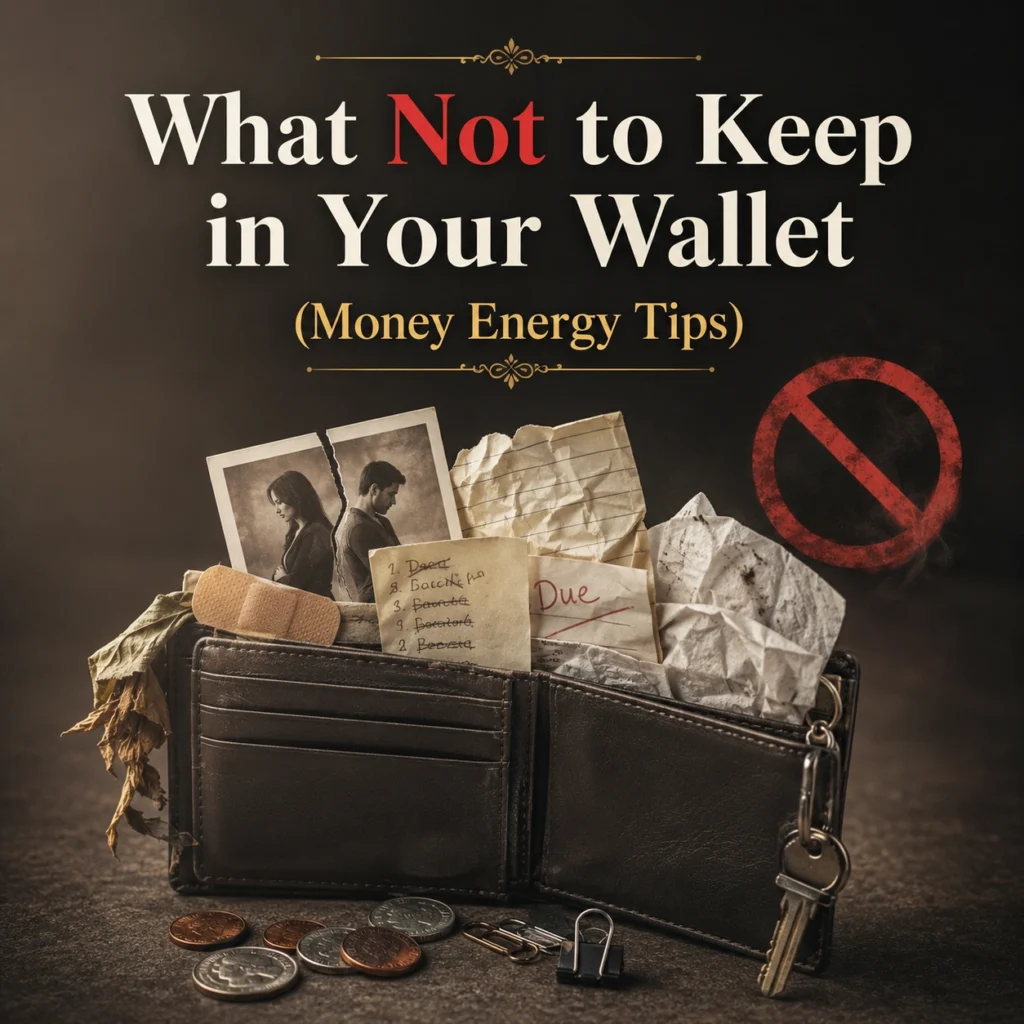
Now let’s go through, one by one, everything that experts of Vastu Shastra and energy practices recommend you remove from your wallet. For each item, we will explain why it is harmful and what you can do instead.
1. Torn, Dirty, or Damaged Currency Notes
This is one of the most common mistakes people make without even realising it. Many of us end up collecting torn notes, notes with tape on them, or currency that is faded and dirty, simply because we don’t want to deal with exchanging them at the bank. But from a wallet money energy perspective, torn or damaged money represents broken, weak energy. Symbolically, if your money looks damaged, it sends a message — even if unconsciously — that money is something fragile, something that breaks down, something you don’t fully respect.
Damaged notes also make your wallet visually messy, which affects how you feel every time you open it. If you feel embarrassed, irritated, or careless when opening your wallet, that emotion becomes part of your daily relationship with money. Over time, this small daily friction adds up to a much bigger block in how you attract and manage wealth.
What to do instead: Make it a habit to exchange or deposit torn and damaged notes as soon as possible. Keep only clean, crisp notes in your wallet. If you receive a torn note, don’t just accept it and forget about it — treat it the way you would treat a broken tool: something that needs to be fixed or replaced quickly, not something you casually carry around indefinitely.
2. An Empty Wallet or Empty Compartments
There is an old belief, followed across many cultures, that you should never let your wallet go completely empty. An empty wallet is thought to attract emptiness — meaning it reinforces a scarcity mindset and can actually make it harder for money to come in. This isn’t about having a huge amount of cash on you; it’s about the symbolic principle that “energy attracts similar energy.” If your wallet constantly sits empty, the energetic message you are sending out into the universe is one of lack, rather than one of abundance.
This doesn’t mean you need to be wealthy to follow this rule. Even keeping a small, fixed amount of money that you never spend — sometimes called a “seed amount” — can shift how your wallet feels and how you feel about your finances.
What to do instead: Always keep at least a small amount of cash in your wallet that you treat as untouchable — money you don’t spend under normal circumstances. This creates a subconscious feeling of security and abundance every time you open your wallet, rather than a feeling of “not enough.”
3. Photographs of Deceased Family Members
This is an important one, and it comes from deep-rooted belief systems around energy and memory. Many people keep photographs of parents, grandparents, or other loved ones who have passed away, tucked inside their wallet as a way of feeling close to them. While the emotional intention is beautiful and completely understandable, Vastu and energy practitioners generally advise against keeping such photographs in your wallet specifically.
The reasoning is this: your wallet is meant to be a space of forward-moving, active, flowing energy — the energy of ongoing life, growth, and circulation. Photographs of those who have passed carry a very different kind of energy — one connected to memory, grief, and stillness. When these two energies are placed together in a small, enclosed space like a wallet, it can create a subtle internal conflict, making it harder for the wallet to fully support active money flow.
What to do instead: Honour your loved ones’ memory by keeping their photographs in a dedicated, respectful space at home — a photo frame in a living area, or as part of a small remembrance altar — rather than inside your daily-use wallet. This allows both the memory and the money energy to exist in their own appropriate spaces, without one dampening the other.
4. Unpaid Bills, Old Receipts, and Debt Reminders
How many of us have a wallet stuffed with old receipts, unpaid bill reminders, or notes about money we owe someone? This is one of the most common “energy blockers” in modern wallets. Every time you open your wallet and see a reminder of debt or an unpaid bill, you experience a small moment of stress, worry, or guilt. Multiply that by the number of times you open your wallet each day, and you can see how this becomes a constant, repeated negative emotional pattern tied directly to money.
From a positive money energy standpoint, your wallet should represent ease and flow, not stress and obligation. Constantly being reminded of what you owe, rather than what you have or what is flowing toward you, trains your mind to associate money with anxiety.
What to do instead: Deal with bills and receipts in a separate system — a folder, an app, or a designated drawer at home — away from your wallet. Once a bill is paid, remove any related paper immediately. Your wallet should only contain what is currently useful and active, not a running archive of financial stress.
5. Too Many Business Cards or Visiting Cards
It’s common, especially for working professionals, to collect business cards at networking events, meetings, and conferences. Many people simply shove these into their wallet and forget about them until the wallet becomes impossibly thick. While networking itself is valuable, an overstuffed wallet full of other people’s contact details creates physical and energetic clutter.
A wallet that is stretched, bulging, and disorganised doesn’t just look messy — it physically struggles to “hold” anything new. Symbolically, a wallet that is already overflowing with clutter has no space left to receive new money or new opportunities.
What to do instead: Transfer business card information into your phone or a digital contacts app regularly, and keep only the cards you are actively planning to use within the next few days in your wallet. Everything else should be filed away or discarded.
6. Broken, Expired, or Unused Cards
Old gym membership cards, expired discount coupons, cards from banks you no longer use, expired ID cards — these are extremely common wallet clutter. Just like torn currency notes, expired and broken cards represent stagnant, non-functional energy. They serve no active purpose but still take up physical and energetic space in your wallet.
What to do instead: Do a wallet audit at least once a month. Go through every single card and ask yourself: “Am I actively using this right now?” If the answer is no, remove it. Keep only what is currently active and useful.
7. Loose, Jumbled Coins Mixed with Notes
Many people toss loose coins into the same compartment as their paper currency, creating a jumbled, disorganised mess. This might seem like a small, harmless habit, but from a Vastu perspective, disorganisation itself is considered disruptive to smooth energy flow. When your money — whether notes or coins — is tangled and chaotic inside your wallet, it mirrors and reinforces chaos in your financial life.
What to do instead: Keep coins separate from notes, ideally in a small coin pouch or a separate compartment. Keep your currency notes organised by denomination, all facing the same direction. This might sound like a small detail, but the discipline of organising your money teaches your subconscious mind to treat money with order and respect, which in turn supports better financial decision-making in daily life.
8. Sharp Objects Like Needles, Blades, or Pins
It might sound unusual to even think about keeping sharp objects in a wallet, but many people do carry small items like safety pins, needles for quick repairs, or even small blades for practical use. In Vastu Shastra, sharp and pointed objects are generally associated with cutting or breaking energy. When placed near money, this “cutting” energy is believed to symbolically cut off the flow of wealth — almost like constantly puncturing small holes in your financial stability.
What to do instead: Keep sharp objects in a separate utility pouch or toolkit, completely away from your wallet and your money. If you need a small sewing kit or similar items for daily use, store it in your bag or car, not tucked between your currency notes.
9. Matchboxes or Lighters
This is a traditional Vastu belief: fire-related items like matchboxes and lighters are considered to have a “burning” or consuming energy. Just as fire burns and destroys physical objects, it is believed to symbolically “burn away” money when kept in close contact with it. Many elders in Indian households specifically warn against this combination.
What to do instead: If you’re a smoker or regularly need a lighter, keep it in a separate pocket, bag compartment, or car glovebox — never inside the same space as your wallet or currency.
10. Dried Flowers, Old Prasad, or Religious Items Past Their Use
Many people, out of devotion, keep a small piece of prasad, a dried flower from a temple visit, or a religious thread in their wallet for blessings and protection. While the intention here is positive, once these items become old, dried out, or forgotten, they actually work against you. Old, decaying religious items are believed to carry stagnant energy rather than active blessings — the freshness and intention behind the original blessing fades with time.
What to do instead: If you like to carry a small sacred item for protection, that’s completely fine — but refresh it regularly. Replace old prasad or dried flowers with a fresh one during your next temple visit, rather than letting the same item sit in your wallet for months or years.
11. Written IOUs or Reminders of Money You’ve Lent
Similar to unpaid bill reminders, keeping written notes about money you’ve lent to others — “Rahul owes me 2000,” for example — creates a subtle, ongoing energy of “waiting” and “incompleteness.” Every time you see that note, you’re reminded of money that hasn’t returned to you, which reinforces a mental pattern of loss rather than gain.
What to do instead: Track money you’ve lent in a separate notebook or app used specifically for that purpose, not inside your everyday wallet. This keeps your wallet focused purely on active, flowing money rather than pending, unresolved matters.
12. Someone Else’s Money Mixed with Yours
It’s common in families or shared households for someone to hand you cash to hold “for safekeeping” or to pass along later. If this money gets mixed in with your own currency and stays in your wallet for an extended period, it can create confusion in your personal money energy. Your wallet works best when it clearly reflects your own financial reality — mixing in money that isn’t truly yours blurs that clarity.
What to do instead: If you must hold money for someone else temporarily, keep it in a clearly separate envelope or pouch, and return or deposit it as quickly as possible rather than letting it linger indefinitely in your main wallet compartment.
13. Negative or Emotionally Heavy Written Notes
Some people keep small handwritten notes in their wallet — reminders of arguments, sad messages, or notes connected to a difficult breakup or loss. While it’s natural to want to hold onto meaningful items, if a note carries heavy sadness, anger, or emotional pain, it doesn’t belong in a space meant to hold flowing, positive energy.
What to do instead: Keep sentimental items in a memory box or journal at home instead of in your daily wallet. Reserve your wallet for items connected to active, present-day life — your money, your essential cards, and perhaps one or two meaningful but emotionally light items, like a photo of your children or a positive personal note.
14. Old Lottery Tickets or Expired Coupons
Holding onto old, expired lottery tickets “just in case,” or coupons long past their expiry date, is another subtle form of clutter that represents holding onto false hope or missed opportunities. Vastu principles emphasise that your wallet should represent what is real, current, and active — not “maybe” or “what could have been.”
What to do instead: Check lottery results and discard tickets immediately after the draw. Set a habit of clearing out expired coupons at the end of each week.
15. Excess Dust, Dirt, and Physical Grime
Finally, and perhaps most simply — physical cleanliness matters enormously for wallet money energy. A wallet that’s covered in dust, has crumbs or dirt inside the compartments, or smells musty is, quite literally, an unclean space for your money to live in. Physical cleanliness and energetic cleanliness are deeply connected in Vastu Shastra; you cannot expect a dirty, neglected object to hold and attract clean, flowing wealth.
What to do instead: Wipe down your wallet regularly, both inside and outside. If it’s a fabric wallet, air it out occasionally. If it’s leather, use a suitable cleaner to keep it looking fresh, not worn out and grimy.
Vastu Tips for Choosing the Right Wallet
Now that we’ve covered what to remove, let’s talk about the wallet itself. Choosing the right wallet is just as important as maintaining what’s inside it, according to Vastu tips for wallet selection.
Color: Vastu generally recommends warm, rich colors for wallets — shades like brown, maroon, deep red, or golden tones are considered auspicious and connected to prosperity and stability. Black is a debated color; some traditions avoid it as it’s associated with heaviness, while others consider a good quality black wallet perfectly fine as long as it’s kept clean and well-maintained. Bright, chaotic multi-colored wallets are generally discouraged, as they don’t reflect the calm stability associated with wealth.
Material: Leather (genuine or good-quality vegan leather) is traditionally preferred over synthetic plastic materials, as it is considered a more “grounded” and natural material that holds energy steadily. Fabric wallets are acceptable too, especially in rich, solid colors, as long as they are well cared for.
Shape and Size: A wallet that is too small to comfortably hold your notes without folding them multiple times is considered restrictive — it symbolically “squeezes” your money. On the other hand, an overly large, bulky wallet can encourage clutter, as discussed earlier. The ideal wallet is medium-sized, with enough compartments to keep things organised, but not so many compartments that it invites unnecessary clutter.
Condition: A wallet with a broken zip, torn stitching, or a broken clasp is one of the most important things to replace immediately. A “broken” container for your money sends a very direct symbolic message of “leaking” wealth — money that comes in but doesn’t stay.
Where and How to Keep Your Wallet at Home
Beyond what’s inside your wallet and what your wallet looks like, Vastu also has guidance about where you place your wallet when you’re at home or in your workspace.
According to Vastu Shastra, the north direction is associated with Kuber, the deity of wealth, while the north-east direction is considered the zone of positive energy and growth overall. Keeping your wallet in the north or north-east corner of your home or bedroom, especially overnight, is considered favourable for supporting steady wallet money energy.
It’s also advised to avoid keeping your wallet directly on the floor, in the bathroom, or near the shoe rack — these spaces are considered energetically “low” or unclean in Vastu terms, and placing your money-holding object there is thought to weaken its positive energy. Instead, use a small dish, tray, or drawer at a reasonable height to store your wallet when you’re not carrying it.
Click Here To Book An Appointment With Best Astrologer In India: Acharya Sakshi Sanjeev Thakur
The Numerology Angle: How Much Cash to Keep
Numerology, closely connected to Vastu and astrology, also offers guidance on wallet money energy — specifically about the amount of cash you keep. Round numbers, like exactly 1000 or exactly 5000, are sometimes considered less favourable in numerology, as they suggest completeness with nothing left to grow. Many practitioners suggest keeping an amount that ends in a specific single unit — for example, 1001 or 5001 — symbolising that there’s always “one more” coming, reflecting a mindset of continuous growth rather than a fixed, closed amount.
While this might sound like a small, symbolic detail, the psychology behind it is powerful: it trains your subconscious mind to see money as something always in motion and always increasing, rather than something static.
Wallet Cleaning Rituals: When and How
Just like your home needs regular cleaning, your wallet benefits from a structured cleaning routine — commonly referred to as wallet cleaning rituals in Vastu-based money practices.
Best days for wallet cleaning: Fridays are traditionally associated with Goddess Lakshmi and are considered an excellent day to clean, organise, and refresh your wallet. Some people also choose Amavasya (new moon day) as a day to specifically clear out old, unnecessary items from their wallet, symbolically starting a fresh financial cycle with the new lunar month.
How to do a wallet cleaning ritual: First, completely empty your wallet onto a clean surface. Go through every single item — cards, notes, coins, and papers — and sort them into three categories: keep, relocate to another storage space, and discard. Wipe down the inside and outside of the wallet itself. As you place items back in, do so mindfully and in an organised manner — notes together, cards together, coins in their own pouch. Some people also like to light a small diya (oil lamp) or incense nearby during this process, and softly chant a simple mantra of gratitude for the money they have and openness to the money that is coming.
This entire process might take just ten to fifteen minutes, but doing it consistently — ideally once a week or at least once a month — keeps your wallet money energy clear, organised, and genuinely welcoming to new abundance.
Simple Mantras and Remedies to Boost Positive Money Energy
For those interested in adding a spiritual practice to their financial habits, here are a few simple, widely known remedies:
Chanting “Om Shreem Mahalakshmiyei Namah”: This is one of the most commonly used and simple mantras associated with Goddess Lakshmi and abundance. Chanting it a few times while holding your wallet, especially on a Friday morning, is a gentle daily practice many people use to invite positive money energy.
Keeping a small yellow or red thread tied around your wallet or a tiny piece of turmeric wrapped in cloth inside a corner pocket: These are considered simple, traditional good-luck items that many households use, as long as they are refreshed regularly and not left to become old and forgotten (as discussed earlier).
Offering gratitude before spending: A very simple, non-ritualistic practice — before you spend money from your wallet, take one second to mentally acknowledge and appreciate that you have this money available to you. This small shift in mindset, done consistently, changes your entire relationship with spending from anxiety to gratitude.
Buying a New Wallet: Choosing an Auspicious Time
If your current wallet is old, torn, or has served its time, buying a new one is often recommended over continuing to use a damaged wallet, no matter how sentimental it might feel. According to Vastu and astrology, certain days are considered more auspicious than others for buying a new money magnet wallet.
Fridays, as mentioned earlier, are associated with wealth and are a popular choice. Additionally, festivals like Dhanteras (which falls just before Diwali) are traditionally considered one of the best times of the year specifically for buying new items related to wealth — including wallets, coins, and jewelry. Buying a new wallet during Dhanteras is a very common practice in many Indian households, based on the belief that wealth purchased or welcomed on this day multiplies throughout the coming year.
When you do get a new wallet, it’s also traditionally recommended to place a small amount of money, a pinch of rice, and a few grains of turmeric inside it before using it for the first time — this is meant to symbolically “seed” the wallet with abundance from day one, rather than starting it out completely empty.
Common Mistakes People Make Without Realising It
Let’s quickly summarise some of the most common, everyday mistakes that quietly damage wallet money energy, so you can do a quick self-check:
Carrying a wallet that is visibly torn or broken for months because you haven’t gotten around to replacing it. Letting receipts and old bills pile up without ever clearing them out. Mixing personal money with money you’re holding for someone else. Keeping the same old prasad or religious thread in your wallet for years without refreshing it. Never doing a proper cleanout of expired cards and coupons. Throwing your wallet carelessly on the floor or in low, cluttered spaces at home. Letting your wallet sit completely empty for extended periods.
None of these mistakes are things people do on purpose — they happen simply because most of us have never been taught to think about our wallet as an energetic object rather than just a practical one. Now that you know, you can start making small, simple shifts.
The Psychology Behind Wallet Money Energy
Some readers might wonder whether all of this is “just superstition” or whether there’s something real happening beneath these traditional beliefs. The honest answer is that wallet money energy works on two levels at once — the symbolic, energetic level that Vastu Shastra describes, and a very real psychological level that modern behavioural science actually supports.
Think about how your brain works when you repeat an action multiple times a day, every single day, for years. Opening your wallet is one of those repeated actions. If, every time you open it, you see chaos — torn notes, old receipts, forgotten debts, expired cards — your brain quietly registers a small, repeated signal: “money is messy, money is stressful, money is something to avoid thinking about.” Over months and years, this repeated signal shapes your unconscious beliefs about money far more strongly than any single big decision ever could.
On the other hand, if every time you open your wallet, you see order, cleanliness, and a small reserve of untouched cash, your brain registers a completely different signal: “money is calm, money is organised, money is under my control.” This is exactly why financial coaches, completely separate from any spiritual tradition, also recommend keeping your wallet organised — they call it a “money mindset” practice rather than an energy practice, but the underlying principle and the results are strikingly similar.
This is why Vastu Shastra and modern psychology don’t actually contradict each other on this topic — they’re describing the same phenomenon from two different angles. One uses the language of energy, flow, and directions; the other uses the language of habits, subconscious conditioning, and behavioural triggers. Either way, the practical advice ends up being the same: keep your wallet clean, organised, and free of anything that reminds you of lack, stress, or loss.
A Simple Weekly Wallet Ritual You Can Start Today
If everything above feels like a lot to remember, here is a simple, condensed version you can start using this very week. Choose one day — Friday works well, but any day that’s consistent for you is fine. On that day, take five minutes to completely empty your wallet. Wipe it clean, inside and out. Go through every single item one more time and ask, “Does this belong here right now?” Put back only what passes that test — your active cards, your organised notes facing the same direction, your small untouched reserve amount, and perhaps one or two meaningful, light-energy items. As you close your wallet, take one breath and mentally set an intention, such as, “I welcome ease and abundance into my life this week.” That’s it. No incense, no elaborate ritual required, though you’re welcome to add those if they feel meaningful to you.
Doing this one simple five-minute habit, every single week, is often enough to notice a genuine shift — not overnight, and not in some magical, unrealistic way, but in the slow, steady way that most real financial and energetic changes actually happen: through consistency.
Frequently Asked Questions About Wallet Money Energy
Is it true that keeping a black wallet is bad for money?
Not necessarily. While some traditional beliefs caution against black due to its “heavy” association, many modern Vastu practitioners agree that a good-quality, well-maintained black wallet is perfectly fine. The condition and cleanliness of the wallet matter far more than the color alone.
Can I keep a photo of my living family members in my wallet?
Yes, absolutely. The caution mentioned earlier in this guide is specifically about photographs of people who have passed away, not about your living loved ones. A photo of your children, spouse, or parents (while they are alive) is generally considered a warm, positive addition to your wallet.
How often should I really clean out my wallet?
Once a week is ideal for a quick check, and once a month for a deeper clear-out where you review every single card and compartment. If weekly feels like too much, even a consistent monthly habit will make a noticeable difference compared to never doing it at all.
Does the direction I keep my wallet at home actually matter that much?
Direction is one layer among many in Vastu Shastra, not a rule that overrides everything else. If keeping your wallet in the exact north-east corner of your home isn’t practical for you, simply avoiding low, cluttered, or unclean spots (like the floor or near the shoe rack) will already give you most of the benefit.
That’s completely normal, especially in joint families. The key is to keep it clearly separated — a distinct pouch or envelope — rather than mixed loosely with your personal notes, so your own wallet money energy stays clear and easy to read at a glance.
Click Here To Learn Astrology Online With Best Astrologer in India: Acharya Sakshi Sanjeev Thakur
Bringing It All Together
By now, you have a genuinely complete understanding of wallet money energy — what it means, why it matters, and exactly what practical steps you can take to improve it. Let’s do a quick recap of everything we’ve covered, so it’s easy to remember and apply.
Remove torn notes, expired cards, unpaid bill reminders, sharp objects, old prasad, sad notes, other people’s money, and general clutter from your wallet. Choose a wallet in warm, auspicious colors like brown, maroon, or gold, made of good quality material, in a well-organised medium size. Keep your wallet in the north or north-east direction at home, off the floor, away from the bathroom and shoe rack. Maintain a small, untouchable “seed amount” of cash at all times, and consider numerology-friendly amounts ending in one. Do a proper wallet cleaning ritual weekly or monthly, ideally on a Friday. Consider simple remedies like chanting a short mantra or keeping a small turmeric pouch, refreshed regularly. When it’s time for a new wallet, consider buying it on an auspicious day like a Friday or during Dhanteras.
None of this requires you to change your religion, your beliefs, or spend large amounts of money. These are small, mindful habits — the kind that take just a few minutes here and there but compound over time into a completely different relationship with money. Just as physical clutter in a room can make us feel stressed and stuck, clutter in our wallet quietly shapes how we feel about money every single day, often without us even realising it.
If you found this guide helpful and want a more personalised look at your money and wealth patterns — based on your birth chart, your numerology, and your specific Vastu placements at home — feel free to reach out for a one-on-one consultation. Sometimes, the small daily habits we’ve discussed here work best when combined with a deeper understanding of your unique astrological blueprint.
